
Motorcycle Steel Bridge Gratings and Rain Grooves: Stay Calm and Stay Straight
Learn why motorcycles feel loose on steel bridge grating and rain grooves, how to prepare, and which calm control habits help you cross with more margin.
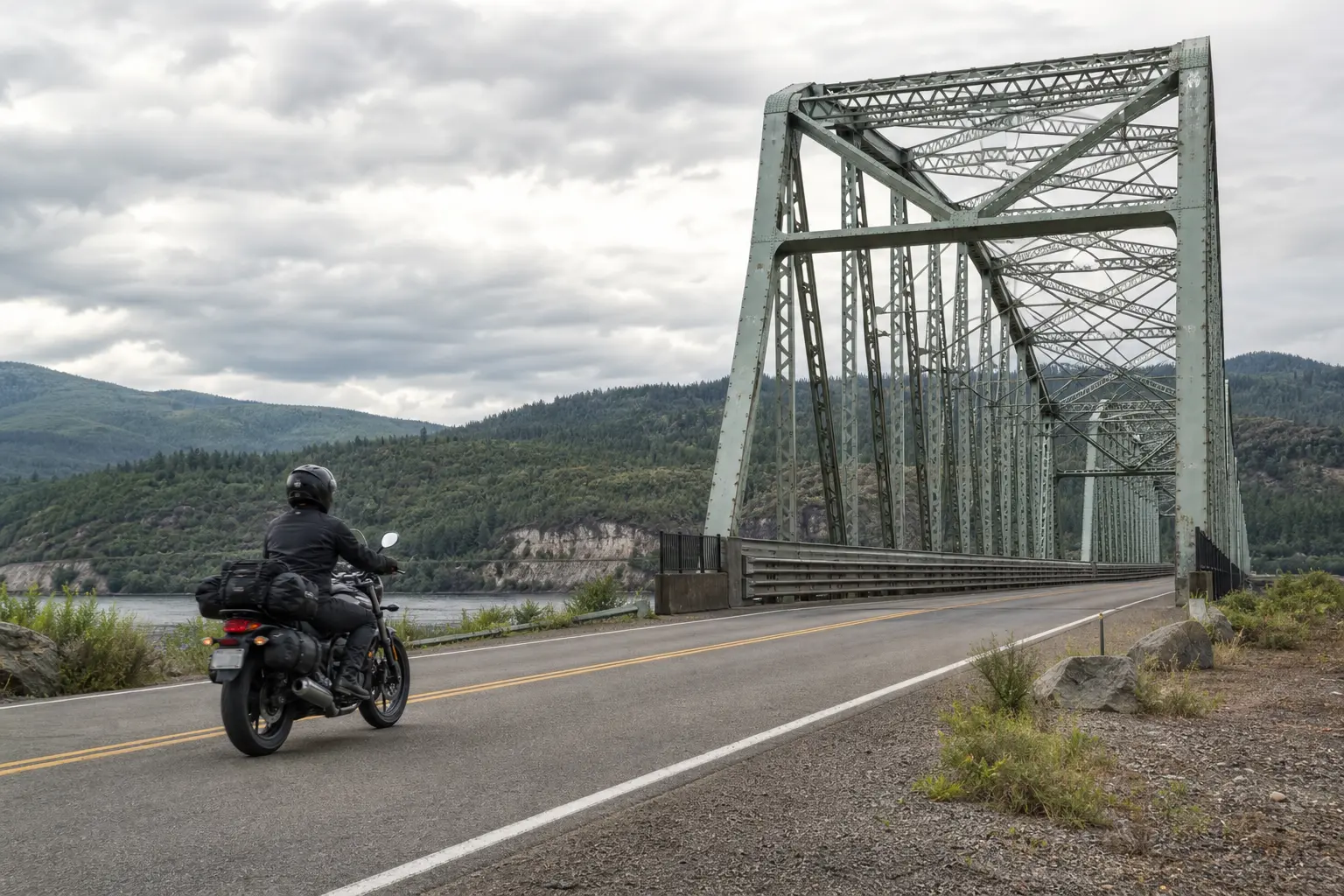
Fact-checked against cited official documentation
Reviewed against Fact-checked against three Motorcycle Safety Foundation resources covering steel gratings, rain grooves, steady control, scanning, space, and adapting to surface conditions..
Last updated October 26, 2026
Steel bridge grating and longitudinal rain grooves can make a motorcycle feel as if it is wandering, sliding, or being nudged sideways. The sensation can be startling, particularly when the surface is wet, traffic is close, or the rider has never encountered it before. Yet a nervous-feeling motorcycle is not automatically a motorcycle with a failed tire or suspension part.
The useful first distinction is between surface feedback and a developing mechanical problem. Grating and grooves can steer the tires slightly along the surface pattern. The motorcycle may move within a small part of the lane while still tracking forward. Your job is not to overpower every movement. It is to preserve room, keep the controls smooth, and avoid turning a manageable surface transition into an abrupt steering or braking event.
The Motorcycle Safety Foundation specifically discusses steel-mesh bridge gratings and rain grooves as situations in which the motorcycle may feel loose or squirmy. Its practical guidance is to keep a steady throttle, follow a straight path, and avoid gripping the handlebar too forcefully. The same principle appears in the broader MSF material: scan ahead, maintain space, and adjust speed and control inputs to the surface and conditions.
This article is a conservative riding plan, not a diagnosis and not a substitute for your motorcycle manufacturer’s owner’s manual or professional instruction. If the movement continues on ordinary pavement, or if the bike shows a new pull, vibration, noise, or tire concern, leave the unusual surface question behind and have the motorcycle checked.
Why Steel Grating and Rain Grooves Feel So Unsettling
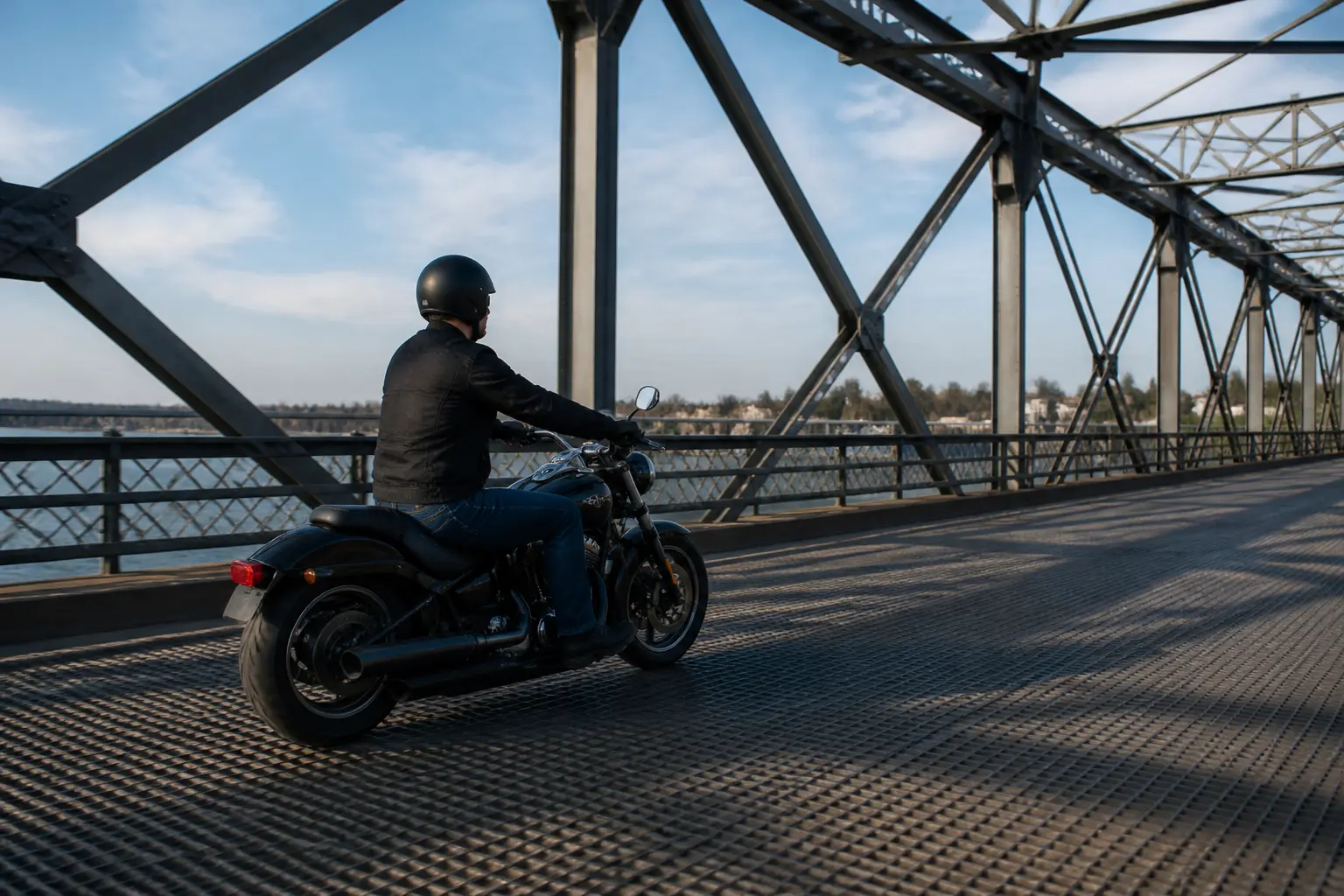
A bridge deck made from steel mesh has repeated openings and bars rather than one continuous, uniform road surface. Rain grooves are long channels cut into pavement, often running in the direction of travel. Neither surface necessarily means that your tires have lost normal function. They simply give the tires a different set of contact transitions to follow.
A motorcycle has only two tire contact patches, and the rider is positioned high above them. Small lateral movements at the contact patches can therefore be felt clearly at the handlebar, seat, and foot controls. The feedback may arrive as a weave, a light side-to-side sensation, or a feeling that the front of the motorcycle wants to follow a groove. The rider can interpret that movement as a slide even when the motorcycle is continuing forward.
Several conditions can make the sensation more noticeable:
- A perpendicular approach: Crossing a grating or groove at an angle can create a more abrupt transition than meeting it with a planned, stable line.
- Speed that leaves little thinking time: A faster approach reduces your margin to assess the surface, traffic, and exit.
- Wetness or poor visibility: Water, glare, spray, darkness, and shadows make the surface harder to read and reduce confidence.
- A rigid upper body: Tight shoulders and a strong grip pass every small movement back into the steering.
- Nearby traffic: Cars, trucks, barriers, and lane edges can make normal surface movement feel much more threatening.
- A loaded or unfamiliar motorcycle: Luggage, a passenger, or a different motorcycle can change how much movement you notice and how much space you want.
These factors do not create a magic technique that works identically on every motorcycle. They do explain why the same bridge can feel ordinary one day and alarming the next. Treat the surface, weather, traffic, and your own condition as one decision rather than focusing only on the metal or grooves.
The Calm Response Before You Reach the Surface

The best response often begins before the front tire touches the unusual surface. Scan far enough ahead to identify the bridge deck or grooved pavement while you still have time to choose a conservative approach. Look for the entry, the length of the affected section, the exit, standing water, debris, lane changes, expansion joints, and vehicles that may block your view.
Then make a simple plan:
- Create time. If conditions and traffic allow, reduce speed smoothly before the surface. Do not wait until the motorcycle is already moving around beneath you.
- Choose a usable path. Select a clear line that leaves reasonable space from traffic and barriers. Do not make a sudden lane change simply to avoid every groove.
- Finish unnecessary decisions early. Complete a routine gear change, cancel a turn signal, or settle your lane position before the transition when practical.
- Look toward the exit. Your eyes should not become fixed on the nearest bar or groove. Keep checking the route ahead and the space you need to occupy.
- Leave an escape margin. A vehicle beside you, a narrow bridge, or a poor surface may justify slowing further or waiting for a better opportunity.
A planned approach helps prevent two common overreactions: accelerating to get the sensation over with, and making a sudden steering correction when the motorcycle gives a small movement. Neither response creates useful space. A steady, unhurried entry does.
The correct speed is not a universal number. It depends on your motorcycle, tire condition, weather, visibility, traffic, bridge geometry, and experience. Follow applicable speed laws and the limits of your owner’s manual, but remember that a posted limit is not a promise that the surface will feel comfortable at that speed.
What to Do Once the Tires Reach Grating or Grooves
Once you are on the surface, keep the motorcycle’s controls quiet and deliberate. The MSF guidance for these situations emphasizes a steady throttle, a straight path, and avoiding an overly forceful grip. Those ideas work together: a stable drive force and an unstrained steering input allow the tires to respond to the surface without the rider adding abrupt corrections.
Keep your hands firm but not rigid
Hold the handlebar securely enough to operate the controls, but do not clamp down as if you are trying to prevent every millimeter of movement. A rigid grip can amplify the very feedback that worries you. Keep your elbows and shoulders relaxed where your normal riding position permits, and let your vision remain active.
“Relaxed” does not mean careless or loose. You still need full control of the motorcycle. It means avoiding a fight with a surface that may be causing small, expected movements. If your hands, wrists, or shoulders are tiring, treat that as information that your approach or pace may be too demanding.
Keep the throttle smooth
Avoid an abrupt roll-on or roll-off while the motorcycle is negotiating the surface. A smooth, steady throttle helps avoid adding a sudden change to the motorcycle’s movement. Do not accelerate merely because the bridge feels uncomfortable, and do not close the throttle sharply because the bike wiggles.
If you need to slow, do it progressively and with the motorcycle as settled as conditions allow. Your motorcycle’s owner’s manual is the first source for braking and control instructions specific to that model. The aim here is not to prescribe a universal control sequence; it is to avoid panic inputs.
Follow a clear, predictable path
A straight path means a deliberate line through the available space, not an attempt to force the front wheel to ignore every groove. Keep your eyes up and steer with small, measured inputs. Do not weave across multiple grooves or change lanes on the grating unless there is a clear, necessary reason and enough space to do so safely.
A bridge may have narrow lanes, barriers, joints, or traffic that remove your preferred line. In that case, accept that the surface may feel busy and concentrate on staying predictable. If your selected path becomes blocked, make any change gradually and only after checking the space around you.
Keep your eyes beyond the front wheel
Your front tire will naturally attract attention when it starts to move. Resist staring at it. Look through the affected section toward the exit while using peripheral awareness for lane boundaries, vehicles, and changing hazards. Looking farther ahead supports smoother steering and gives you more time to notice the end of the grating or grooves.
This does not mean ignoring the immediate surface. It means balancing near and far information rather than allowing one bar or channel to dominate your vision. On a wet or unfamiliar bridge, scanning should be more active, not more frantic.
A Practical Decision Table
Use this table as a planning aid rather than a substitute for judgment or the owner’s manual. “Continue” means continue only if the route remains within your control margin.
| Situation | What the motorcycle may feel like | Conservative response | When to reconsider continuing |
|---|---|---|---|
| Dry, visible grating with open space | Light weave or squirm | Smooth approach, steady throttle, clear path, relaxed grip | The movement is severe, unfamiliar, or your confidence is falling |
| Longitudinal rain grooves in dry conditions | Wandering or following a channel | Look ahead, avoid abrupt corrections, preserve lane space | The motorcycle also behaves abnormally on ordinary pavement |
| Wet grating or grooves | More pronounced feedback and less confidence | Slow before the surface, increase space, use smooth controls | Visibility, traction concerns, traffic, or surface water remove your margin |
| Heavy traffic beside a narrow bridge | Normal movement feels amplified by reduced escape space | Avoid rushing, remain predictable, and reassess before entry | You cannot maintain a safe buffer or a clear route |
| Passenger or substantial luggage | Movement may feel different from an unloaded ride | Use the model’s loading guidance and choose a larger margin | The motorcycle feels unstable before the surface or load is not secure |
| Repeated pull, vibration, noise, or tire concern | More than normal surface feedback | Exit the situation conservatively and arrange inspection | Do not treat it as a grating problem until the motorcycle is checked |
The important pattern is that the surface alone is not the whole decision. A dry bridge with visibility and space may be manageable. The same bridge in rain, beside fast traffic, may not be a sensible place to test your confidence. Good riding includes choosing not to enter when your margin is already too small.
Common Reactions That Make the Moment Worse
Fighting every movement
The instinct to hold the bar motionless is understandable, but forceful steering can create a series of corrections. The motorcycle moves slightly, the rider counters aggressively, and the next movement feels larger. A secure but less rigid grip gives the tires room to track the surface while you maintain direction.
Staring at the grating
A close visual target narrows your attention. You may miss the exit, a vehicle slowing ahead, water, or a lane boundary. Keep looking through the section and update the whole traffic picture.
Braking abruptly after the sensation starts
A sudden control input can make a manageable surprise more complicated. This does not mean you must continue into a hazard. It means that if you need to slow, do so with a deliberate plan and in accordance with your motorcycle’s controls and the conditions. If the surface is clearly unsafe, prioritize getting to a safer place without panic.
Accelerating to escape
Adding speed can reduce your available decision time and increase the distance needed for a later response. It may also place you alongside traffic or at the exit before you have reassessed conditions. “Get it over with” is not a substitute for space.
Making a sharp lane change
Rain grooves and bridge grating can make a rider want to jump immediately to a smoother strip. A sudden lateral move may introduce another hazard, including a vehicle, seam, standing water, or barrier. Scan first, then move only when the route is clear and the change is necessary.
Assuming the motorcycle is broken without checking context
A grating can reveal how tense you are, but it does not by itself prove a mechanical fault. At the same time, dismissing every symptom as the road is equally unhelpful. Compare what you felt on the unusual surface with how the motorcycle behaves on normal pavement. If there is a persistent or new symptom, stop treating this as a riding-technique question.
When Surface Feedback May Point to a Motorcycle Problem
The approved MSF guidance supports calm handling of grating and grooves, not a diagnosis of tires, wheels, steering, suspension, or chassis components. Manufacturer-first safety guidance matters here: consult the owner’s manual for the inspection points, pressure information, loading limits, warnings, and riding instructions for your exact model.
Arrange a qualified inspection if you notice a symptom that remains on ordinary, predictable pavement, especially if it is new or worsening. Examples include a persistent pull, a repeated vibration, a damaged-looking tire, a change in steering effort, unusual noise, or instability that appears before the grating. Do not attempt an exact repair based on a general article.
Before a planned ride, use your normal pre-ride inspection routine. Confirm that the motorcycle appears ready, that tires and controls are in the condition specified by the manufacturer, and that luggage or a passenger is handled within the model’s instructions. If you are unsure what to inspect or how to interpret a symptom, ask a qualified technician or take a professional rider-training course.
A useful comparison is to notice whether the feeling is:
- Surface-specific: present mainly on grating or grooves and absent on ordinary pavement.
- Condition-specific: worse with wetness, glare, poor visibility, or reduced space.
- Persistent: present across different road surfaces and conditions.
- Progressive: becoming stronger, accompanied by noise, or changing the motorcycle’s normal steering behavior.
This comparison is not a permission slip to ride a questionable motorcycle. It is a way to communicate clearly with a technician and to avoid confusing ordinary surface feedback with a fault.
For a broader preparation routine, pair this article with the Motorcycle Maintenance Guide. Keep the maintenance information model-specific, and do not use a riding article to override a manufacturer warning.
A Bridge-Grating Practice Plan
If this surface makes you anxious, do not deliberately seek the busiest or wettest bridge to prove that you can cross it. Build familiarity in stages, ideally with an experienced instructor or a rider-training environment that can provide feedback.
Start by reviewing the owner’s manual and your normal controls on a familiar, low-pressure route. Refresh your ability to maintain a line, scan ahead, and make smooth speed changes without traffic crowding you. Then choose a route where you can see the surface well in advance and where there is a safe alternative if your confidence drops.
On the approach, state your plan in simple words: “Slow early, look through, smooth hands, clear exit.” Avoid adding a long list of corrections. The goal is to make the response repeatable, not to micromanage every movement.
Afterward, review facts rather than judging yourself. Did the motorcycle move only while on the surface? Did you have enough space? Did wetness or traffic change the decision? Did you grip the bar harder as the sensation increased? What would create more margin next time: a different route, an earlier time, a lower workload, or professional coaching?
If you are returning to riding, carrying a passenger, riding an unfamiliar motorcycle, or recovering from a recent scare, choose a route that does not require a bridge-grating test. Confidence is built by repeated control in appropriate conditions, not by forcing a difficult moment.
Clearly Titled Checklist: Before, During, and After the Crossing
Before the crossing
- Identify the grating or grooves early enough to plan.
- Scan the full section, including the exit, traffic, water, joints, and barriers.
- Reduce speed smoothly when conditions call for it; do not use a universal speed target.
- Choose a clear, predictable line with useful space around it.
- Check that your motorcycle, tires, load, and passenger arrangement follow the owner’s manual.
- Decide whether weather, visibility, traffic, or confidence makes another route wiser.
On the surface
- Keep your throttle smooth and avoid an abrupt roll-on or roll-off.
- Hold the handlebar securely without an overly forceful grip.
- Keep your eyes up and look toward the route and exit.
- Use small, measured steering inputs rather than fighting every movement.
- Avoid sudden braking, acceleration, weaving, or an unnecessary lane change.
- Maintain space and remain predictable to surrounding traffic.
After the surface
- Reassess the motorcycle on ordinary pavement.
- Notice whether any pull, vibration, noise, or steering change remains.
- If a symptom persists or worsens, stop treating it as normal surface feedback.
- Record the conditions clearly for a qualified technician if inspection is needed.
- Adjust the next route or seek training rather than repeating a low-margin situation.
How Vojo Helps
Use Vojo as a simple pre-ride decision record: create the ride, note the bridge or grooved section in the route, and add a short condition note such as “wet surface,” “narrow lanes,” or “alternative available.” Before departure, review the note alongside the motorcycle’s maintenance and service history so a known tire or handling concern is not confused with ordinary surface feedback. After the ride, record whether the sensation occurred only on the grating or continued on normal pavement. That gives you a clearer handoff if a qualified technician needs to investigate it.
A practical workflow is to save the route in the Motorcycle Ride App, attach the planned go/no-go conditions, and log any persistent symptom in your service record rather than relying on memory. Vojo can organize the observation; your owner’s manual, instructor, and technician remain the authorities for model-specific safety decisions.
Quick answers
Frequently asked questions
Why does my motorcycle feel unstable on steel bridge grating?
Repeated steel bars and openings can create noticeable tire feedback and make the motorcycle feel loose or squirmy. The sensation can be normal for that surface, particularly when the rider grips the handlebar tightly or enters with too much workload. Keep a steady throttle, follow a clear path, and assess whether the feeling disappears on ordinary pavement.
Should I speed up to get across bridge grating faster?
No. Accelerating to escape the sensation can reduce thinking time and leave less room for traffic or a changing surface. Choose a conservative speed before entry, then keep the throttle smooth and maintain a predictable path.
Should I brake while riding over rain grooves?
Do not make an abrupt braking input simply because the motorcycle feels busy. If you need to slow, do so deliberately and according to your motorcycle’s owner’s manual, the traffic situation, and available traction. If the route is outside your margin, prioritize reaching a safer place without panic.
Is it safer to cross grooves at an angle?
There is no universal angle that is safe for every road, motorcycle, or traffic situation. The conservative objective is a clear, deliberate path with smooth controls and enough space. Do not make a sudden lane change merely to avoid a groove, and do not override the owner’s manual or professional instruction.
How can I tell normal grating feedback from a motorcycle problem?
Surface-specific movement that disappears on ordinary pavement may be related to the road surface. A persistent pull, vibration, noise, damaged-looking tire, changed steering effort, or instability on normal pavement deserves a qualified inspection. Consult the manufacturer’s guidance and do not attempt an exact repair based on a general article.