
Motorcycle Road Debris and Potholes: A Slow-Straight-Inspect Plan When Avoidance Fails
Learn how to ride over road debris or potholes on a motorcycle when avoidance fails, with a conservative plan for slowing, staying straight, and checking afterward.
Fact-checked against cited official documentation
Reviewed against Fact-checked against accessible MSF operator manuals covering uneven surfaces, obstacle approach, braking-versus-swerving, low-traction riding, pre-ride checks, and tire/rim inspection after contact..
Last updated October 8, 2026
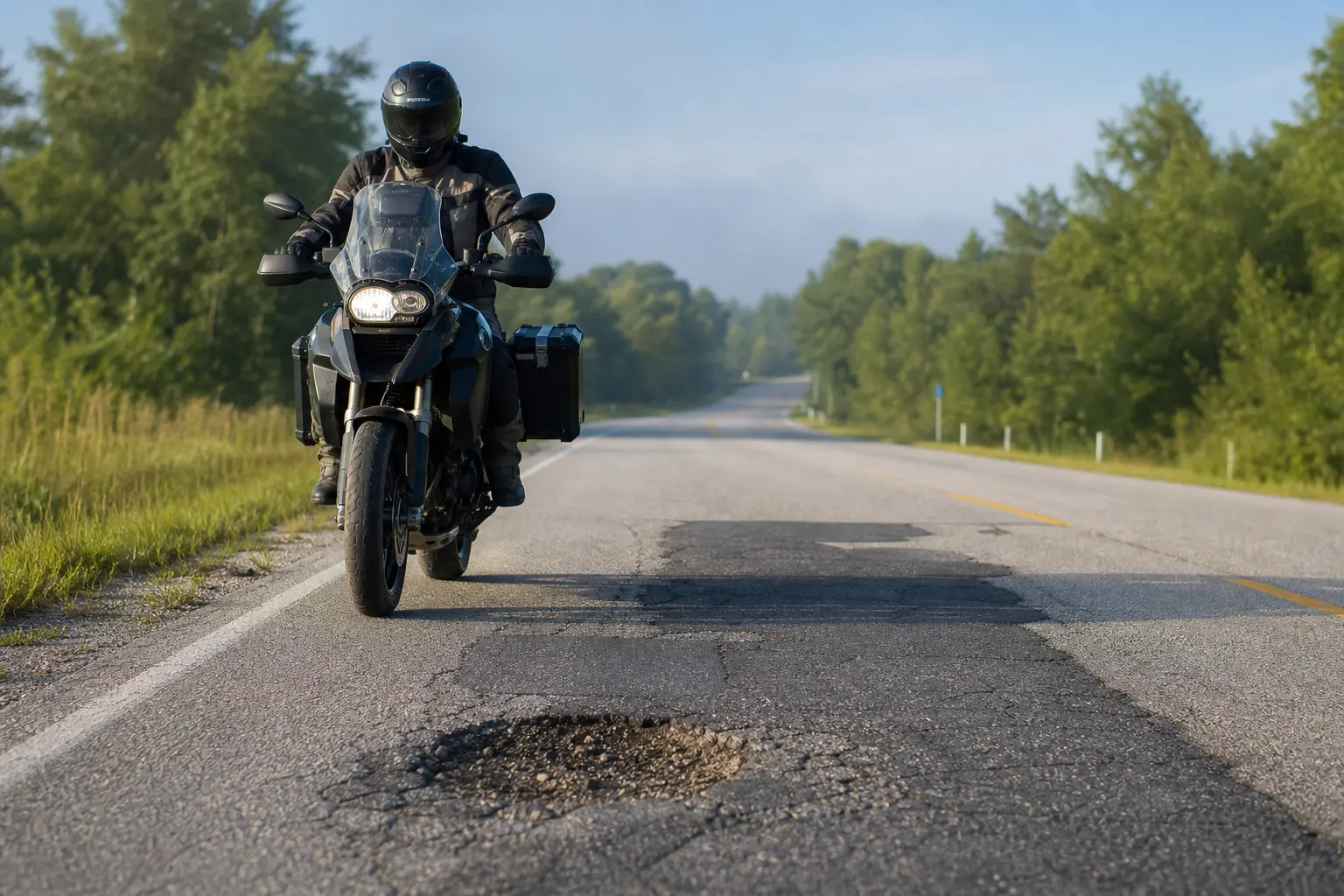
A pothole, a broken pavement seam, loose cargo, or a small object in the lane can become an immediate problem before there is time to choose an ideal line. A vehicle ahead may conceal it. Rain, shadows, glare, traffic, or a curve may leave little warning. And sometimes the path around the hazard is less certain than the hazard itself.
The best response is still early recognition: reduce speed, use a verified path around the problem, or stop if doing so is safe. But when that window has closed, a rider needs a simpler objective. Rather than attempting a desperate late maneuver, use a conservative slow-straight-inspect order:
- Reduce speed while there is still room and the motorcycle is as upright as possible.
- Keep the motorcycle tracking straight through the available path.
- Avoid abrupt braking, steering, or throttle changes at the point of contact.
- Continue only far enough to reach a safe place to stop.
- Check the motorcycle before deciding whether to ride farther.
This is not a promise that every pothole or object can be crossed safely. A deep hole, a large item, standing water, loose material, traffic conflict, or high approach speed may make the situation unsafe regardless of technique. It is also not a substitute for supervised rider training. It is a decision framework for the uncomfortable moment when a safe avoidance path is no longer clearly available.
The Motorcycle Safety Foundation (MSF) identifies potholes, broken pavement, bumps, and small roadway litter as hazards that can raise a rider’s crash risk. Its operator guidance prioritizes avoiding the hazard when possible; where a smaller obstacle must be crossed, it emphasizes reducing speed before contact, approaching on a near-perpendicular path where practical, keeping the motorcycle straight, and checking tires and rims after the strike. 1 Your own motorcycle’s owner’s manual remains the first authority for tire pressure, loading, warning indicators, approved inspections, and model-specific limits.
How to Ride Over Road Debris or Potholes on a Motorcycle When You Cannot Avoid Them
The key distinction is between a hazard that is avoidable and one that is merely visible. Seeing an object does not automatically create enough pavement, traction, or time to miss it safely. A gap that looks open may lead toward loose shoulder material, oncoming traffic, a parked vehicle door zone, a curb, or another road defect that you cannot yet see.
When the motorcycle is already close to a pothole or debris, the rider can easily stack too many tasks together: braking hard, changing direction, watching adjacent traffic, leaning, and absorbing the impact. That overload is often more dangerous than the original object. MSF crash-avoidance guidance teaches that aggressive swerving and braking should be separated whenever conditions allow, rather than combined into one hurried movement. 2
For this reason, use a brief internal question rather than a long calculation:
Do I have a clearly open, lawful, and controllable way around it—or is the safer remaining plan to slow, align, and cross?
If the answer is uncertain, do not make the uncertainty worse with a last-second dive toward the edge of the lane. A conservative rider accepts that preserving control may be more important than perfectly avoiding a small obstacle.
That does not mean aiming at hazards. It means choosing the least demanding option left after avoidance has become doubtful. The order below is deliberately simple because it needs to work under stress:
- Speed first: shed as much speed as conditions safely permit before reaching the hazard.
- Direction second: let the motorcycle travel on a stable, deliberate line.
- Impact third: do not introduce a panic input as the wheel reaches the defect.
- Inspection last: treat a hit as a reason to stop and look, even if the motorcycle seems to continue normally.
A rider who has room to make a controlled avoidance maneuver should use that room. A rider who does not should avoid turning the final seconds into an unplanned test of braking and swerving skill.
Build Time and Space Before the Hazard Appears
Most pothole encounters are decided well before the wheel reaches the hole. The more clearly you can see the road surface, the more choices you retain. The less time you have, the more likely you are to react to the object instead of managing the whole situation around it.
Following distance matters because a vehicle directly ahead can hide pavement defects until the last moment. MSF guidance notes that a two-second following interval provides a minimum buffer and can improve the rider’s view of potholes and other roadway hazards; it also calls for a larger space cushion when stopping distance, visibility, or surface conditions are compromised. 1 Treat that as a baseline, not a fixed entitlement. Increase the margin whenever your view is obstructed or the road offers less predictable grip.
Look beyond the rear bumper, tailgate, or trunk of the vehicle in front. Search for information that may reveal a hazard before it becomes obvious:
- Vehicles ahead braking unexpectedly or changing lane position without an obvious traffic reason.
- A repeating pattern of cars moving around one section of pavement.
- Dark depressions, irregular patches, broken asphalt edges, or abrupt changes in road texture.
- Debris near trucks, trailers, construction entrances, or recently loaded vehicles.
- Shade, reflected glare, rainwater, or accumulated grime that obscures the actual road surface.
- A narrowing view through a curve, over a crest, behind a bus, or around parked vehicles.
Lane position is useful when it improves your view and preserves options, but it should never be treated as a permanent rule. The best position changes with traffic, pavement condition, sightlines, road edge quality, and escape space. A lane track that gives a better look past a vehicle is only helpful if it does not put you too close to adjacent traffic, an open door zone, loose material, or a deteriorating edge.
Also resist pace pressure. A close follower can make riders feel compelled to hurry toward a blind road surface. That pressure does not create traction or extend sight distance. Where lawful and safe, create more room in front, let faster traffic proceed, or choose a place to move out of the flow. The practical goal is a pace that matches what you can see and assess—not someone else’s urgency.
Decide Whether to Avoid, Stop, or Cross
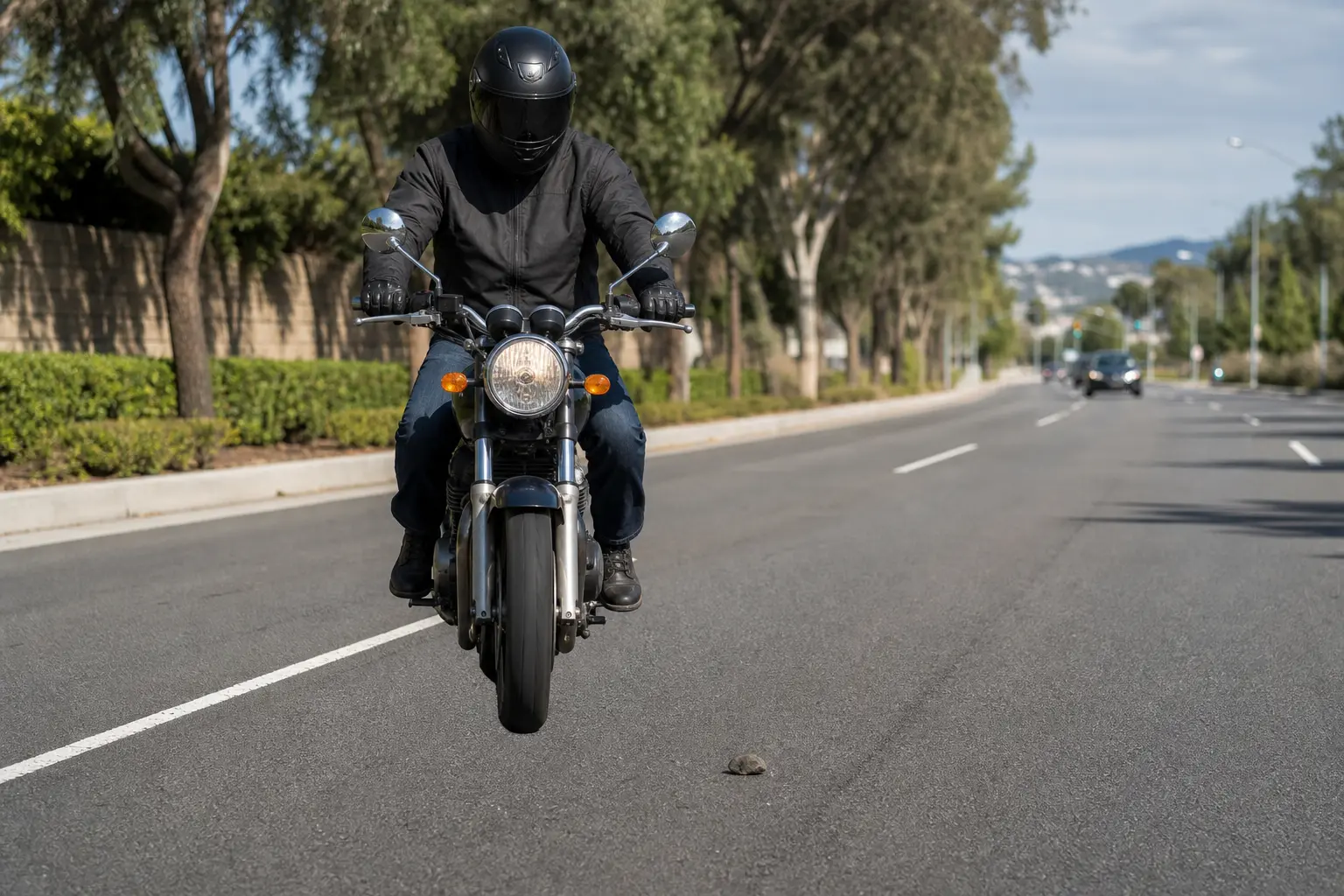
Once you identify a pothole or object, commit to one primary plan. Trying to execute every option at the same time is where riders get trapped.
| What you can confirm | Conservative priority | What adds risk |
|---|---|---|
| There is a clear, legal path around the hazard | Reduce speed if possible, check the full path, then make one measured direction change | Moving abruptly toward an unseen shoulder, adjacent vehicle, or lane edge |
| There is enough distance and a safe stopping situation | Brake in a stable line and stop before the hazard | Fixating only on the hole and overlooking traffic behind you |
| Avoidance space and stopping distance have both closed | Lower speed as much as possible, keep the motorcycle aligned, and minimize inputs at contact | A last-second turn combined with severe braking |
| The hazard is in a bend or on a low-grip surface | Reduce demands and accept a larger safety margin | Assuming familiar pavement will offer normal traction |
| The motorcycle behaves differently after contact | Pull over safely and evaluate before riding farther | Treating continued movement as proof that nothing happened |
If the route around it is truly clear
A path around debris or a pothole can be preferable, but only when it is fully accounted for. “Clear” means more than seeing an empty patch of pavement beside the object. You need to consider traffic, lane boundaries, the pavement edge, surface contamination, visibility beyond the maneuver, and whether your line can be completed without a sudden correction.
Slow before changing direction whenever the situation permits. Then make the maneuver as one deliberate action rather than a series of hurried corrections. A small obstacle does not justify crossing a centerline, forcing another road user to react, or leaving the pavement for an unknown shoulder.
If the only apparent escape is unverified, it is not a dependable escape path.
If stopping is the safer option
If you have sufficient room and can stop without creating a greater threat from traffic behind, stopping before the hazard may be the most conservative decision. Use the braking method you have learned and practiced, keeping the motorcycle stable and as straight as conditions allow. MSF notes that available braking traction is reduced when a motorcycle is leaned; its guidance stresses smooth, progressive brake use and careful management of braking in corners. 2
After stopping, do not rush into a U-turn, walk into an active traffic lane, or make a sudden reentry. Take time to identify a lawful and safe next move. Waiting for a better gap, using a side road, or rerouting can be the better answer when the surface ahead remains uncertain.
If crossing is now unavoidable
When there is not enough room for a controlled stop and no confirmed line around the hazard, reset the task. You are no longer trying to save every inch of pavement. You are trying to lower the impact demand and maintain a predictable path.
Look toward the place you need the motorcycle to travel after the hazard, rather than locking your attention on the deepest point of the hole or the object itself. This is not denial; it is path management. Your vision helps organize steering and balance. Staring at the object can consume the attention needed to stay within the safe portion of the lane.
The Slow-Straight-Inspect Plan for an Unavoidable Pothole or Object
1. Reduce speed before the wheel reaches the hazard
Do the meaningful slowing before contact, not during it. The purpose is to reduce the demands placed on the tires, wheels, suspension, and rider at the same moment. MSF’s obstacle guidance specifically places speed reduction before the object, while its slippery-surface guidance warns against sudden speed or direction changes on reduced-traction pavement. 1
Use only controls and braking techniques you have practiced and can apply smoothly. Do not assume that anti-lock brakes, traction control, ride modes, or other electronics make a pothole harmless. These systems may assist in some circumstances, but they do not fill a hole, make debris predictable, or manufacture space where traffic has removed it.
If the road is wet, sandy, leafy, oily, painted, or otherwise questionable, revise your expectations downward. The same pothole may be accompanied by surface conditions that reduce grip before you ever reach it. Favor smoothness and a larger margin rather than trying to recover normal pace immediately.
2. Keep the motorcycle aligned with the path
For a smaller obstacle that must be crossed, the MSF advises a path as near to perpendicular as practical and a motorcycle that is straight at contact. 1 The important qualifier is practical. Do not steer toward another lane, the centerline, a curb, or an unsafe pavement edge merely to create a mathematically perfect crossing angle.
The goal is a stable, forward-tracking motorcycle—not a rigid rider or an exaggerated correction. Make the line as direct as the lane, traffic, and road conditions safely permit. Avoid a late steering snap just as the wheel enters the pothole or touches the debris.
If the road curves, the safer answer may be to accept a lower entry speed long before the hazard becomes immediate. A pothole in a bend leaves fewer usable options because braking, cornering, and impact loads begin to overlap. A familiar route deserves no extra trust when surface conditions have changed.
3. Maintain a balanced posture without experimenting
MSF describes a slight rise from the seat, with weight supported on the footrests, as an approach for absorbing shock over a smaller obstacle. 1 That is a training concept, not a command to try an unfamiliar body position during a surprise event.
If you have received proper instruction and have practiced that posture in a suitable controlled setting, apply it only within your training and the circumstances. Keep your body balanced, your knees and elbows capable of flexing, and your inputs measured. Do not stand tall, lock your legs, or turn the encounter into an improvised stunt.
If you have not practiced this skill, stay in a normal, secure riding posture. Focus on the fundamentals that do not require a new movement pattern: slow earlier, travel straight, keep your eyes on the intended path, and do not clamp onto the controls in panic.
A passenger, luggage, physical limitations, or the design of the motorcycle may further limit what is sensible. Manufacturer instructions for passenger carrying, cargo, tire pressure, and loading should be followed before the ride—not improvised when a pothole appears.
4. Avoid a sharp input at the exact moment of contact
One reason road defects cause trouble is that riders react to the jolt with an immediate grab at the brake, a sudden steering correction, or a violent throttle movement. Those reactions can unsettle the motorcycle when the tires are already coping with an uneven surface.
The MSF describes a brief throttle roll-on and roll-off for crossing a smaller obstacle. 1 This article does not present that as a universal instruction for every motorcycle, hole, passenger load, road surface, or rider. It is a specific training technique that should not be applied outside the rider’s experience and conditions.
The broadly useful takeaway is narrower: do not add a large surprise input at contact. Your priorities remain earlier slowing, a stable direction, and control movements that are calm rather than abrupt. Let the motorcycle complete the immediate disturbance before demanding a major new direction or braking response.
5. Ride out only far enough to make a safe stop
After the hit, keep scanning. Do not stop in an active lane merely because you want to inspect the motorcycle immediately, unless an acute emergency leaves no safer alternative. Signal, move to a legal and stable location away from traffic, and stop with enough room to assess the motorcycle without exposing yourself to passing vehicles.
Pay attention to new information: a warning light, a changed steering response, a pull to one side, unusual vibration, a fresh noise, visible tire deflation, or an unfamiliar fluid mark. These observations are not a diagnosis. They are reasons to stop treating the motorcycle as known-good until it has been checked.
MSF specifically directs a rider who has struck an object to pull off and examine tires and rims before continuing. 1
Conditions That Require a Bigger Safety Margin
The basic plan does not change, but some conditions make it more important to slow earlier, avoid abrupt changes, and consider stopping or rerouting.
Rain, standing water, and contaminated pavement
Water can conceal the depth and edge of a pothole. It can also coexist with oil, dirt, paint, steel covers, leaves, gravel, or other low-traction material. MSF lists wet pavement, gravel, sand, leaves, painted markings, steel plates, and surface covers among conditions that can provide poor traction, and it advises reducing speed before slippery areas while avoiding sudden changes in speed or direction. 1
Do not assume that going around the visible hole is automatically safer if the alternative path crosses an unknown wet or contaminated patch. Separate the questions: can you avoid the hole, and can you do so on a surface that is likely to support the maneuver?
Curves, crests, and limited sightlines
A pothole hidden around a bend or just beyond a hill is a pace-management problem before it becomes an obstacle problem. Enter places with restricted views at a speed that leaves room for what you cannot yet see. This is particularly important when the road edge, lane markings, traffic, or oncoming vehicles limit where you can go.
If the hazard appears mid-corner, avoid a reflexive attempt to straighten by crossing lane boundaries. Maintain the safest available path, smooth the controls as much as possible, and do not rely on a last-moment correction to solve a problem that has already reduced your margin.
Night, glare, and fatigue
Darkness changes what can be seen and how soon surface changes can be recognized. Glare from opposing headlights, a scratched or fogged visor, rain, low sun, or fatigue can reduce the usable view further. A safer nighttime pace is not based on what the road might contain; it is based on how much road you can actually evaluate in time.
If visibility is badly compromised, stopping for a reset, delaying the ride, or selecting a better-lit route is a sound risk decision. Continuing at a daytime pace while relying on hope is not.
Passenger, cargo, or an unfamiliar motorcycle
A loaded motorcycle should be operated according to the manufacturer’s passenger, cargo, and tire-pressure instructions. Added load can change the feel of acceleration, braking, and bumps; it is not a situation for reducing following distance or copying an unladen rider’s pace.
Similarly, MSF advises extra caution with an unfamiliar motorcycle, including gentler acceleration, slower turns, and additional stopping room. 1 If you do not know how a motorcycle responds, leave more margin for the unexpected rather than trying to discover its behavior during a roadway emergency.
After Contact: Stop, Inspect, and Make a Conservative Decision

A motorcycle that remains upright and moving after a strike has not automatically passed an inspection. Some concerns may be visible immediately; others may be uncertain to a rider at the roadside. The appropriate response is neither panic nor casual dismissal. Stop in a safer location, conduct a limited visual and functional check within your competence, consult the owner’s manual, and arrange qualified assistance if anything appears abnormal.
Post-impact checklist
- Get out of the traffic flow first. Choose a legal, stable stopping location with room to stand clear of moving vehicles. Use your motorcycle’s hazard flashers if equipped and appropriate for the situation.
- Pause before making another riding decision. Check whether you or a passenger are shaken, injured, distracted, or unable to focus. Do not let a desire to “get going again” override judgment.
- Visually inspect both tires. Look for obvious loss of inflation, cuts, bulges, embedded objects, unusual scuffing, or any change in the tire’s apparent condition.
- Visually inspect the rims and wheels. Look for obvious dents, cracks, deformation, or components that appear displaced or loose. This follows MSF’s specific post-object instruction to inspect tires and rims before riding farther. 1
- Check for visible leaks, warnings, or changed controls. Note new warning lights, fluid on the ground, an altered lever or mirror position, or controls that do not operate normally from a parked position.
- Assess the motorcycle’s behavior honestly. New vibration, pulling, wandering, unusual noise, or altered steering feel is enough reason to stop riding and seek qualified evaluation.
- Use model-specific documentation. Your owner’s manual is the first reference for warnings, tires, wheels, load condition, and maintenance requirements. If the situation cannot be confidently assessed, do not turn uncertainty into a longer ride.
A roadside look is a screening step, not proof that every part of the motorcycle is undamaged. Do not attempt an unfamiliar repair at the roadside. If the tire, wheel, brake system, steering, suspension, or controls may be affected, arrange appropriate transport or qualified inspection instead of riding on speculation.
What Not to Do When You See Road Debris or a Pothole
Some advice sounds decisive but strips away the conditions that make it safe. Avoid these shortcuts:
- Do not try to jump every object. Road shape, object size, suspension travel, rider ability, surface grip, passenger load, and the motorcycle itself all matter. The goal is reduced risk, not dramatic contact.
- Do not cross the centerline or leave the pavement just to improve the angle. A near-perpendicular approach only matters within a safe and lawful path.
- Do not make obstacle contact the first time you practice a new posture or throttle technique. Training drills belong in an appropriate, controlled environment.
- Do not stare at the pothole. Identify it, make a decision, and direct your vision through the route you intend to use.
- Do not assume electronics erase the hazard. Rider aids may help within their operating conditions, but they do not replace observation, speed choice, traction, or space.
- Do not let group pressure make the decision. If your motorcycle has had a significant strike or feels different, communicate that you need to stop. A delayed arrival is preferable to riding an uncertain motorcycle.
Make Road-Surface Awareness Part of Every Ride
The strongest pothole response is often prevention: giving yourself enough observation time that a minor defect remains a routine adjustment instead of an emergency. Build that prevention into your normal riding process.
Before every ride, follow the inspection guidance in your owner’s manual. MSF’s T-CLOCS material includes tire inflation, tread and sidewall condition, brake feel, controls, lights, fluid checks, chassis condition, and stands among its pre-ride considerations. 1 This does not guarantee immunity from road impacts, but it helps ensure that you are not beginning the day with an already compromised tire, wheel, control, or brake concern.
During the ride, return to three repeatable habits:
- Protect your view. Leave following distance that allows you to see pavement and traffic behavior ahead.
- Protect your options. Avoid staying boxed in where a small surface change would force an extreme decision.
- Protect traction. Where possible, do your major braking before a hazard and keep direction changes smooth and intentional.
For a broader model-first approach to condition checks and scheduled care, visit the Motorcycle Maintenance Guide. The goal is not to turn every ride into an inspection session; it is to make tire, wheel, control, and warning awareness routine enough that an impact check has useful context.
Finally, seek formal hands-on training if you want to improve emergency braking, swerving, surface assessment, and body-position skills. MSF states that the physical abilities required to control direction, speed, and balance are learned through practice, preferably as part of formal instruction. 1 Reading can improve your decision order. Proper training gives you a safer place to build the physical skill behind it.
How Vojo Helps
After a pothole or debris strike, use Vojo to make the event traceable instead of relying on memory. Once you have stopped safely and completed your initial visual check, open the motorcycle maintenance tracker and create an entry with the ride date, road conditions, the type of impact, visible findings, and any new vibration, warning, or handling change. Then add a follow-up reminder for the owner-manual check or qualified inspection you decide is appropriate. If a symptom appears later, your service record will show when it began and what happened immediately beforehand.
Download Vojo on the App Store
Bottom Line
When you cannot safely avoid road debris or a pothole on a motorcycle, simplify the response. Reduce speed before the impact zone, keep the motorcycle on a stable and as-straight-as-practical line, avoid sudden control changes at contact, and pull over somewhere safe to inspect before continuing. The conservative choice to stop, reroute, or arrange help is not a failure of skill. It is good risk management.
Sources
1 Motorcycle Safety Foundation, Motorcycle Operator Manual.
2 Motorcycle Safety Foundation, Motorcycle Operator Manual With Supplementary Information.
Quick answers
Frequently asked questions
Should I brake or swerve for a pothole on a motorcycle?
Use a controlled avoidance maneuver only when you have a verified, lawful path and enough room to complete it. If stopping and swerving are no longer realistic options, reduce speed as much as safely possible before the hazard and keep the motorcycle on a stable line rather than combining hard braking with a sudden turn.
Should I stand up when riding over a pothole on a motorcycle?
MSF guidance for a smaller obstacle includes a slight rise from the seat with weight supported on the footrests to help absorb shock. Treat this as a trained skill, not a surprise-road technique to attempt for the first time. If you have not practiced it appropriately, maintain a secure normal posture and focus on slowing early and staying straight.
Can ABS prevent damage from a pothole or road debris?
No. ABS can assist with braking in conditions within its design, but it cannot remove the impact, reveal a hole’s depth, protect a wheel from every strike, or create traction and space that are not available. Early speed reduction and a stable path still matter.
What should I inspect after hitting road debris on a motorcycle?
After pulling over safely, inspect for obvious tire deflation, cuts, bulges, embedded objects, visible rim damage, leaks, warning lights, unusual noises, vibration, and changed steering or control feel. MSF specifically advises checking tires and rims after striking an object. Consult the owner’s manual and seek qualified help if anything is abnormal or uncertain.
Can I keep riding if my motorcycle seems normal after hitting a pothole?
Do not assume that continued movement means the motorcycle is undamaged. Stop safely and inspect the tires and rims first. If you find visible damage, a warning light, a leak, unusual vibration, changed steering feel, or anything you cannot confidently assess, do not continue riding until the motorcycle has been appropriately evaluated.