
Deer and Other Large Animals on a Motorcycle Route: A Conservative Slow-Stop-Scan Plan
Use a conservative motorcycle deer encounter safety plan to manage route timing, blind sightlines, braking margin, group pace, and safe stops.
Fact-checked against cited official documentation
Reviewed against Fact-checked against MSF animal-encounter, pre-ride inspection, control, and autumn wildlife-risk guidance; model-specific motorcycle requirements remain owner-manual first..
Last updated September 29, 2026
A deer encounter is not a test of bravery, quick steering, or how aggressively a motorcycle can be ridden through a rural road. It is a planning problem first and a control problem second. The rider who sees less, arrives faster, and has fewer usable options is carrying the most risk.
For motorcycle deer encounter safety, use a conservative sequence: slow before the uncertainty, be ready to stop, then scan for what may follow. That sequence also applies to elk, cattle, horses, moose, and other large animals. It is intentionally less exciting than an evasive-maneuver story, but it gives you more time, more road, and more decisions that do not depend on guessing what an animal will do.
The Motorcycle Safety Foundation (MSF) specifically advises riders confronting larger animals such as deer, elk, and cattle to brake and prepare to stop because they are unpredictable. Its rider material also emphasizes keeping attention on control and the intended path rather than letting an animal become a distraction. [1]2
This guide does not promise a way to out-ride wildlife. It builds a route and riding plan that lowers exposure, preserves braking room, and makes stopping or delaying the ride an acceptable decision.
The Core Plan: Slow, Stop, Scan
The three words are a mental script, not an exact maneuver prescription.
Slow means reducing your commitment before a sightline, roadside cover, or time of day makes an animal encounter plausible. You are not waiting to identify a deer in the lane before changing the risk level. You are acknowledging that the space beyond the visible road may contain something you cannot yet see.
Stop means treating a large animal near, entering, or standing on the roadway as a reason to prioritize a controlled reduction in speed and to be prepared to come to a complete stop. It does not mean aiming for a narrow gap between animals, relying on a last-second swerve, or assuming the animal will continue in one direction.
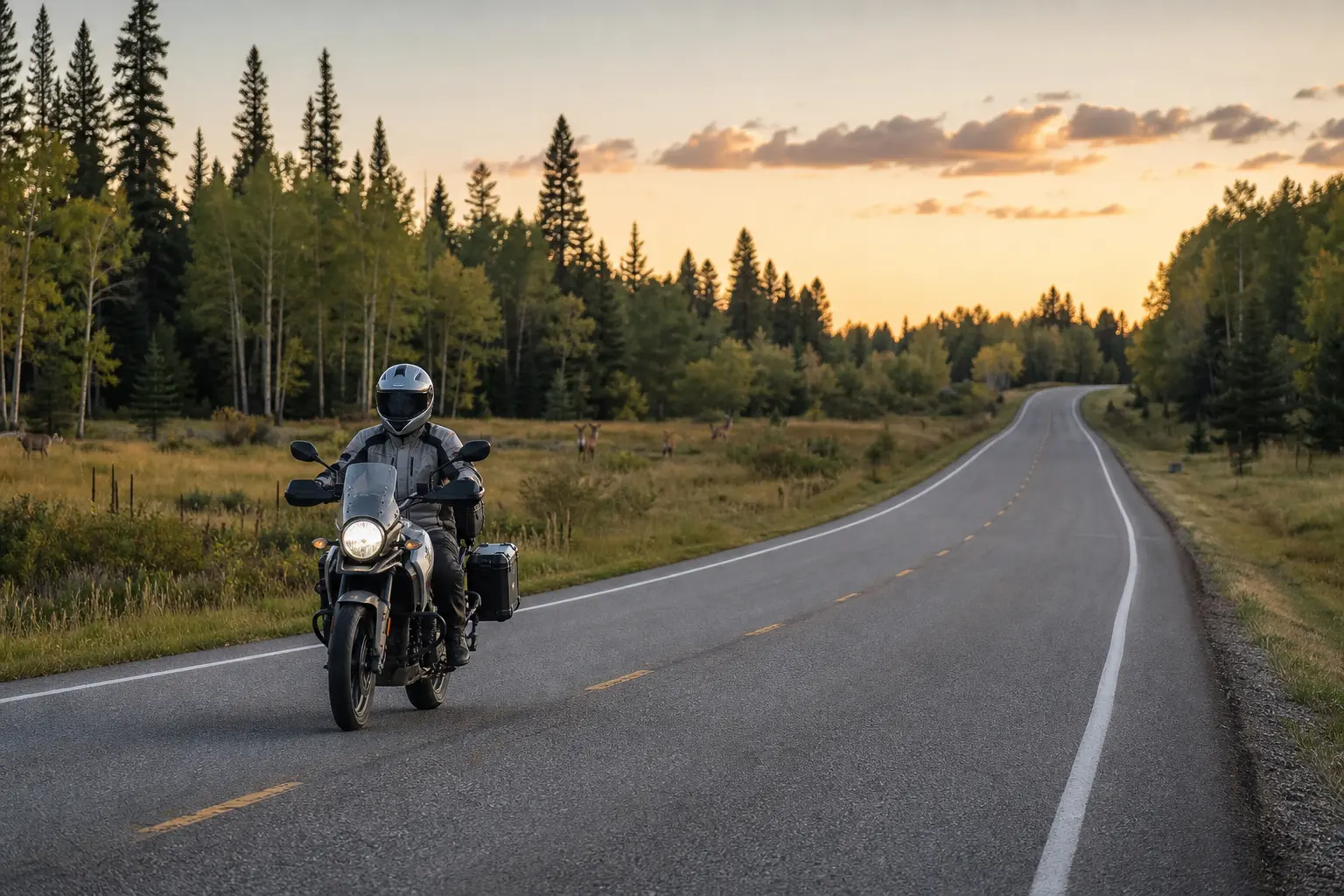
Scan means looking beyond the first animal and beyond the immediate lane. A deer at one edge of the road can be a signal to look for additional animals, changing movement, oncoming traffic, a vehicle following too closely, and the safest available space in which to stop. MSF notes that where one deer is seen, riders should expect more, and it calls for additional caution around wooded areas, blind corners, and dawn or dusk during the autumn wildlife-risk period. 3
The point is not to turn every country road into a crawl. The point is to make your speed fit the distance you can actually see, the traction you can trust, and the distance in which you can respond without panicking.
| Route or road condition | What increases uncertainty | Conservative adjustment | What not to assume |
|---|---|---|---|
| Wooded roadside or thick brush | Animals can remain hidden until close to the lane | Ease off before entering the limited-sightline section and scan both verges | That a clear road surface means the corridor is clear |
| Blind curve, crest, or dip | Your visible stopping space ends before the road does | Enter with enough margin to respond within what you can see | That the curve will open cleanly or the road beyond is empty |
| Dawn, dusk, or fading light | Contrast and distance judgment are reduced; wildlife crossings may be more likely | Favor daylight timing where practical; lower pace as visibility falls | That headlights reveal every animal early enough |
| Wet leaves, gravel, or debris | Available grip and braking confidence may be reduced | Increase margin further; avoid compounding wildlife risk with rushed inputs | That dry-road response expectations still apply |
| Vehicle close behind | A sudden reduction in speed becomes a rearward risk too | Check mirrors early, create space where possible, signal intentions clearly | That the following driver recognizes wildlife risk |
| Group ride or passenger | Pace pressure and added load can reduce flexibility | Set a no-pressure pace and use planned regroup points | That every rider has the same sight distance or braking comfort |
Build Wildlife Risk Into the Route, Not Just the Reaction
A safer wildlife plan begins before the engine starts. Many riders treat animal risk as random, then discover that their route contains long runs of woods, fields, creek bottoms, ranch land, or remote roads at the least forgiving time of day. You cannot eliminate the possibility of an encounter, but you can stop stacking avoidable disadvantages.
Start with timing. If your schedule is flexible, place the most exposed rural sections in full daylight. This is especially useful when a route includes long wooded stretches, blind turns, or areas with limited places to pull over. If daylight will run out, decide in advance whether the sensible answer is to shorten the loop, use a more developed road, stop earlier, or postpone the segment. Treating the final hour as a fixed appointment encourages exactly the pace pressure you do not want.
Then consider road design. A route can be scenic and still be a poor choice for a tired rider late in the day. The combination of tree cover, frequent curves, rolling crests, narrow shoulders, and limited pull-offs creates repeated uncertainty. A more direct road with wider views and predictable junctions may be the better travel choice when visibility is falling. That is not a verdict on skill; it is an adjustment to the information available to you.
Pay attention to transitions. Risk often changes when the road passes from town into woods, from open field into a creek corridor, or from a broad highway into a shaded back road. Instead of maintaining the same pace by habit, use those changes as prompts to reset: reduce speed slightly, open following distance, locate an escape-free stopping area ahead, and resume active scanning.
Finally, account for your return leg. A route that is comfortable in the morning may put you on its most enclosed, unfamiliar section at dusk. When planning a loop, ask a simple question: If the ride takes longer than expected, which section will I be riding in reduced light? If the answer is the remote, wooded part, reverse the route, cut the loop shorter, or establish an earlier turnaround point.
This route-first thinking belongs alongside ordinary trip preparation. Before a longer ride, use the model-specific owner’s manual as the authority for your motorcycle’s inspections, loading limits, tire guidance, and maintenance requirements. MSF likewise directs riders to the owner’s manual as the primary source for how the motorcycle should be inspected and maintained. 1 For a broader pre-departure routine, see the Motorcycle Maintenance Guide.
Read Sightlines Instead of Hunting for Deer
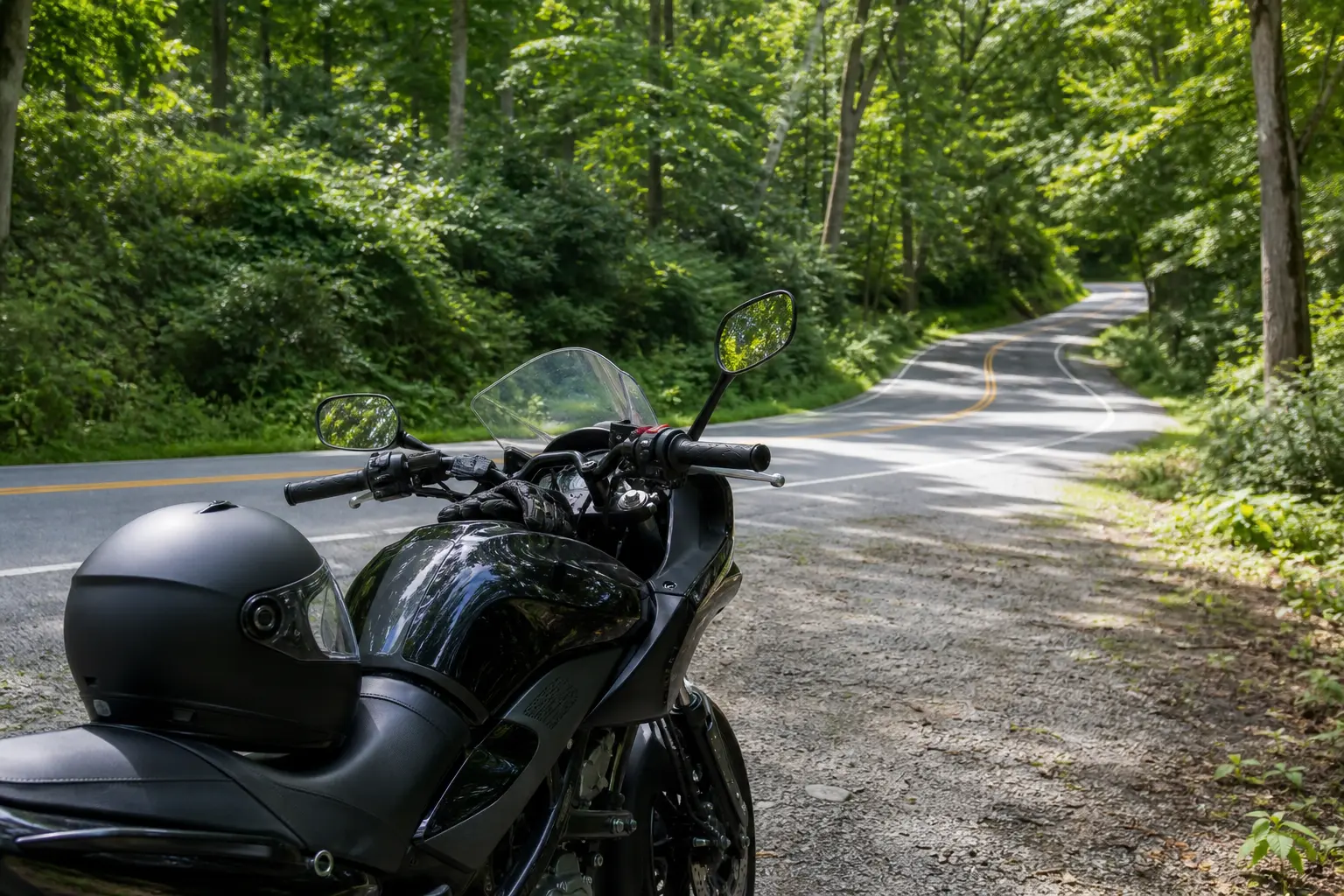
Trying to stare into every patch of brush is exhausting and usually ineffective. Better scanning is about reading where the road takes away your options.
Start far ahead. Identify the point where your view of the roadway ends: the bend, crest, shadow line, parked vehicle, foliage wall, bridge rail, or rise. That point is your practical horizon. As it moves closer, your response options shrink. The appropriate adjustment is usually earlier and smoother than riders expect: ease off while you still have room, rather than waiting for proof of danger.
Then broaden the scan. Move attention between the road surface, far path, each roadside verge, mirrors, and traffic behavior. A fixed stare at the shoulder can make you miss a changing curve, loose material, or a car slowing ahead. A fixed stare down the center of the lane can make you miss movement at the edge. The purpose is a repeatable visual rhythm, not a frantic search.
Look for context clues, but never treat them as a guarantee. Freshly cut fields, fence openings, water crossings, wooded edges, and roadside reflectors can all make a rider more alert to the possibility of movement. Yet an animal can appear where no clue was obvious. The clue tells you to create more margin, not to predict the exact location or behavior.
Use lane position for vision and space, not as a magical “deer avoidance” position. Select a lane position that improves your view through the next section and leaves usable room away from immediate hazards, while respecting traffic, surface condition, and lane boundaries. Keep revising it as the curve, vehicles, and roadside change. A position that improves your view around a right-hand bend may not be the best choice after the bend opens into oncoming traffic or debris.
Avoid letting a headlight beam create false confidence. At night, the illuminated road feels like a complete scene, but it is only a limited slice of one. Beyond it may be a stationary animal, a dark animal, a curve, or a roadside that offers no additional reaction room. If you cannot identify and manage the road space ahead with confidence, reduce speed or stop in a suitable place and reconsider the plan. The goal is not to prove that night riding is always unsafe; it is to recognize that reduced information deserves reduced commitment.
When You See a Deer or Other Large Animal
The moment you identify a large animal, simplify the task. Do not turn it into a contest between panic and improvisation.
First, keep the motorcycle under deliberate control. Look along the path you intend to use rather than locking your vision on the animal. MSF’s guidance on animal encounters stresses maintaining control and looking where you want to go rather than being distracted by the animal. [1]2
Second, reduce speed and prepare to stop. A large animal can hesitate, reverse direction, accelerate unexpectedly, or be followed by another. The important distinction is that you are responding to uncertainty, not to a known, stable obstacle. A gap that appears open for a second is not necessarily a route you should commit to.
Third, scan for the full scene:
- Is there another animal behind the first one or already crossing from the opposite side?
- Is the animal moving toward your lane, away from it, or standing without a predictable direction?
- Is oncoming traffic occupying the space you might otherwise consider using?
- Is a vehicle following you closely enough that a gradual, early speed reduction is safer than a late one?
- Is the pavement clean and dry, or are leaves, gravel, rain, shadows, or uneven surface reducing your margin?
- Is there an upcoming straight, driveway, turnout, or other appropriate place to stop and reset if the situation remains unclear?
The answer may be to stop and wait. Waiting is not indecision when the hazard is mobile and unpredictable; it is a positive choice to avoid forcing a low-information path.
Do not rely on horn use, shouting, revving, or another attention-grabbing tactic to create a predictable animal response. An animal may move, freeze, turn, or do nothing. Likewise, do not aim to pass close to a large animal just because it appears to be facing away. The closer you ride, the less time you have if its behavior changes.
If an animal has crossed and the road seems clear, do not snap back to travel pace. Continue the scan for a short distance, because the event may not be complete. Reset your lane position, check mirrors, and return to a speed that still fits the next visible section.
The Conservative Deer-Encounter Checklist
Use this checklist before and during rural or low-light sections of a ride.
Before leaving
- Check the exact owner’s manual guidance for your motorcycle’s pre-ride condition, tire settings, cargo limits, and passenger requirements.
- Confirm that lights, brakes, tires, controls, and mirrors are ready for the ride; do not let a known motorcycle issue accompany you into a low-margin route.
- Identify whether the route includes long wooded sections, blind corners, crests, ranch land, or limited pull-offs.
- Plan the most exposed segment for daylight when practical.
- Decide on a turnaround time that protects against arriving at the rural return leg in fading light.
- Pack and dress for the possibility that you may stop, wait, or take a longer alternate route rather than press on.
Entering a higher-risk section
- Reset your pace before the blind corner, tree tunnel, crest, or shadowed stretch—not after you spot movement.
- Increase following room so your view is not blocked by another vehicle and your response does not have to be abrupt.
- Scan road surface, far path, both road edges, mirrors, and traffic rather than staring at one point.
- Choose lane position to improve vision and preserve space, then reassess it as the road changes.
- Treat fading light, wet debris, fatigue, passenger load, and unfamiliar pavement as reasons for additional margin.
When an animal is visible
- Keep your eyes working toward your intended path of travel.
- Reduce speed early and be ready to stop.
- Look for another animal, not only the first one.
- Avoid assuming that the animal will continue in the same direction or remain off the roadway.
- Do not force a narrow pass between wildlife, traffic, roadside hazards, or an uncertain surface.
- Once clear, continue scanning before returning to normal travel pace.
When conditions feel wrong
- Pull over only where it is safe and legal to do so, then reassess your route, fatigue, weather, and remaining daylight.
- Use a more open or developed route if it meaningfully improves sightlines and stopping options.
- Stop for the day if your available visibility and attention no longer support a conservative pace.
Group Rides, Passengers, and Pace Pressure
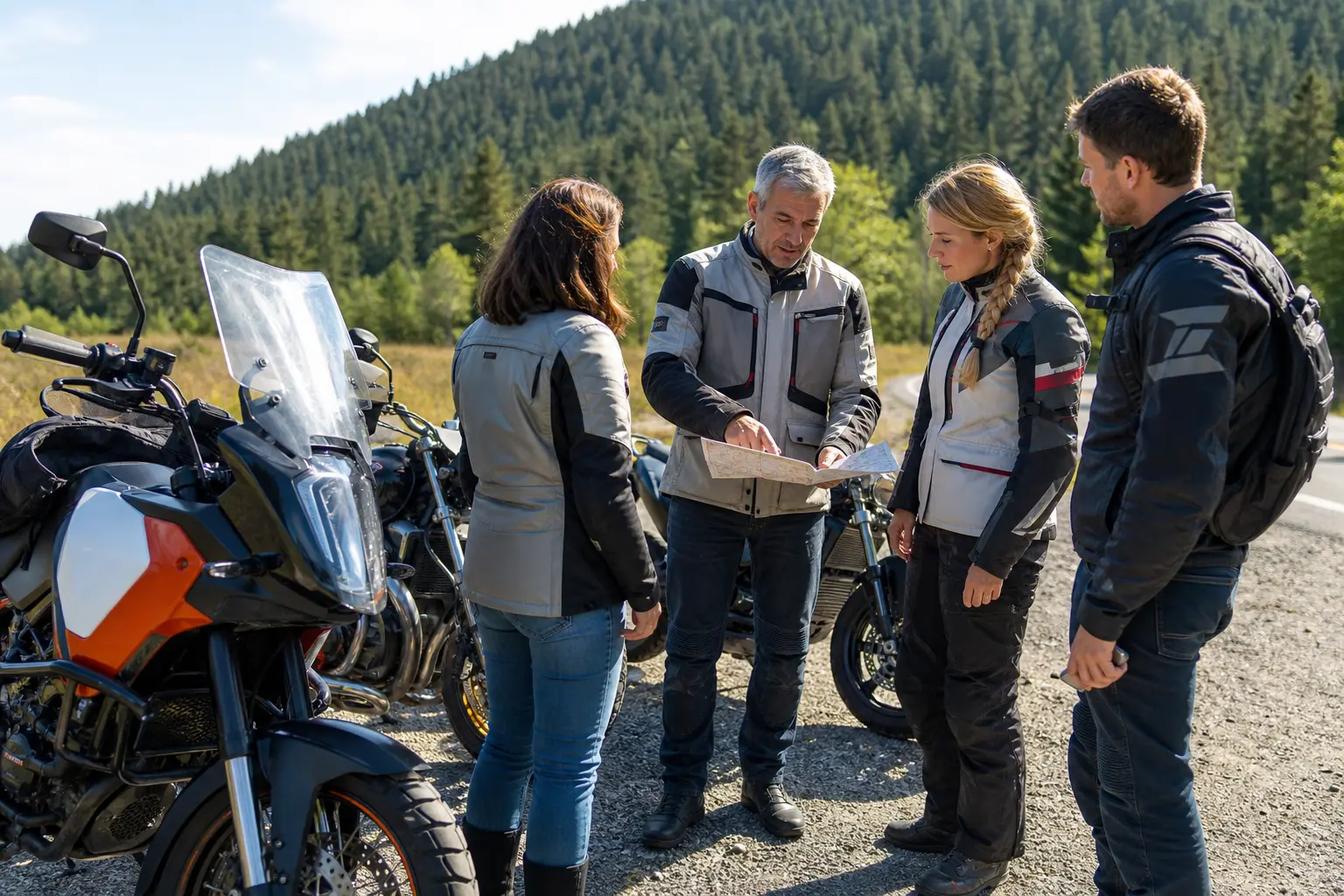
Wildlife risk gets harder to manage when riders feel they must keep up. The rider at the back may have a blocked view, encounter debris thrown up by the group, or arrive at the same blind section with less distance and more urgency. A passenger can also change the motorcycle’s feel and makes a sudden, poorly planned response even less desirable.
Make the plan explicit before departure. Tell the group that anyone may slow for an animal-risk section without apology, that no one should chase to close a gap, and that the route includes planned regroup points. The lead rider should not set pace based solely on the clearest view in the group; they should leave room for riders with less view, less experience, a passenger, cargo, or a different motorcycle.
For passenger rides, have the same conservative conversation you would have for rain or fatigue: the ride may slow down, reroute, pause, or end early. This prevents a passenger from interpreting an unplanned stop as a failure and prevents the rider from treating a schedule as more important than conditions.
If you are the less comfortable rider, state your limit before the road narrows or daylight fades. It is far easier to choose a meeting point in advance than to make a rushed decision while trying to track taillights through a wooded curve. A safer group culture makes room for the rider who slows down; it does not reward the rider who guesses correctly once.
Prepare the Motorcycle, but Do Not Confuse Preparation With Protection
A well-maintained motorcycle supports safer decisions, but it cannot cancel wildlife risk. Good lights do not remove blind corners. Fresh tires do not make an animal predictable. ABS, traction systems, rider aids, or a larger engine do not turn a close-range animal encounter into a controllable experiment.
Preparation matters because it reduces avoidable complications. Before a wildlife-exposed route, follow the owner’s manual and confirm that the motorcycle is in safe operating condition. MSF’s pre-ride material includes attention to tires and wheels, controls, lights and electrics, fluids, chassis, and stands; it also says routine checks should happen before rides. 1 If you discover a brake concern, a tire issue, lighting trouble, loose luggage, a control problem, or anything you cannot confidently assess, resolve that question before choosing a route with restricted sightlines.
Load management matters too. Secure luggage according to the motorcycle manufacturer’s instructions and stay within the model’s limits. A trip loaded for camping or touring may feel different in braking, steering, and low-speed balance. You do not need to calculate a perfect wildlife-response scenario; you need to recognize that extra mass and an unfamiliar load are reasons to lower pace and increase the margin.
Use training as preparation, not as permission to take bigger risks. Controlled rider training can help develop braking, vision, and hazard-management skills, but a deer on a dark curve is not a practice range. If your plan depends on executing a high-pressure maneuver perfectly, the better route plan is usually to reduce the exposure before it becomes necessary.
How Vojo Helps
Create a trip entry in the Vojo motorcycle ride app before a rural ride, then add a short note for the route’s wooded, blind-corner, or low-light segments. Pair that note with a planned turnaround time and a pre-ride maintenance reminder for your lights, tires, brakes, controls, and luggage. After the ride, log any wildlife encounter and the conditions—location type, time of day, surface, traffic, and what changed your plan—so the next route decision is based on your own riding record rather than memory alone.
Download Vojo on the App Store
A Safer Standard for Success
Success is not reaching a destination at the original ETA. It is arriving without turning a blind, wildlife-exposed section into a rushed gamble. The best deer-encounter response may happen minutes before any animal is visible: choosing daylight, reducing pace at a sightline, leaving more room behind another vehicle, or deciding that the route can wait.
Use the slow-stop-scan plan every time conditions make the road ahead uncertain. Slow before the uncertainty compounds. Be prepared to stop for a large animal rather than attempting to predict it. Scan beyond the first deer and beyond the first apparent opening. That conservative approach leaves you with the most useful resource a rider can have on a changing road: time.
FAQ
What is the safest response when a deer appears on a motorcycle route?
Treat the deer as unpredictable: reduce speed, prepare to stop, keep the motorcycle under control, and scan for additional animals and traffic. The MSF specifically advises braking and preparing to stop for larger animals such as deer, elk, and cattle. 1
Should I speed up to get past a deer before it crosses?
Do not build your plan around trying to time or outguess the animal. A large animal can change direction or stop without warning. A conservative response is to reduce commitment, preserve space, and be ready to stop rather than force a close pass.
If one deer crosses, is the road clear afterward?
Do not assume so. MSF advises riders that if they see one deer, they should expect more. Continue scanning both sides of the road and avoid immediately returning to travel pace. 3
Are deer encounters mainly a night-riding problem?
Reduced light can make detection and judgment harder, but deer risk is not limited to full darkness. MSF identifies dawn and dusk, wooded areas, and blind corners as situations needing extra caution during the autumn wildlife-risk period. Build margin whenever visibility or sightlines are limited. 3
Does ABS make deer encounters safe?
No. Braking technology can be valuable, but it does not make wildlife predictable, lengthen a blind sightline, or create open space around traffic and roadside hazards. Ride within the limits described in your motorcycle’s owner’s manual and use conservative speed and route choices.
Should I keep riding after a close deer encounter?
Only if you can do so calmly and conditions remain manageable. If the encounter leaves you rattled, visibility is worsening, the road is unfamiliar, or wildlife activity continues, stop at a safe and legal location to reset or choose a different plan. A pause is often safer than trying to regain time.
Sources
1 Motorcycle Safety Foundation, Motorcycle Operator Manual.
2 Motorcycle Safety Foundation, Street Motorcycle Tips.
3 Motorcycle Safety Foundation, Riders, Drivers Urged to Use Extra Care During Autumn Road Trips.
Quick answers
Frequently asked questions
What is the safest response when a deer appears on a motorcycle route?
Treat the deer as unpredictable: reduce speed, prepare to stop, keep the motorcycle under control, and scan for additional animals and traffic. The MSF specifically advises braking and preparing to stop for larger animals such as deer, elk, and cattle.
Should I speed up to get past a deer before it crosses?
Do not build your plan around trying to time or outguess the animal. A large animal can change direction or stop without warning. Preserve space and be ready to stop rather than force a close pass.
If one deer crosses, is the road clear afterward?
Do not assume so. Continue scanning both sides of the road for additional animals and avoid immediately returning to travel pace.
Are deer encounters mainly a night-riding problem?
Reduced light can make detection and judgment harder, but wildlife risk is not limited to full darkness. Dawn, dusk, wooded areas, and blind corners all call for more margin.
Does ABS make deer encounters safe?
No. Braking technology does not make wildlife predictable, extend a blind sightline, or create open space around traffic and roadside hazards.
Should I keep riding after a close deer encounter?
Only if you can continue calmly and conditions remain manageable. If visibility, fatigue, or wildlife activity is still a concern, stop safely to reset or choose a different plan.