
Motorcycle Controls After Storage: A Safe First-Ride Inspection Before Traffic
Use this motorcycle controls after storage checklist to screen throttle, brakes, clutch, cables, lights, tires, and stands before returning to traffic.
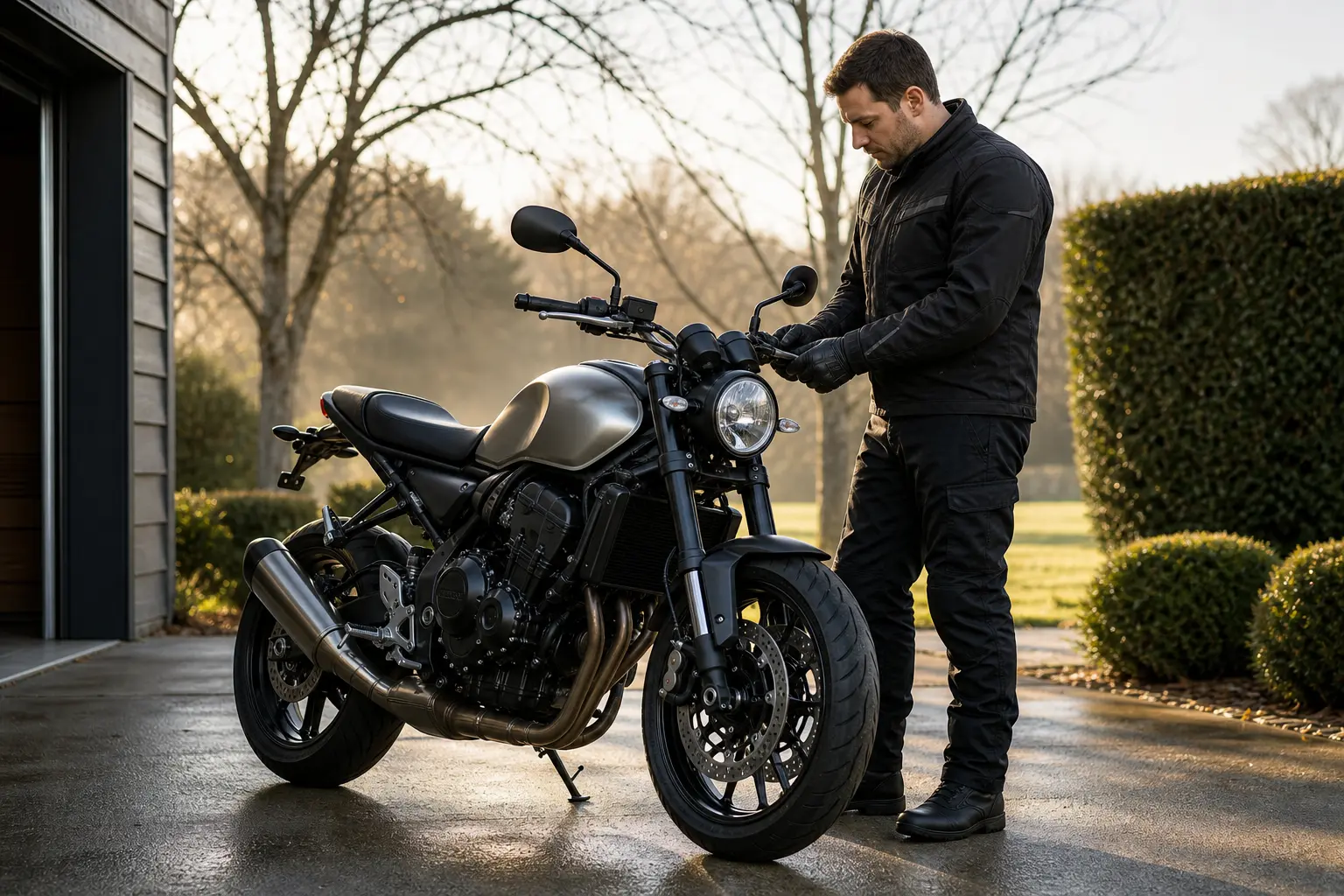
Fact-checked against cited official documentation
Reviewed against Reviewed against MSF guidance on pre-ride checks and equipment failures, plus Harley-Davidson’s T-CLOCS-based maintenance overview for controls, tires, lights, and stands..
Last updated October 27, 2026
A motorcycle that starts after storage has passed only one limited test. It has not yet shown that the controls will feel normal, that the braking controls are free from obvious concerns, or that the rider can safely manage the motorcycle in traffic.
That distinction matters because storage changes the context of a pre-ride check. The motorcycle may have been exposed to damp air, temperature swings, dust, a tight cover, an accidental bump, or work performed before it was parked. A cable can be displaced, a lever can feel different, a tire can lose air, and a stand can be obstructed without any warning from the engine.
This article is a conservative, parked-bike screening process for motorcycle controls after storage. It is not a substitute for the owner’s manual, a maintenance schedule, recalls, or professional diagnosis. Follow the motorcycle manufacturer first whenever its instructions differ. If you find an abnormal control, leak, damaged component, or uncertain condition, keep the motorcycle parked rather than trying to prove it is acceptable on the road.
The Motorcycle Safety Foundation identifies pre-ride inspection, control awareness, lighting, tires, and stands as core rider-safety considerations. Harley-Davidson’s maintenance guidance similarly organizes a walk-around around tires, controls, lights, fluids, chassis items, and stands. Those official frameworks support a broad inspection, while your model manual supplies the details that a general checklist cannot.
For the wider return-to-service picture, pair this focused process with the Motorcycle Maintenance Guide.
Motorcycle Controls After Storage: Start With the Owner’s Manual
Before touching a lever or starting the engine, locate the owner’s manual. Review the model-specific pre-ride information, required maintenance, warning indicators, recommended tire-pressure information, starting sequence, and instructions for any side-stand or clutch-related interlocks. The correct sequence and expected behavior can vary substantially among motorcycles.
This is also a sensible time to recall what happened during storage. Was the motorcycle moved? Did someone remove the battery, wash it, fit accessories, transport it, or work around the handlebars? Was it stored where rodents, moisture, cleaning chemicals, or falling objects were possible? You are not trying to diagnose a fault from the answer. You are deciding where to pay closer attention.
Check for changes that affect your interface with the motorcycle as well. Bar-mounted accessories, handguards, luggage straps, heated-grip wiring, replacement levers, or a shifted cover can interfere with normal movement. A problem need not be dramatic to deserve a no-ride decision: a throttle that hesitates, a brake control that feels unfamiliar, or a cable that tightens as the bars turn is enough to pause.
Avoid using universal measurements, adjustment advice, or fluid recommendations from general online discussions. If a model-specific check requires a measurement, product, tool, adjustment, or disassembly, use the manufacturer’s information or arrange qualified service.
Why a Running Engine Is Not a Control Check
It is easy to let a successful start create false confidence. Starting confirms that some electrical, fuel, and engine-related functions are working at that moment. It does not establish that the motorcycle will stop normally, that the throttle will close as intended, or that its control routing remains unobstructed through steering movement.
A useful post-storage mindset is to separate three decisions:
- Parked inspection: Is there an obvious reason not to ride?
- Controlled test: If the parked screen is clear, can the motorcycle be assessed briefly in a low-pressure setting?
- Normal riding: Only after the controls and motorcycle behavior remain familiar should traffic, passengers, a commute, or a longer route enter the plan.
This progression is deliberately cautious. The first trip should not be the one where you discover a lever issue while merging, a tire concern in a corner, or an intermittent light during poor visibility.
Choose a level, well-lit location with room around the motorcycle. Keep the engine off for the initial walk-around and movement checks. Secure the motorcycle according to its manual and avoid any test that might allow unexpected movement. If you are tired, rushed, distracted, or uncertain, postpone the ride. Storage return is not a deadline.
Motorcycle Throttle Check After Storage
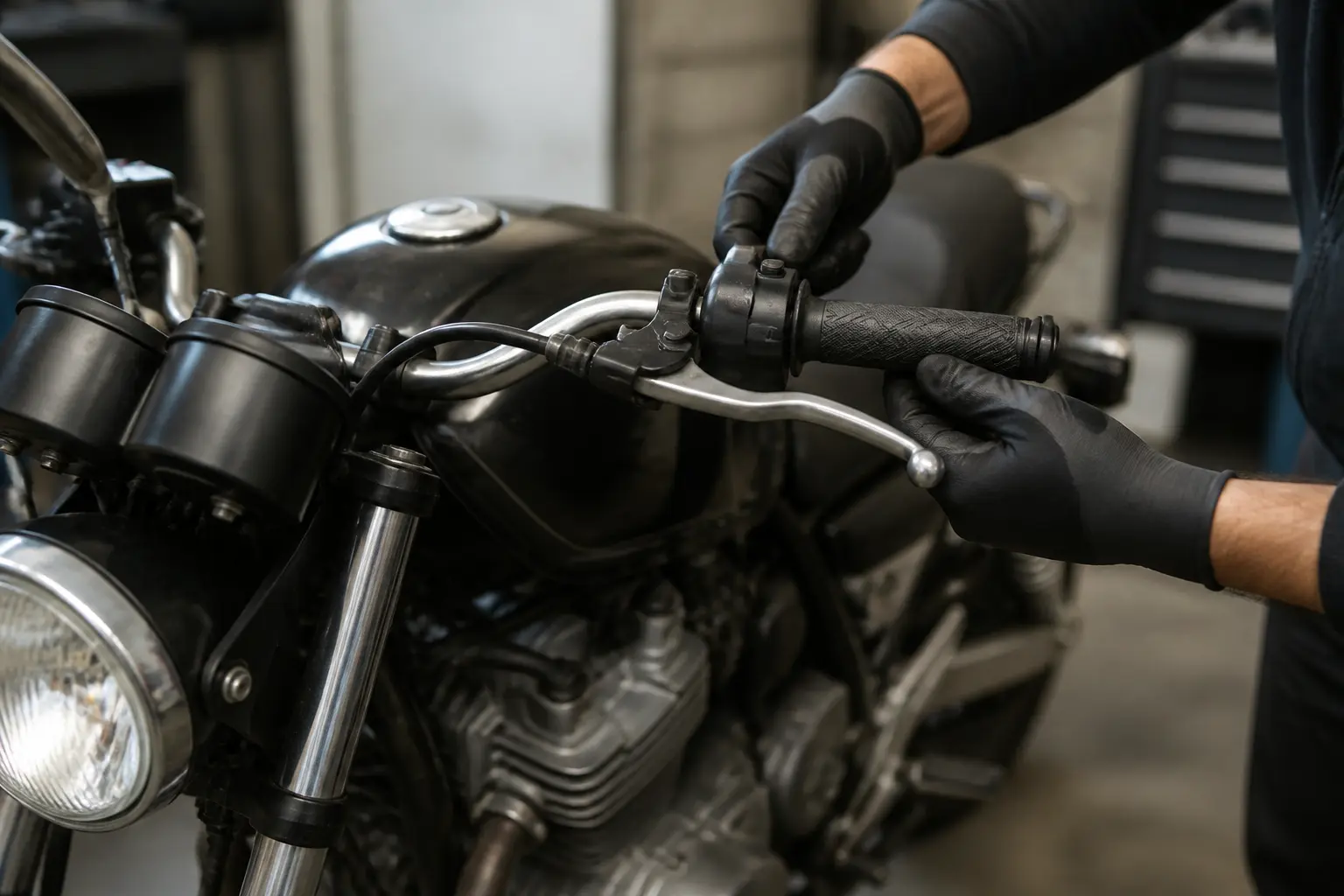
The throttle deserves particular attention because it directly manages power. With the motorcycle stationary and the engine off, inspect the grip and its surrounding area. Look for anything that could crowd or rub the grip, including a bar-end item, handguard, cover residue, accessory mount, damaged switch housing, or displaced wiring.
Then operate the throttle only as the owner’s manual permits. Observe whether it moves evenly and returns consistently when released. Repeat the observation while moving the handlebars slowly through their normal range. You are looking for a change in feel, resistance, or return behavior—not attempting to service the throttle.
Stop the process if the throttle sticks, catches, returns inconsistently, feels rough, or behaves differently at a steering position. Do not ride it to “see whether it clears up.” Do not take apart the housing, introduce a lubricant, or alter cable adjustment unless the manufacturer’s method specifically applies and you are qualified to perform it. The MSF includes stuck-throttle situations in its equipment-failure guidance; identifying a concern before movement is much safer than confronting it in traffic.
A normal result means only that no obvious stationary fault was detected. It does not cancel the need for a short, cautious first test.
Motorcycle Brakes After Storage: Lever, Pedal, and Visible Condition
Brakes are not a system to validate through optimism. Begin with visual checks of the front brake lever, the visible master-cylinder area, brake hose routing, and nearby components. Look for fresh wetness, physical damage, chafing, an obviously displaced lever, or anything pressing against the control.
Operate the front brake lever gently in the manner described for your motorcycle. Its movement and resistance should be familiar. Do not force it, repeatedly pump it in an effort to create a desired sensation, or assume an unfamiliar feel is harmless because the lever still moves.
Next, inspect the rear brake pedal. Make sure it is not blocked by a loose object, luggage hardware, a shifted footrest, or damage from parking or transport. Operate it carefully and compare the result with the motorcycle’s established normal behavior. General descriptions of a “good” pedal feel cannot replace familiarity with your own machine and its manual.
Do not ride if either brake control is damaged, unusually soft, unexpectedly resistant, contaminated, or otherwise unlike normal. Likewise, do not ride if you see a possible fluid concern around a brake component. A parked inspection cannot prove complete brake condition; it can identify enough uncertainty to justify service before the motorcycle returns to the road.
Clutch, Cables, Hoses, and Steering Movement
If your motorcycle uses a hand clutch, inspect the lever and its immediate surroundings. Look for obvious damage, loose-looking hardware, visible fraying, kinks, rubbing, or signs of fluid where it should not be. Gently move the lever according to the manual and note any catch, unusual resistance, or change from its familiar operation.
For cable-operated systems, visually follow the accessible cable sections without removing parts. For hydraulic systems, inspect the visible line and fittings for external concerns. The goal is not to certify hidden components. It is to spot a condition that makes riding an unreasonable gamble.
Turn the handlebars slowly from side to side while watching exposed cables, hoses, and wiring. They should not appear pinched, trapped, sharply bent, pulled taut, or dragged across a moving area. Pay attention to whether throttle or clutch action changes as steering position changes. Steering should also move normally without an accessory, cable, or harness obstructing it.
This review includes more than throttle and clutch cables. Brake hoses and electrical leads may be disturbed by a cover, an accessory installation, or an impact. If you find uncertain routing, document it with photos before anything is moved. Qualified service can use that record to understand the condition you observed.
The MSF notes that riders should understand equipment failures, including clutch-control problems. For a motorcycle coming out of storage, the better choice is prevention: do not set out with a clutch control that binds, a suspect cable, or an unexplained change in operation.
Lights, Switches, Tires, and Stands Before the First Ride
A control inspection is incomplete if it ignores the systems that help you be seen, stop, turn, and park safely. Use the owner’s manual to verify the correct sequence for ignition, engine-stop switch, horn, signals, headlight functions, brake light, and other equipment fitted to your model.
Check results from outside the motorcycle where possible, rather than relying only on an instrument-panel indication. A signal, lamp, or switch that flickers, stays dark, appears loose, or works only intermittently is a concern to resolve before traffic. If the model is designed for both brake controls to activate the brake light, confirm that function using its documented procedure.
Then examine both tires and wheels. Look for obvious damage, embedded objects, unusual wear, cracking, or low inflation. Use the manufacturer-specified pressure information for your motorcycle rather than a generic online number. A tire that looks reasonable can still be underinflated, and a tire with visible damage should not be evaluated by riding on it.
Finally, inspect the side stand and any center stand. Check for obvious damage, obstruction, or abnormal position. Confirm operation according to the manual and ensure the stand is fully retracted before powered movement. Manufacturer and MSF inspection frameworks both include stands because a stand concern can affect stability before a ride even begins.
| Area | Parked-bike observation | Conservative decision |
|---|---|---|
| Throttle | Moves evenly and returns consistently through normal steering movement | Continue the inspection, then retest during a low-pressure ride |
| Throttle | Catches, sticks, or changes with bar position | Do not ride; arrange qualified assessment |
| Front or rear brake control | Familiar movement with no visible external concern | Continue, while treating the first ride as a test |
| Front or rear brake control | Damage, wetness, contamination, or abnormal feel | Do not ride; use model-specific guidance or service |
| Clutch and cable/line | Familiar movement and clear visible routing | Continue with a cautious test plan |
| Clutch and cable/line | Binding, visible damage, leak, or routing concern | Keep the motorcycle parked |
| Lighting and switches | Required functions operate consistently | Continue the inspection |
| Lighting and switches | Required item is absent or intermittent | Resolve before riding in traffic |
| Tires and wheels | Manufacturer guidance is met and no obvious defect is visible | Continue conservatively |
| Stands | Normal visible condition and documented operation | Continue; retract fully before moving |
Clearly Titled Checklist: First-Ride Inspection After Storage
Parked-bike control checklist
- Read the owner’s manual sections for pre-ride checks, storage return, warning indicators, and stand operation.
- Place the motorcycle on a stable surface with enough room for a full walk-around.
- Look under and around the motorcycle for fresh fluid, debris, or signs of damage.
- Check that the handlebars, grips, levers, mirrors, and switch housings appear unobstructed.
- With the engine off, check throttle movement and consistent return through normal handlebar movement.
- Inspect the front brake lever, visible hose routing, and nearby areas for damage or wetness.
- Check the rear brake pedal for obstruction, damage, and familiar operation.
- Inspect clutch control, visible cable or line condition, and movement without forcing it.
- Look for pinched, kinked, chafed, or tensioned cables, hoses, and wiring.
- Confirm required lights, brake-light function, horn, signals, and switches as specified for the model.
- Inspect tires and wheels and check tire pressure against manufacturer information.
- Check the side stand and center stand, if fitted, for condition and expected movement.
- Photograph and record anything that is new, uncertain, or abnormal.
Go/no-go decision checklist
- Go to a controlled test only if all controls behave normally, required equipment works, and no visible concern remains.
- Pause for advice or service if a result is unfamiliar and the manual does not clearly explain it.
- Do not ride if there is throttle binding, brake uncertainty, a fluid concern, cable or hose damage, tire damage, lighting failure, or a compromised stand.
- Do not bypass an interlock, make an improvised adjustment, or use a short trip as a diagnostic method.
The First Ride After Storage Should Stay Out of Traffic
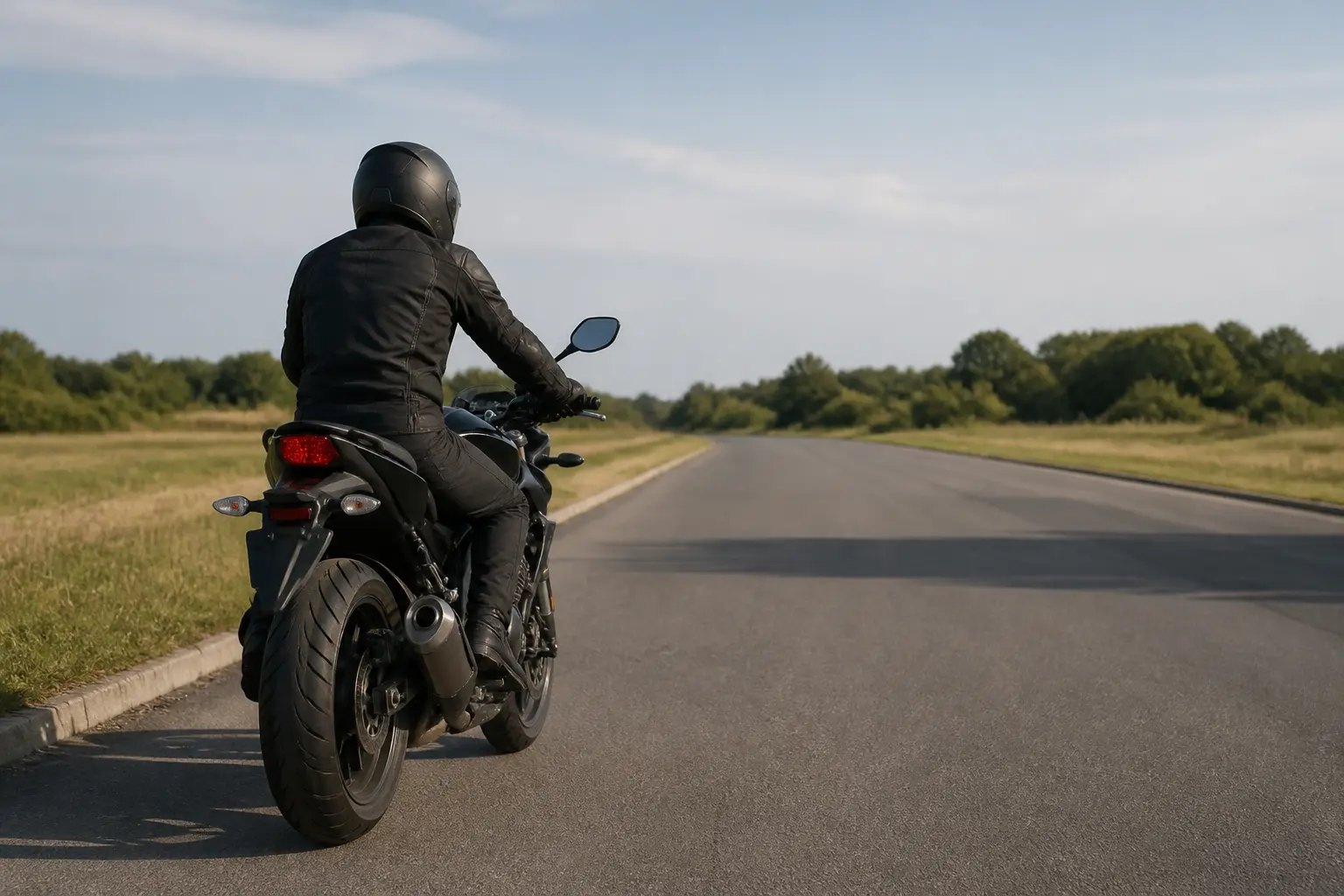
A satisfactory driveway screen is not a release to resume every kind of riding. Select a quiet, familiar, legal location with good visibility, plenty of space, and an easy way to stop or return. Avoid beginning with a busy commute, highway merge, passenger ride, group departure, poor weather, contaminated pavement, or a route that requires immediate complex decisions.
Wear the same protective equipment you intend to use on a normal ride. Before moving, make sure gloves, jacket cuffs, footwear, luggage, and any accessory do not interfere with levers, pedals, grips, or your ability to put a foot down securely.
Start the motorcycle according to the manual. Keep the initial movement slow and short. In a controlled environment, pay attention to whether throttle response, clutch engagement, braking, steering, gear selection, and general balance feel predictable. Leave a generous buffer around the motorcycle and preserve room to stop; the MSF emphasizes maintaining options for escape rather than allowing hazards to close in.
The purpose of this first movement is observation, not endurance. Stop if you notice a warning indicator, new vibration, scraping, smell, fluid appearance, control stiffness, pulling sensation, or any behavior you cannot confidently explain. Do not continue because the route is short or because the issue appeared only once. An intermittent symptom is still information.
Once the motorcycle has behaved normally in a low-demand setting, you can gradually return to regular riding. That progression gives both the machine and rider time to re-establish familiar behavior without the pressure of traffic.
When Inspection Ends and Qualified Service Begins
A visual review can reveal a concern, but it cannot establish the cause or correct it. Arrange qualified service when you find a throttle that does not return properly, an unfamiliar brake-control result, a suspected brake-fluid leak, a damaged or poorly routed cable or hose, tire or wheel damage, a failed required light, or a stand issue.
Professional assessment is also the sensible choice when you simply do not know how your model is meant to behave. Bring useful context: how long the motorcycle was stored, known storage conditions, work done before or during storage, photos, and a clear description of what changed. That record is more valuable than a vague report that something “felt off.”
Avoid turning uncertainty into an unsupervised repair project. Random tightening, unapproved sprays, forced control movement, and bypassed safety systems can introduce risks that were not there at the start. Inspection is a decision-making tool. Repair requires accurate model information, appropriate parts and tools, and suitable competence.
How Vojo Helps
Create a dated post-storage entry before you ride. In the Motorcycle Maintenance Tracker, add a checklist record named “Controls return-to-service check,” then log the storage dates, manual sections reviewed, tire-pressure result, light check, throttle return observation, brake-control observation, and photos of any concern. If a no-ride item appears, mark the motorcycle as on hold rather than recording a completed ride. After qualified service, add the service outcome and record the result of the controlled test ride in the same timeline.
That workflow keeps the original observation, the service decision, and the return-to-riding result together. It can help you spot recurring seasonal concerns while leaving diagnosis and repair decisions to the manufacturer guidance and qualified professionals.
Download Vojo on the App Store
Frequently Asked Questions
Is starting the motorcycle enough after storage?
No. Starting indicates only that the motorcycle can run at that moment. It does not confirm throttle return, brake-control condition, clutch operation, cable routing, lights, tires, or stand readiness. Complete a stationary inspection first and use a controlled test before normal traffic.
What should I do if the throttle does not return normally?
Keep the motorcycle parked. A sticking, rough, or inconsistent throttle is a direct control concern. Document what you found and arrange model-specific assessment instead of riding to a shop or trying an improvised adjustment.
Should I check cable routing with the handlebars turned?
Yes, as a visual screen with the motorcycle stationary and engine off. Slowly move the bars through their normal range and watch accessible cables, hoses, and wiring for tension, pinching, rubbing, or a change in control behavior. Stop if anything appears abnormal.
Can I ride if a brake lever or pedal feels different but still works?
A change from your motorcycle’s normal operation is sufficient reason to pause. Do not use a ride to determine whether unfamiliar brake feel is acceptable. Consult the owner’s manual and seek qualified assistance if the cause is unclear.
How long should the first ride after storage be?
There is no universal distance. Begin in a quiet, low-demand setting where you can stop easily and return without pressure. The goal is to observe predictable behavior, not to complete a certain mileage.
Make the Conservative Decision
The best result is not merely a motorcycle that starts. It is a motorcycle whose controls, tires, lights, stands, and visible components give you no reason to doubt a cautious first ride. Treat unfamiliar control feel as useful evidence, not an inconvenience to ignore.
If the parked inspection is clear, begin with a low-pressure test away from traffic. If anything is uncertain—especially throttle return, brake operation, cable or hose condition, tire integrity, required lighting, or stand function—leave the motorcycle parked and seek model-specific guidance. A few careful minutes before departure are easier than managing a control problem at an intersection.
Quick answers
Frequently asked questions
Is starting the motorcycle enough after storage?
No. Starting confirms only limited engine-related function. It does not confirm throttle return, brakes, clutch operation, cable routing, lighting, tires, or stand readiness.
What should I do if the throttle does not return normally?
Keep the motorcycle parked. Document the symptom and arrange model-specific assessment rather than riding it to a shop or making an improvised adjustment.
Should I check cable routing with the handlebars turned?
Yes. With the engine off, slowly move the bars through their normal range while observing accessible cables, hoses, and wiring for pinching, tension, rubbing, or a change in control behavior.
Can I ride if a brake lever or pedal feels different but still works?
Do not use a ride to decide whether unfamiliar brake feel is acceptable. Consult the owner’s manual and seek qualified assistance if you cannot clearly account for the change.
How long should the first ride after storage be?
There is no universal distance. Start in a quiet, low-demand location where you can stop easily. The objective is predictable behavior, not reaching a mileage target.