
Motorcycle Chain Tight Spots: Why Uneven Slack Matters More Than a Single Measurement
Motorcycle chain tight spots can make one slack measurement misleading. Learn how to inspect uneven slack, sprocket teeth, and no-ride warning signs safely.

Fact-checked against cited official documentation
Reviewed against Checked against MSF T-CLOCS chain tension and sprocket guidance plus MSF owner-manual-first routine inspection guidance..
Last updated November 5, 2026
A motorcycle chain can appear correctly adjusted at one point and still be too tight somewhere else. That is the central problem with checking slack at only one convenient position: the chain and sprockets do not necessarily wear evenly, and the rear wheel may not leave every part of the chain under the same tension.
A tight section does not automatically prove that the chain is unusable. It does mean that a single measurement is incomplete. Before deciding whether this is a routine adjustment concern or a reason to stop riding, you need to compare several positions, look for damaged or reluctant links, inspect the sprocket teeth, and consider what the owner’s manual specifies for your motorcycle.
This guide explains how to think through motorcycle chain tight spots and uneven slack without guessing at a universal adjustment number. Exact slack values, measurement methods, permitted wear limits, and adjustment procedures are model-specific. Use the motorcycle manufacturer’s service information first; this article is a condition-screening guide, not a substitute for that information or for a qualified inspection.
Why one chain-slack measurement can mislead
Chain slack is the amount of movement available when the chain is checked at a particular location. That location matters. If a chain has a tighter section, measuring only there can make it appear too tight. Measuring only at a looser section can make it appear acceptable—or even too loose—while another section has little movement left.
The Motorcycle Safety Foundation’s T-CLOCS inspection material specifically directs riders to check chain or belt tension at the tightest point and to inspect the sprocket teeth. That is useful because it turns “check the slack” into a search for the most restrictive condition, not a one-position ritual. See the MSF T-CLOCS pre-ride inspection checklist for the broader inspection context.
Uneven slack can develop for several different reasons:
- The chain may have stretched or worn unevenly over its service life.
- Individual links may not articulate freely, leaving a section that does not settle naturally.
- Sprocket teeth may be worn in a way that changes how the chain seats.
- The wheel position or measurement method may be inconsistent.
- Dirt, corrosion, contamination, or neglected lubrication may make the chain’s behavior less uniform.
- A previous adjustment may have been made against a loose section rather than the tightest section.
These possibilities can look similar from the saddle but do not have the same remedy. A rider’s job at home is to identify the pattern and its urgency. The job of an approved repairer is to determine whether components remain serviceable and whether adjustment, replacement, or a deeper drivetrain inspection is appropriate.
What a chain tight spot feels and looks like
A tight spot is not simply “the chain feels firm.” A healthy assessment compares the chain’s movement at multiple positions around the rear wheel. The important observation is whether slack changes substantially as the chain is moved through its rotation, and whether one section becomes notably restrictive.
A chain can also show a tight spot through behavior rather than a measurement. While the motorcycle is stationary and safely supported according to the manufacturer’s guidance, observe whether the chain settles consistently, whether links remain kinked instead of aligning, or whether a section seems reluctant to move through the sprocket. Do not put fingers near moving chain and sprocket components, and do not run the engine to rotate the wheel for this inspection.
A few distinctions help prevent overdiagnosis:
| Observation | What it may suggest | Conservative next step |
|---|---|---|
| Slack appears similar at several positions | The chain may be comparatively uniform, assuming the measurement method is correct | Compare the result with the owner’s manual and complete the wider pre-ride check |
| Slack changes noticeably around the wheel | Uneven wear, a tight section, measurement inconsistency, or sprocket-related wear | Recheck methodically at the tightest point; arrange inspection if the difference is clear or severe |
| One or more links remain kinked or do not articulate normally | A stiff, damaged, contaminated, or corroded link may be present | Do not treat a simple adjustment as the answer; seek qualified inspection |
| Sprocket teeth look hooked, pointed, or irregular | Possible sprocket wear or poor chain engagement | Stop relying on a slack reading alone and obtain a drivetrain assessment |
| Chain has visible damage, missing rollers, severe corrosion, or a separated area | A potentially unsafe drivetrain condition | Do not ride; arrange professional help |
| The chain is tight throughout or has almost no movement | Incorrect adjustment, incorrect measurement, or a serious condition may be involved | Do not force an adjustment by guesswork; use model-specific service information or a qualified technician |
The table is a screening aid, not a pass/fail wear chart. The manufacturer may provide specific limits, inspection points, and replacement criteria for your motorcycle. If the manual and a general checklist differ in detail, the model-specific documentation governs.
A repeatable inspection approach
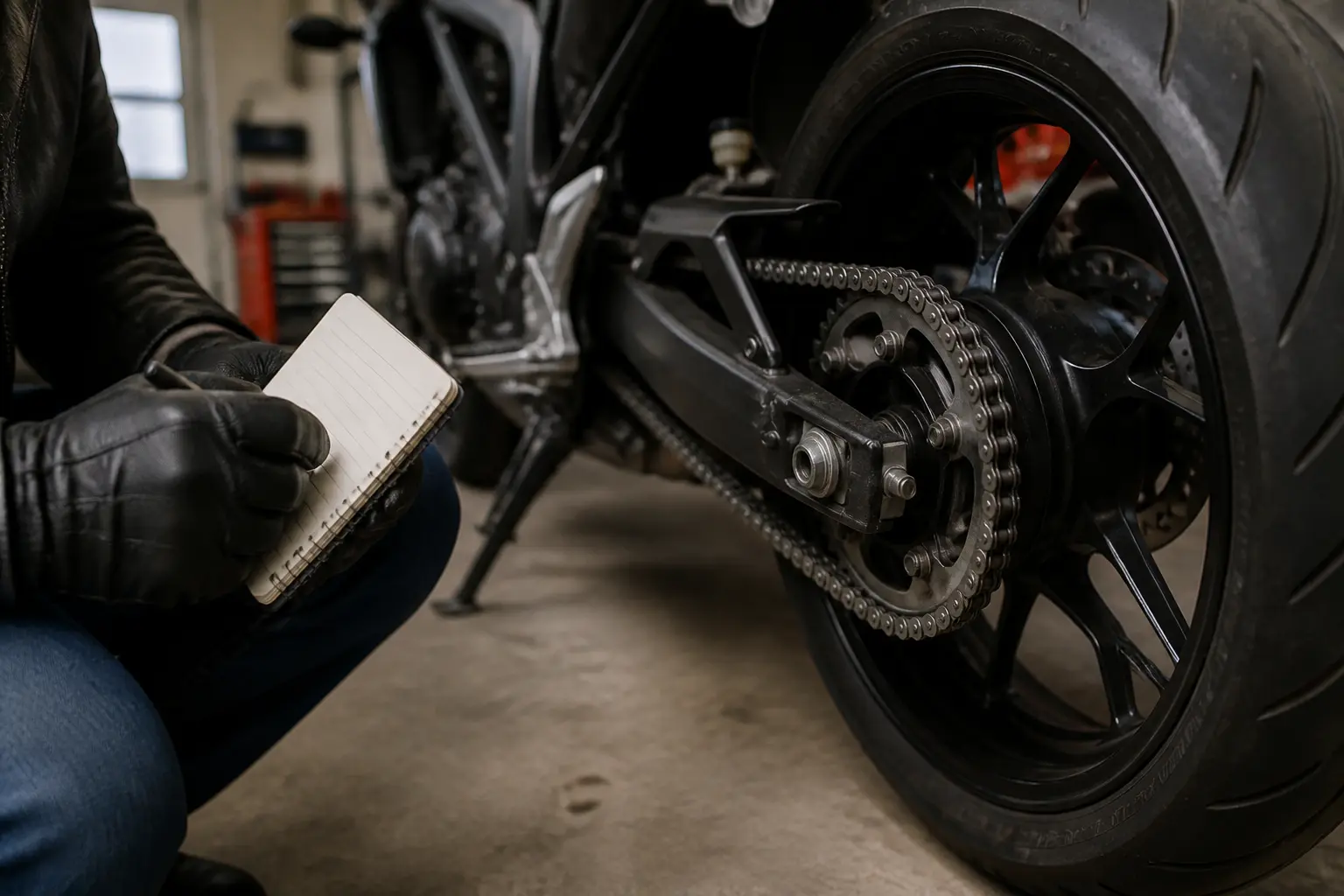
The purpose of a repeatable inspection is to separate a real pattern from a measuring error. Start with the motorcycle secure, switched off, and supported in the manner specified by the manufacturer. Keep loose clothing, hands, and tools away from the chain path. If you are uncertain whether your stand or support is safe, do not improvise; ask a dealer or qualified technician.
1. Establish the correct reference
Find the chain-slack inspection instructions in the owner’s manual or official service information. Note where the manufacturer says to measure, how the motorcycle should be positioned, and whether there are model-specific cautions. Do not substitute a number from another motorcycle, even if the machines look similar.
The measurement may depend on whether the motorcycle is unloaded, whether it is on a stand, and where the measurement is taken. Those details are not interchangeable. A correct number measured under the wrong conditions can still lead to a bad decision.
2. Check more than one chain position
Move the rear wheel only by a safe, manual method and inspect the chain at several points around its travel. The goal is not to collect a perfect laboratory measurement. It is to identify whether the amount of movement changes and to locate the tightest point.
Use the same technique and reference point each time. If the chain looks different at each position, record that fact rather than averaging the readings. An average can conceal the condition that matters most.
3. Look at the links and rollers
Observe whether the links line up and move as a connected chain should. A kinked section, a link that does not settle, missing or visibly damaged rollers, heavy corrosion, or evidence of a damaged side plate should not be dismissed as ordinary slack variation.
Do not try to free a suspect link with force, pry against it, or invent a roadside repair. A chain is a load-bearing drivetrain component. If its condition is unclear, documentation and professional inspection are safer than experimentation.
4. Inspect the sprocket teeth
Sprocket teeth are part of the same wear story. Look for a profile that is visibly hooked, pointed, uneven, or otherwise unlike the surrounding teeth. Compare what you see around the sprocket rather than focusing on one tooth.
The MSF T-CLOCS checklist includes sprocket-tooth inspection alongside chain or belt tension. That pairing matters: a chain can have a plausible slack reading while worn teeth still indicate a drivetrain problem. Conversely, a visual impression alone does not establish a replacement limit. Use the manufacturer’s criteria or a qualified inspection for that decision.
5. Check for related clues
A chain concern deserves context. Note unusual drivetrain noise, visible contamination, corrosion, evidence of chain contact where it should not occur, or a recent event that may have changed the motorcycle’s condition. Also consider whether the chain has been adjusted recently, whether the motorcycle has been stored, and whether the concern appeared suddenly or gradually.
Do not assume every noise comes from the chain. Brakes, wheel components, engine accessories, and other drivetrain parts can produce sounds that overlap. If the source is uncertain, treat that uncertainty as a reason to inspect rather than as evidence that the chain is at fault.
How to tell adjustment uncertainty from a condition concern
An adjustment question usually starts with a fairly uniform chain whose measured slack does not match the manufacturer’s specification. A condition concern is more likely when the chain changes significantly around the wheel, contains stiff or damaged links, or is paired with questionable sprocket teeth.
That distinction is not absolute. A chain can be both incorrectly adjusted and worn. It can also look acceptable while an underlying issue remains hidden. The safer decision is based on the worst credible finding, not the most reassuring measurement.
Consider these practical scenarios:
The chain is uniformly outside the specified range. If the chain otherwise appears sound, this may be a model-specific adjustment or service issue. Follow the manual or arrange service. Do not use a generic internet number.
The chain is loose in one area and tight in another. This is not a good candidate for “tighten until it looks right.” Recheck the measurement at the tightest point using the manufacturer’s method. If the variation remains clear, have the chain and sprockets assessed before normal riding.
The chain has tight sections plus hooked teeth. Treat the combination as more serious than either observation alone. A new slack reading cannot establish that the drivetrain is safe. Arrange a professional inspection and avoid riding until the condition is resolved.
The chain has one visibly stiff link but otherwise appears clean. Do not assume cleaning or lubrication will restore safe function, and do not force the link to move. Document the location and ask a qualified technician to evaluate it.
The chain was recently adjusted and now feels tight. Stop and verify the model-specific method and reference conditions. A recent adjustment is not proof that the result is correct. If the chain binds, has very little movement, or varies markedly around the wheel, do not continue riding to “see if it settles.”
Manufacturer-first decisions about riding

The Motorcycle Safety Foundation describes routine inspection as a rider habit, not merely a mileage event. Its general riding guidance reinforces following the owner’s manual and maintaining the motorcycle as part of responsible riding. Read the MSF You and Your Motorcycle riding tips alongside your motorcycle’s own documentation.
Use a conservative decision process:
- Is the concern only a measurement mismatch, or is there visible damage? Visible damage, severe corrosion, missing components, kinked links, or questionable sprocket teeth raise the urgency.
- Does the condition change around the wheel? Significant variation means one reading cannot represent the chain.
- Can you identify the manufacturer’s specification and inspection method? If not, do not guess at a number or adjustment.
- Would a failure create an immediate loss of drivetrain control? A chain problem can affect propulsion and can damage nearby components if it fails. Uncertainty deserves a professional opinion.
- Has the motorcycle been inspected after a recent adjustment, impact, storage period, or unusual noise? A changed condition warrants a fresh check rather than reliance on an old record.
Do not ride when the chain is visibly damaged, partially separated, missing rollers, severely corroded, binding, or accompanied by sprocket damage that you cannot confidently classify as serviceable. Also avoid riding when the chain is so tight that it has little or no movement, or when you cannot establish that the motorcycle meets the manufacturer’s required condition. Arrange transport or qualified assistance instead.
A dealer is particularly appropriate when the motorcycle is under warranty, uses a less familiar drivetrain design, has a documented service dispute, or requires model-specific inspection measurements. An independent technician with appropriate motorcycle experience may also be suitable. The key is qualified evaluation, not the label on the workshop.
What not to do with uneven chain slack
Several tempting shortcuts make this issue harder to diagnose:
- Do not measure once and declare the chain good. The tightest point is the meaningful reference when variation exists.
- Do not use a specification from a different model. Similar-looking motorcycles can have different measurement conditions and limits.
- Do not tighten the chain until all slack disappears. A chain needs the manufacturer-specified operating movement, and guesswork can create a more serious problem.
- Do not assume lubricant cures a stiff or damaged link. Lubrication and cleaning are maintenance tasks, not proof that a damaged component is serviceable.
- Do not replace only the part that looks easiest without an assessment. Chain and sprocket wear can be related; component decisions belong to the manufacturer’s criteria or a technician’s inspection.
- Do not rotate the wheel with the engine running for convenience. It adds avoidable risk during a close inspection.
- Do not let a quiet test ride substitute for inspection. A drivetrain can be unsafe even if it does not make an obvious noise on a short ride.
For broader ownership planning, use the Motorcycle Maintenance Guide to place chain inspection alongside the rest of the motorcycle’s scheduled and condition-based checks.
Chain tight-spot inspection checklist
Use this checklist when the chain slack seems inconsistent. It is designed to help you decide what to document and when to stop, not to replace the owner’s manual.
- Locate the manufacturer’s chain inspection and slack instructions.
- Confirm the motorcycle is switched off and safely supported as specified.
- Keep hands, clothing, and tools clear of the chain and sprockets.
- Use the manufacturer’s measurement location and conditions.
- Inspect the chain at multiple positions around the rear wheel.
- Identify and record the tightest section rather than averaging readings.
- Look for kinked, stiff, damaged, missing, or heavily corroded links and rollers.
- Inspect sprocket teeth for hooked, pointed, or irregular profiles.
- Note unusual noise, recent adjustment, storage, impact, or a sudden change.
- Compare findings with model-specific service information.
- Stop riding if there is visible damage, severe binding, or uncertainty about safety.
- Arrange a qualified inspection when variation remains significant or components look worn.
- Record the finding and service decision for the next inspection.
The final checkbox is easy to overlook. A record of where the tight spot occurred, what the sprocket looked like, and what action followed can help a technician see whether the condition is stable, worsening, or linked to recent work.
How Vojo Helps
A practical Vojo workflow is to create a drivetrain inspection entry as soon as you notice uneven slack, attach a short note identifying the tightest chain position and any sprocket-tooth concern, then set a follow-up task for a dealer or qualified technician. After service, save the technician’s finding and the manufacturer specification used so the next inspection is based on the motorcycle’s actual history rather than memory.
You can organize that record in the Motorcycle Maintenance Tracker, then review the timeline before a trip or after a new noise appears. This keeps a one-time tight-spot observation connected to the motorcycle’s broader maintenance history without turning a generic measurement into a guessed repair plan.
Quick answers
Frequently asked questions
What does a tight spot on a motorcycle chain mean?
It means the chain has a section with noticeably less movement than other sections as the rear wheel is rotated manually. It may reflect uneven wear, a stiff link, sprocket wear, contamination, or an inconsistent measurement. Recheck using the manufacturer’s method and seek inspection if the variation is clear.
Can I adjust a motorcycle chain if the slack is uneven?
Do not make a generic adjustment based on one reading. First identify the tightest point and compare the chain, links, and sprocket teeth with the owner’s manual. Significant variation, binding, or visible damage deserves qualified inspection rather than guesswork.
How much motorcycle chain slack is correct?
There is no universal number. The correct slack and measurement conditions are model-specific and should come from the motorcycle manufacturer’s owner’s or service manual. A value from another motorcycle may be unsafe to apply.
Are hooked sprocket teeth a reason to stop riding?
Hooked, pointed, or irregular teeth are warning signs that should not be judged by chain slack alone. Stop relying on a single measurement and arrange a qualified drivetrain assessment, especially if the chain also has tight spots, stiff links, or unusual noise.
Can cleaning or lubrication fix a chain tight spot?
It may improve the appearance or movement of a dirty chain, but it does not prove that a stiff, damaged, corroded, or worn chain is serviceable. Do not use maintenance products as a substitute for inspection when slack varies significantly or damage is visible.