
Motorcycle Blind Intersections: A Two-Stage Approach to Seeing and Being Seen
Use a two-stage motorcycle blind-intersection plan to choose lane position, reveal hidden traffic carefully, retain an escape path, and stay predictable.
Fact-checked against cited official documentation
Reviewed against Fact-checked against MSF guidance on intersection hazards, lane placement, staged blind-intersection stops, space management, escape options, and turning conflicts..
Last updated October 23, 2026
Blind intersections create a problem that cannot be solved by simply looking harder. A hedge, wall, parked van, building corner, hill crest, or large vehicle can prevent you from seeing cross traffic until you are close to its path. At the same time, another road user may have only a brief opportunity to notice your motorcycle.
The practical challenge is deciding how to gather more information without accidentally committing to the intersection. That is where a two-stage approach helps:
- Use a first stopping position to assess the intersection while retaining control and space.
- If the view remains inadequate, make a separate, deliberate advance solely to uncover more of the sightline.
The second stage is not an instruction to go. It is a way to replace guesswork with a better view while keeping a further stop available. The Motorcycle Safety Foundation (MSF) advises riders to search for traffic that could cross their route, use lane placement thoughtfully, maintain time and space, and consider alternatives before a conflict develops. If You Ride A Motorcycle provides that broader riding framework.
This article is about the rider question behind a motorcycle blind intersection lane position escape path: where should you place the bike, when should you pause again, and how can you preserve a response option if a hidden vehicle appears?
Start with manufacturer-first priorities. Follow your motorcycle manufacturer’s instructions for operating the motorcycle, braking system warnings, tire condition, loading, lighting, and any rider-assistance features. Those instructions apply to your specific machine. Then use lawful road positioning, local traffic rules, a properly maintained motorcycle, and skills that match your training. If visibility, surface condition, traffic behavior, or your own readiness does not support a safe decision, waiting is a sound outcome.
Motorcycle Blind Intersection Lane Position and Escape Path Basics
A blind intersection is not defined only by a stop sign or a side street. It is any point where road users’ paths may meet while your view is materially blocked or incomplete. That may include an unmarked rural junction, a driveway beside a tall fence, a city corner obscured by delivery vehicles, or an intersection beyond a rise.
The key distinction is between what is visible and what is clear. A roadway can look empty from your current location while still concealing a vehicle, cyclist, pedestrian, or turning movement. Treat an incomplete view as incomplete information—not as evidence that the conflict area is open.
At a blind intersection, manage four connected jobs:
| Decision area | Question to ask | Conservative rider objective |
|---|---|---|
| Sightline | What remains hidden from this location? | Identify the obstruction and avoid treating a partial view as a full scan. |
| Lane position | Does this place improve my view or make me easier to detect? | Use a lawful position that adds useful visibility without reducing control. |
| Commitment | Can I stop again before entering another vehicle’s path? | Keep the next movement slow enough and short enough to reassess. |
| Escape path | Where is usable space if the expected route closes? | Preserve room to stop or move only into space that is confirmed open and appropriate. |
The MSF’s operator material describes approaching blind intersections with visibility in mind and, where needed, stopping in stages rather than treating one stop as the final decision. It also emphasizes covering the controls, retaining space, and anticipating an oncoming vehicle that turns across a rider’s route. See the Motorcycle Operator Manual With Supplementary Info.
This does not create a universal lane position. There is no always-left, always-center, or always-right answer. The useful position changes with the corner geometry, traffic direction, parked vehicles, road surface, sunlight, markings, and the space around your motorcycle.
Why One Stop May Not Be Enough
A first stop is valuable because it interrupts forward momentum and creates time to inspect the scene. But it may still be behind the exact obstruction that hides cross traffic. From that first position, you might see only a narrow slice of the cross street.
The common mistake is mentally converting “I stopped and looked” into “I have permission to proceed.” Those are separate decisions. A stop proves that you paused; it does not prove that the hidden approach is empty.
A two-stage method separates the tasks:
- Stage one: arrive under control, choose the best practical initial observation point, and scan what can be seen.
- Stage two: if a blind area remains, move only enough to improve the view, then be ready to pause once more.
That separation reduces a subtle form of pressure. Without it, a rider may feel that stopping has already started the crossing process and that remaining stopped inconveniences traffic behind. In reality, the first pause should make a later decision calmer and more deliberate.
The MSF identifies intersections as particularly important conflict locations because different road users’ travel paths come together there. Its Intersection: Sharing the Road resource is a useful reminder that your prediction must account for others who may be crossing, turning, entering, or misreading the situation.
A better internal question is: What new information would I gain by moving forward, and can I obtain it without giving away my stopping margin? If the movement reveals nothing meaningful, further creeping may simply place you closer to danger. In that case, wait for traffic to pass, let the view change, or reconsider the route.
Stage One: Choose a First Stop With Options
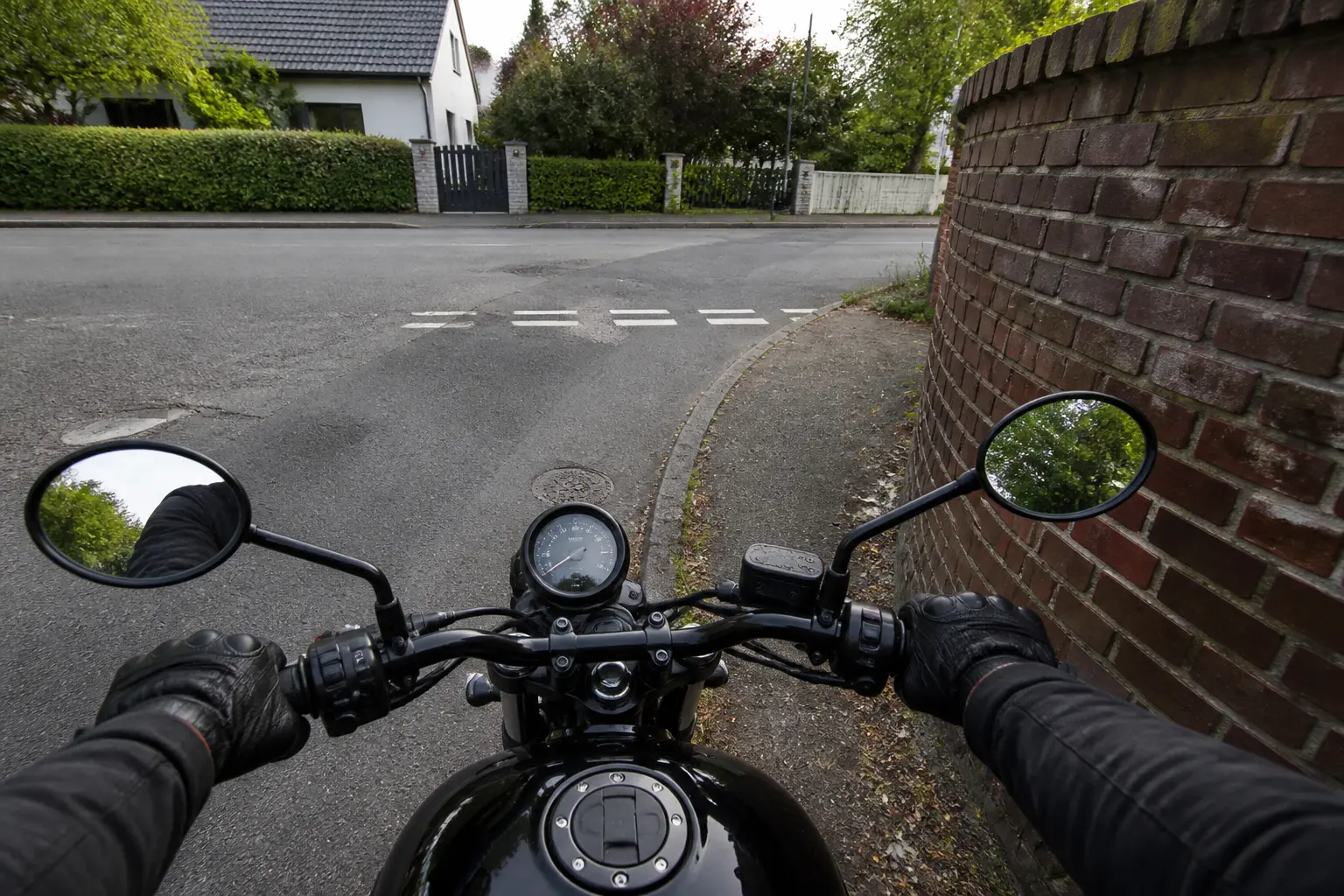
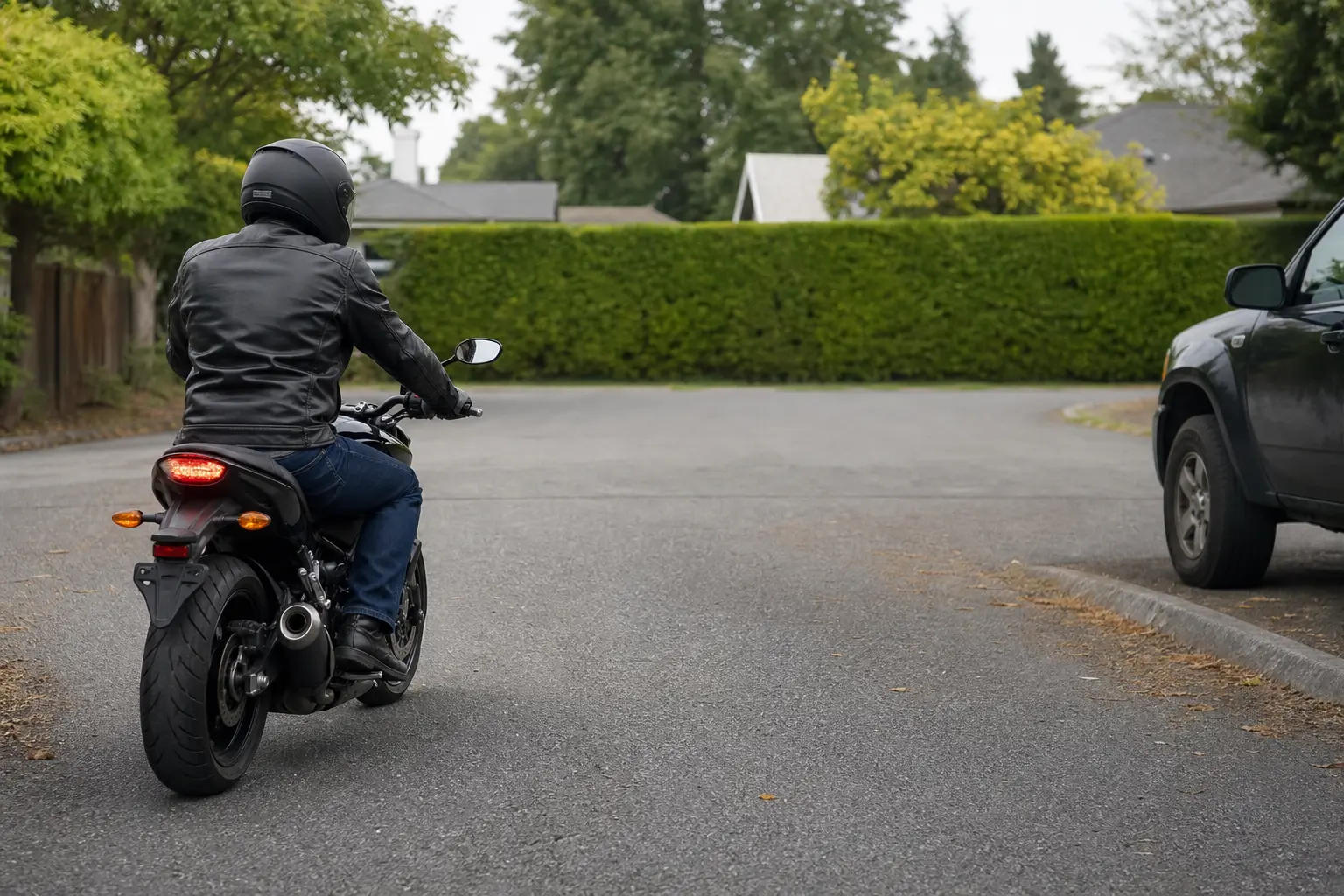
Approach early enough that the stopping decision is unhurried. The appropriate approach speed depends on the available view, surface, traffic, weather, road layout, and the motorcycle’s condition. Do not let a close-following driver persuade you to enter a sightline-limited area too quickly. Their impatience does not improve the intersection.
Your first stop should balance three goals: motorcycle control, useful visibility, and available space. It should normally be before the location where your route would intersect with cross traffic. It should also be in a lawful place where you can stabilize the motorcycle and continue observing.
Before stopping, notice what is shaping the scene:
- Which object is blocking the view, and which direction does it hide?
- Which road users could emerge from that hidden section?
- Is there an opposing vehicle that could turn across your intended route?
- Are parked vehicles concealing a driveway, side street, pedestrian, or bicycle?
- Is the surface near the stopping area affected by debris, water, painted markings, uneven pavement, or other distractions?
- Is there space ahead to remain stopped if the intersection changes?
The value of the first stop is not just that the motorcycle is stationary. It gives you a stable point from which to compare movement. A distant vehicle can become visible. A driver waiting to turn may edge forward. A gap in traffic may prompt someone to enter unexpectedly. Continue looking rather than locking onto the first vehicle you notice.
Keep the first stop separate from the crossing decision
A clear view in one direction does not resolve the other direction. Likewise, seeing an apparently open gap does not answer whether another road user is masked by the obstruction. Re-scan the whole conflict area, including likely turning paths.
If the view is adequate and the route is genuinely open, you can make a normal, controlled decision to proceed. If it is not adequate, acknowledge that fact. Do not turn uncertainty into action merely because you have already stopped once.
Stage Two: Move Forward Only to Reveal Information
When the initial position leaves a meaningful blind area, the next movement has one purpose: improve the sightline. It is not a launch, a claim on the intersection, or a promise that you will complete the crossing.
Make the advance controlled and predictable. Keep searching while you move, and retain the ability to stop again before entering the cross-traffic path. The exact amount of movement is not something a general article can prescribe; it depends on the intersection’s geometry and the space actually available.
A useful stage-two thought process is:
- What will become visible if I move slightly forward?
- Where will my next stopping point be if traffic appears?
- Have I left enough room to make that stop?
- What other conflict could appear as my position changes?
Pause whenever the view changes substantially. New visual information deserves a fresh decision, not a continuation of the prior one. A car, bicycle, or pedestrian may become visible at the same moment your front wheel reaches a more exposed position.
Avoid abrupt forward movements designed to get through the opening quickly. Sudden actions can confuse other road users and reduce your own time to recognize their response. A steady, lawful, readable movement is generally easier for others to interpret, but never assume they have interpreted it correctly.
If advancing does not deliver an adequate view, stop. The correct answer may be to wait longer, allow a larger vehicle to clear the sightline, select another route, or abandon the turn. A rider who declines a bad information situation is not indecisive; they are preserving safety margin.
Lane Position: Use It as a Visibility Tool, Not a Habit
At blind intersections, lane position has two related purposes: it can affect what you can see, and it can affect whether another person has a better opportunity to notice you. Neither purpose overrides legal lane use, surface condition, or the need for space.
Instead of picking a lane track by habit, assess three questions.
Does this position uncover the relevant approach?
A small change within the lane can sometimes reveal more around a parked vehicle or corner. But a position only has value if it exposes useful information. Moving toward an edge without a clear reason may put the motorcycle closer to gravel, a curb, a parked door zone, poor pavement, or another hazard.
Does this position reduce the chance of being hidden?
A motorcycle can disappear in the visual background created by a larger vehicle, sign, building edge, or traffic queue. Thoughtful positioning may make your approach easier to notice. Still, conspicuity is not a guarantee. A driver can look in your direction and fail to judge your distance, speed, or presence correctly.
Use lighting and protective equipment according to your manufacturer’s instructions and applicable law, but do not substitute equipment for a traffic plan. Continue to control your approach and preserve room for another person’s error.
Does this position preserve a response option?
A position can improve a view but remove space. For example, placing the motorcycle tightly against a curb or fixed object may limit the options available if the scene changes. The preferred position is often the one that offers a reasonable view while still leaving room to stop and assess.
Do not enter a prohibited area, opposing traffic path, sidewalk, or unverified shoulder simply to improve sightlines. If lawful lane position does not provide enough information, the limitation is a reason to wait, not a reason to improvise.
Build an Escape Path Before the Conflict Develops
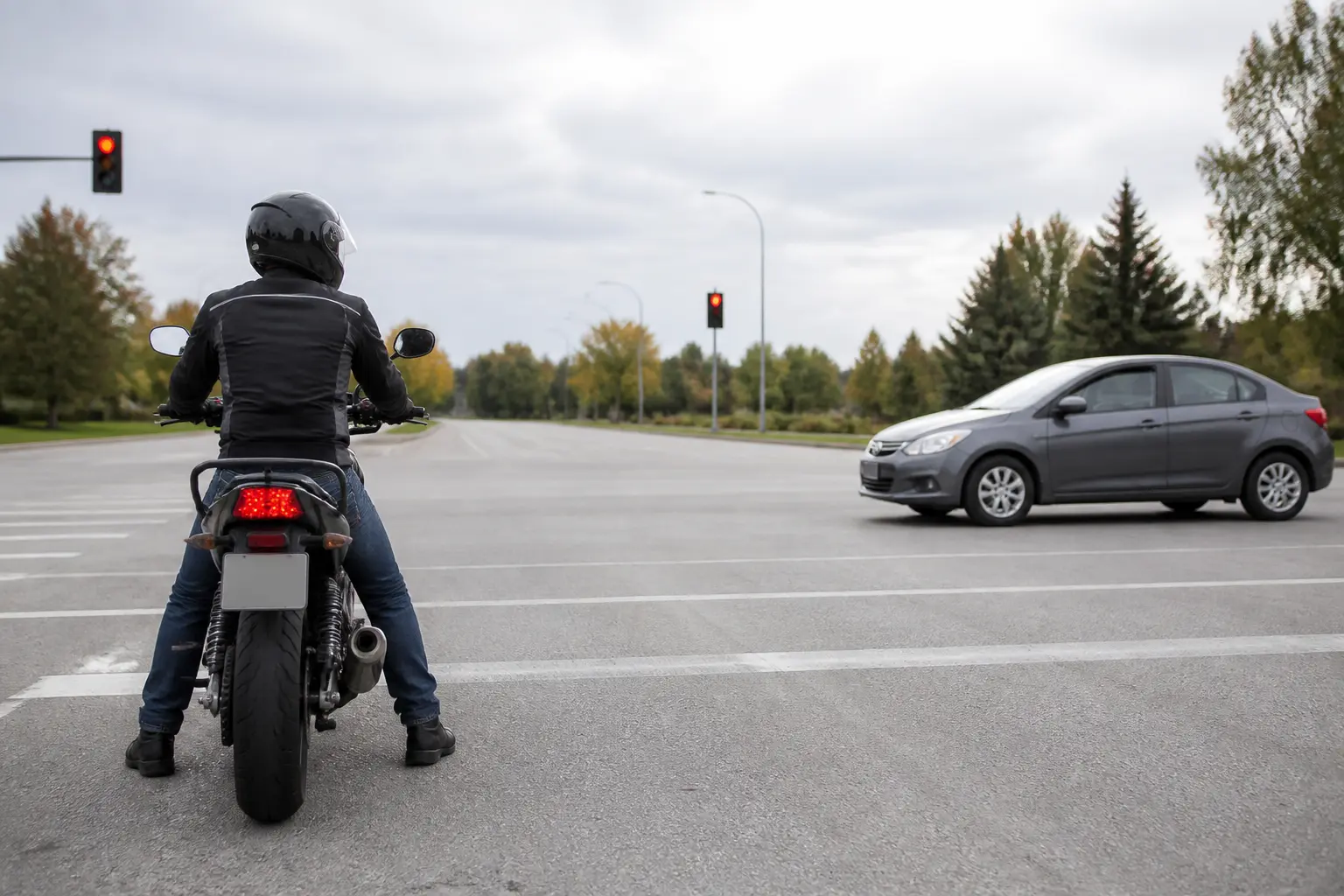
An escape path is not a planned swerve and not a guarantee that every collision can be avoided. It is an ongoing awareness of space that might remain usable if the traffic picture changes.
Begin with the simplest option: space to stop. At a blind intersection, stopping room is often more realistic and more controllable than an abrupt directional change. Ask whether the open pavement ahead remains available, whether your current approach leaves margin, and whether another road user could occupy that space.
Then check the areas beside your intended route. Do not presume that they are usable. An adjacent lane may be occupied, a shoulder may be unstable or restricted, and a sidewalk is not a routine motorcycle refuge. A possible escape route only counts if it is open, lawful, appropriate, and still being monitored.
Keep the escape-path concept modest. You are not trying to invent a dramatic maneuver. You are trying to avoid entering a position where your only imagined solution is a last-second move into unknown space.
The MSF’s rider guidance encourages maintaining time and space and considering escape routes. Applied at a blind intersection, that means reducing commitment before the conflict becomes immediate. It also means revisiting your plan as traffic moves: the space that appeared open at the first stop may no longer be open several seconds later.
Expect the Vehicle That Turns Across Your Path
An opposing vehicle can present a particularly serious blind-intersection conflict. A driver may be waiting for traffic, watching a gap elsewhere, or preparing to turn across your route. The MSF operator manual specifically highlights the need to be ready for this possibility.
Do not rely on eye contact as proof of understanding. The driver may not see you, may look through you, or may have a different idea of who is going first. Instead, observe the vehicle’s location and behavior:
- Is it positioned for a turn?
- Is it rolling or edging forward?
- Has a gap opened in the traffic it is waiting for?
- Does its movement suggest that the driver may enter your route?
These are warning cues, not predictions. They should encourage patience and a lower level of commitment, not overconfidence in your ability to forecast another person’s decision.
If a vehicle begins to move across your route, prioritize staying out of its path. The best response depends on speed, available space, traffic, surface, and rider training. That is why the response option must be built earlier. Once the motorcycle is deeply committed to a blind crossing, choices become narrower.
Right-of-way is important for orderly road use, but it is not a physical shield. A rider can be legally entitled to proceed and still need to delay because another person’s movement makes proceeding unsafe.
Conditions That Make a Blind Intersection More Demanding
The same intersection can require a different plan from one day to the next. Add caution when visibility or traction is reduced, or when the behavior of other traffic becomes harder to interpret.
Pay special attention to:
- glare, low sun, darkness, rain, fog, or a visor that reduces contrast;
- tall vehicles that conceal smaller road users;
- road crests, dips, curves, and angled intersections;
- construction, temporary barriers, or new parked vehicles;
- heavy turning traffic and multiple driveways near the junction;
- pedestrians and cyclists emerging close to the obstruction;
- loose material, standing water, or irregular pavement around the stop area;
- passenger or luggage load that changes your comfort margin or concentration.
When several factors appear together, simplify the task. Slow earlier, increase the time available for observation, wait for a clearer traffic pattern, or choose a route with better visibility. Familiarity should not lower your attention: a familiar intersection can change overnight.
Blind Intersection Checklist
Use this checklist as a short mental reset before entering a limited-sightline junction:
- I identified the obstruction and the road users it could conceal.
- I approached slowly enough to stop before the cross-traffic conflict area.
- My first stop is lawful and gives me control, observation time, and space.
- I scanned for traffic crossing, entering, turning, or emerging from driveways.
- I did not mistake a partial sightline for a confirmed opening.
- If needed, I can make a small visibility advance and pause again.
- My lane position improves the current situation rather than following a fixed habit.
- I considered an opposing vehicle turning across my intended path.
- I know whether there is room to stop if the scene changes.
- I have not assumed that a shoulder, sidewalk, or neighboring lane is available.
- I am using signals and smooth movement, without assuming others understand them.
- I am prepared to wait or choose another route if the view remains poor.
For a broader pre-ride foundation, see the Motorcycle Maintenance Guide. A well-maintained motorcycle supports attention and control, but maintenance does not remove the need to manage a blocked view conservatively.
How Vojo Helps
Create a practical review loop in Vojo after riding a route with repeated blind intersections. In your ride notes, record the location in plain language and capture the condition that affected the decision, such as “morning glare at side-road exit,” “parked vehicles block right view,” or “wait for delivery traffic to clear.” Before your next ride, review those route notes and set a reminder to approach those locations with the two-stage plan already in mind.
Use the Vojo motorcycle ride app to keep observations associated with the ride rather than relying on memory after a long day. If a visibility issue relates to the motorcycle itself—such as a concern you need to discuss with a qualified technician—record that separately and follow manufacturer guidance. This keeps route judgment, motorcycle care, and future planning organized without encouraging in-motion app use.
Download Vojo on the App Store.
Final Takeaway
A blind intersection is an information problem before it becomes a movement problem. Make the first stop a purposeful observation point. If your view is still incomplete, use a second, controlled visibility advance rather than turning the first pause into an automatic go decision.
Choose lane position for the actual sightline and available space, not from a fixed rule. Keep an escape path in mind without assuming that every open-looking edge is usable. Expect turns across your route, remain readable to other traffic, and give yourself permission to wait whenever the intersection is still asking you to guess.
Safety disclaimer
Follow your motorcycle owner’s manual. If a procedure or specification is uncertain, consult a qualified mechanic before continuing.
Quick answers
Frequently asked questions
What is the two-stage approach at a motorcycle blind intersection?
First, stop at a controlled observation point that offers the best practical view without entering the conflict area. Second, if a blind section remains, advance only enough to improve the sightline while keeping another stop available. The second stage gathers information; it does not automatically mean proceed.
What lane position should I use at a blind intersection on a motorcycle?
Use a lawful position that improves the current view or reduces the chance of being obscured while maintaining control and usable space. There is no fixed lane track that works at every junction. Surface condition, road geometry, traffic, and the location of the obstruction all matter.
What counts as a motorcycle escape path at an intersection?
It is an open, appropriate, and lawful area you have identified as a possible response if the expected route becomes occupied. Often, the most useful option is room to stop. Do not assume an opposing lane, sidewalk, shoulder, or adjacent lane can safely be used.
Should I keep creeping forward until I can see everything?
No. Move forward only when doing so reveals useful information and you can still stop before entering cross traffic. If the view does not improve enough, or the next stopping point is uncertain, wait and reassess rather than continuing to creep into the conflict area.
How should I handle a vehicle that might turn across my path?
Treat its position and movement as reasons to reduce commitment and retain space. Do not depend on eye contact or assume the driver has recognized your motorcycle. Be prepared to avoid entering its path, using the room and time you preserved before the conflict developed.