
How to Transport a Motorcycle in a Truck or Trailer: Why Tie-Down Points Must Be Manual-First
Learn how to transport a motorcycle in a truck or trailer by matching the ramp, chock, straps, anchors, vehicle, and manual-approved tie-down points.
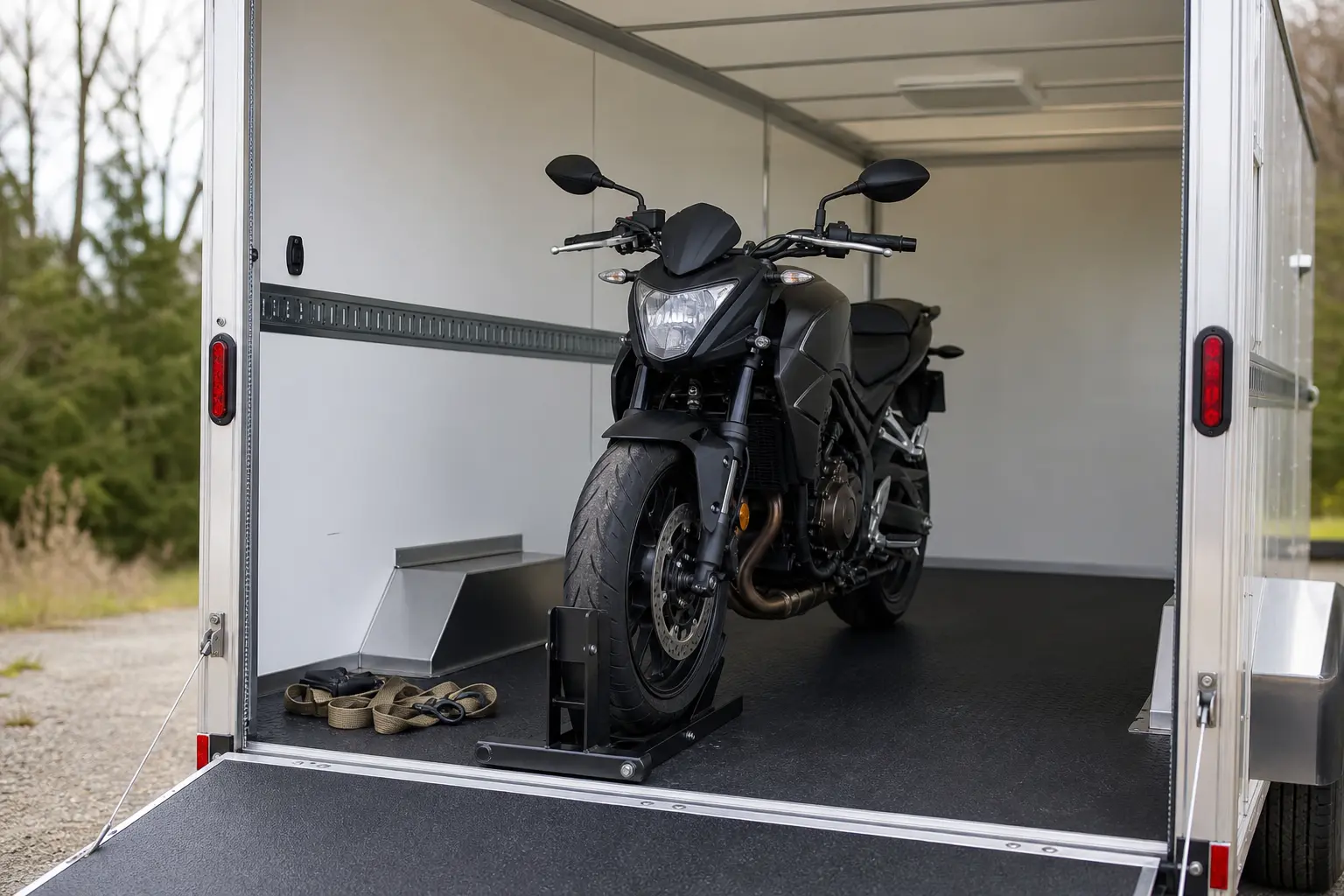
Fact-checked against cited official documentation
Reviewed against Fact-checked against Harley-Davidson’s official truck-loading article and wheel-chock instructions for manual-first restraint guidance, ramp security, chock fit, vehicle suitability, and final transport checks..
Last updated October 17, 2026
How to tie down a motorcycle in a truck or trailer: start with compatibility
The practical question behind how to tie down a motorcycle in a truck or trailer is not simply, “Where do the straps go?” It is, “Can this motorcycle, this loading route, this restraint equipment, and this vehicle work together without asking an unapproved part to carry a transport load?”
That distinction matters because motorcycles do not share one universal set of safe attachment locations. The visible parts of two motorcycles may look broadly similar while their frames, bodywork, suspension layouts, luggage mounts, controls, stands, and clearance needs differ substantially. A strap method that appears to work on one machine is not proof that it is appropriate for yours.
Start with the exact operator’s manual for the motorcycle. It is the document that can identify transport-specific settings, stand instructions, cautions, and any approved or prohibited restraint locations for that model. Harley-Davidson’s truck-loading guidance likewise begins by directing riders to review the motorcycle manual, including any model-specific transport requirements. (harley-davidson.com)
This is why the safest useful answer is manual-first rather than “use this one strap recipe.” The manual establishes what the motorcycle can accept. The ramp, wheel chock, straps, truck or trailer anchors, and towing arrangement must then be chosen around those limits.
Transport also deserves a place in your broader Motorcycle Maintenance Guide. It is not maintenance in the usual sense, but loading and hauling can affect finishes, tires, controls, wiring, suspension, and confidence in the motorcycle’s condition before the next ride.
Why motorcycle transport is a complete system
A motorcycle may look secure while stationary and still be poorly prepared for the forces of travel. Braking, acceleration, corners, pavement joints, wind, vibration, and evasive maneuvers all test the arrangement. The relevant question is not whether the bike stayed upright for two minutes in a driveway. It is whether every part of the carrying system has a clear role and remains compatible when the vehicle moves.
Consider the transport setup as connected layers rather than a collection of accessories.
| System layer | Decision to make | Why it cannot be skipped |
|---|---|---|
| Motorcycle | What does the exact manual permit during transport? | The motorcycle manufacturer defines model-specific limits and cautions. |
| Loading route | Is the ramp stable, aligned, secured, and manageable at the available angle? | A poor transition can create loss of control or contact damage before the bike enters the vehicle. |
| Wheel support | Does the chock fit the tire and install as its maker requires? | A chock positions the wheel; it does not independently secure the motorcycle for travel. |
| Restraints | Are straps, soft loops, anchors, and routing appropriate for the machine and load path? | The restraints must limit movement without cutting, pinching, or loading unsuitable components. |
| Carrying vehicle | Are the bed, trailer, tailgate, anchor locations, and towing arrangement suitable for the whole load? | A correct motorcycle setup cannot compensate for an incompatible truck or trailer. |
The table also explains why a wheel chock should not be treated as the finish line. Harley-Davidson’s wheel-chock instructions say that a motorcycle being carried in a truck or trailer still needs suitable tie-down straps. The same document emphasizes that the chock must be used on a vehicle or trailer capable of carrying the motorcycle. (serviceinfo.harley-davidson.com)
In practical terms, a chock helps hold the wheel in position. It does not remove the need to manage fore-aft movement, side loads, or the changing forces created by road travel. Likewise, a steering lock, side stand, center stand, parking brake, or a very tight-looking strap is not a substitute for a manufacturer-supported restraint plan.
A good transport plan has no mystery parts. You should be able to point to each component and explain its job: the ramp creates a controlled path, the chock stabilizes wheel position, the straps limit movement, the anchors receive restraint load, and the vehicle carries the total load. If an item has no documented role—or must be used in a way its maker does not support—it is a reason to stop rather than improvise.
The motorcycle manual decides the tie-down points
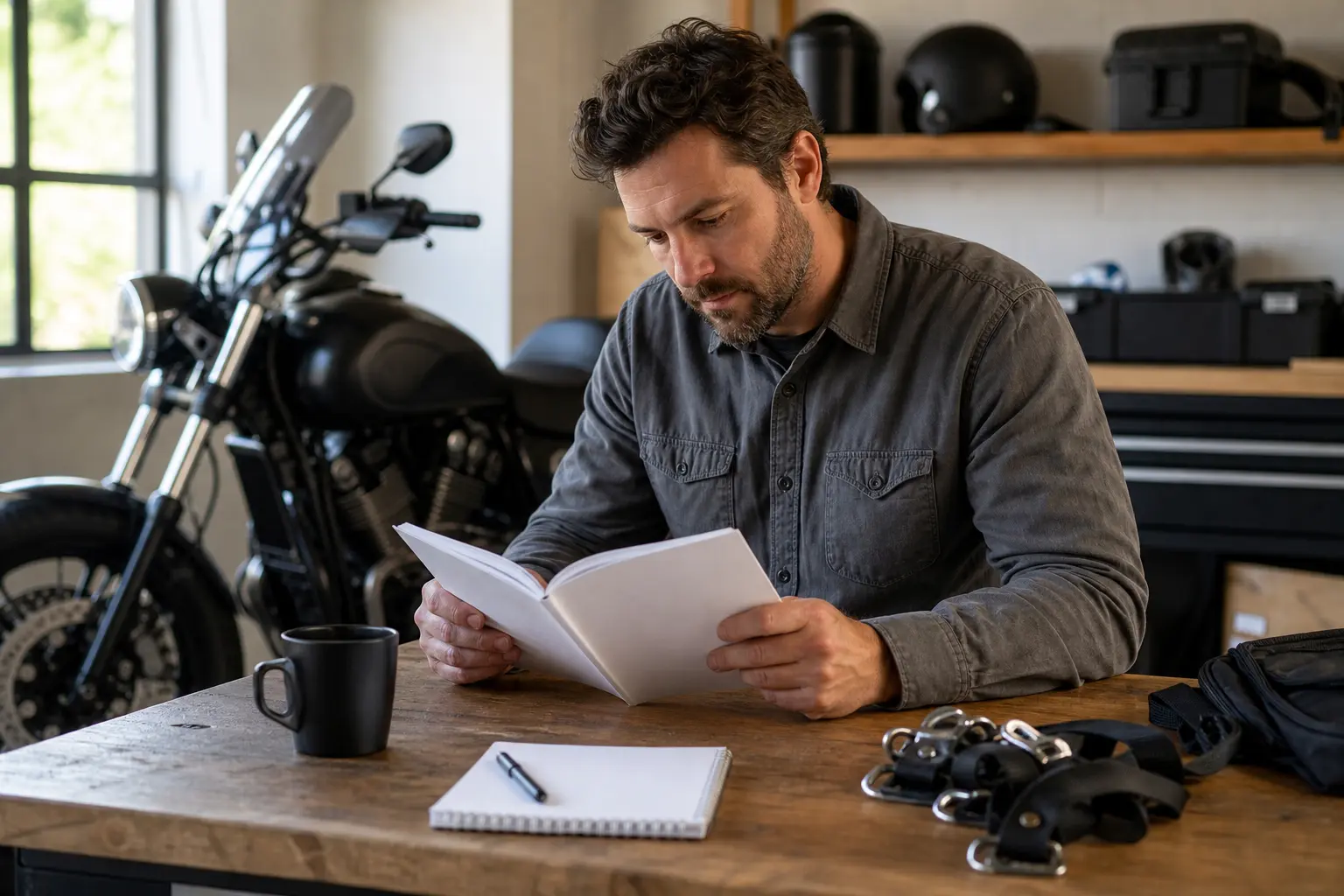
Tie-down-point advice often fails because it focuses on what looks strong. Appearance is not engineering approval. A handlebar, footrest bracket, luggage support, axle area, crash bar, frame tube, fairing support, wheel, or passenger hardware may be accessible, but accessibility alone does not establish that it can be used as a transport attachment point.
Your model’s manual may address more than straps. It can also contain guidance about stand position, security functions, alarms, accessories, and the intended orientation of the motorcycle during transport. Harley-Davidson, for example, notes that models with a security system may require Transport Mode so normal transit motion does not trigger the system. That is a model-dependent point, not an instruction to assume every motorcycle has the same feature. (harley-davidson.com)
Before you bring out a ramp, answer these questions:
- Is there a transport section in the operator’s manual? Read the warnings and notes, not only an illustration or a search-result preview.
- Does the manual identify locations that may be restrained, or locations that must not be used? Follow the stated direction instead of choosing a nearby alternative.
- Does it say anything about the side stand, center stand, steering, or electronics while carried? These instructions can vary with design.
- Have accessories changed access or clearance? Luggage, auxiliary lighting, guards, tall screens, custom bars, lowered suspension, and aftermarket bodywork can create new interference risks without becoming approved anchors.
- Can you identify the vehicle-side anchor points and their intended use? Motorcycle approval alone is not enough if the truck bed or trailer does not provide suitable anchor locations.
The most conservative rule is straightforward: do not place a transport load on a motorcycle part unless the motorcycle manufacturer identifies it as suitable or confirms it for your model. If you cannot establish that, change the plan. That may mean using different equipment, asking an authorized dealer, or arranging professional transportation.
This approach is not an attempt to make hauling complicated for its own sake. It prevents a common reasoning error: starting with straps you already own and then searching for something on the motorcycle to hook them to. Reverse that order. First establish the motorcycle’s approved boundaries. Then select compatible restraint equipment and a compatible vehicle arrangement.
Choose the truck or trailer around the actual load
A pickup truck and a trailer are different environments, but both need an intentional fit check. The motorcycle must fit physically, the load path must be managed, and the relevant ratings must support the job. More straps do not solve an unsuitable bed length, uncertain tailgate capacity, inadequate trailer condition, or questionable tow setup.
Truck-bed questions to resolve
For a truck, look beyond whether the motorcycle can technically be rolled into the bed. Compare the motorcycle’s overall length with usable bed space. Locate the truck’s designated tie-down points. Determine whether the tailgate is part of the loading path, part of the motorcycle’s parked footprint, or both.
Harley-Davidson specifically advises riders to compare motorcycle and bed length, confirm that the truck has bed tie-down eyes, and consult the truck operator’s manual for tailgate capacity. It also notes that a lower bed height can make loading easier. (harley-davidson.com)
That is a useful planning framework, not a universal measurement rule. Truck designs differ. A motorcycle that crowds the bed, depends on an unsupported tailgate arrangement, blocks access to anchors, or leaves no safe working room at the front is not a sound truck-bed match. Reconsider the vehicle or use a trailer designed for the job.
Trailer questions to resolve
For a trailer, evaluate the whole combination: trailer condition, floor structure, anchor locations, chock mounting arrangement, payload, tires, coupler, hitch, and tow vehicle. Do not focus only on whether the motorcycle itself weighs less than a number on a label.
Harley-Davidson’s wheel-chock documentation instructs users to mount its equipment only on a well-maintained trailer or vehicle rated to carry the motorcycle’s weight, while referring riders to the motorcycle owner’s manual for vehicle-weight information. (serviceinfo.harley-davidson.com)
A trailer may be physically large enough and still be the wrong choice if its anchor system is unknown, the floor cannot support the chock installation specified by its maker, or the towing combination is outside the vehicle manufacturer’s guidance. When ratings or compatibility are uncertain, consult the applicable truck, trailer, hitch, or motorcycle manufacturer before departure.
Wheel-chock questions to resolve
A wheel chock is a fitment item, not a generic metal cradle. It must fit the wheel and tire arrangement, provide adequate clearance around fenders or bodywork, and be used according to its own documentation. Harley-Davidson’s instructions for one adjustable chock illustrate that even recommended cradle settings can vary because tires are not all manufactured identically. (serviceinfo.harley-davidson.com)
Do not turn a poor fit into a strap problem. If the wheel binds, cannot sit correctly, contacts bodywork, or the chock cannot be installed in the specified manner, pause. Use a chock intended for the motorcycle and the mounting surface, or choose a different transport method. Avoid making unverified modifications to force compatibility.
Plan the ramp and loading environment before loading
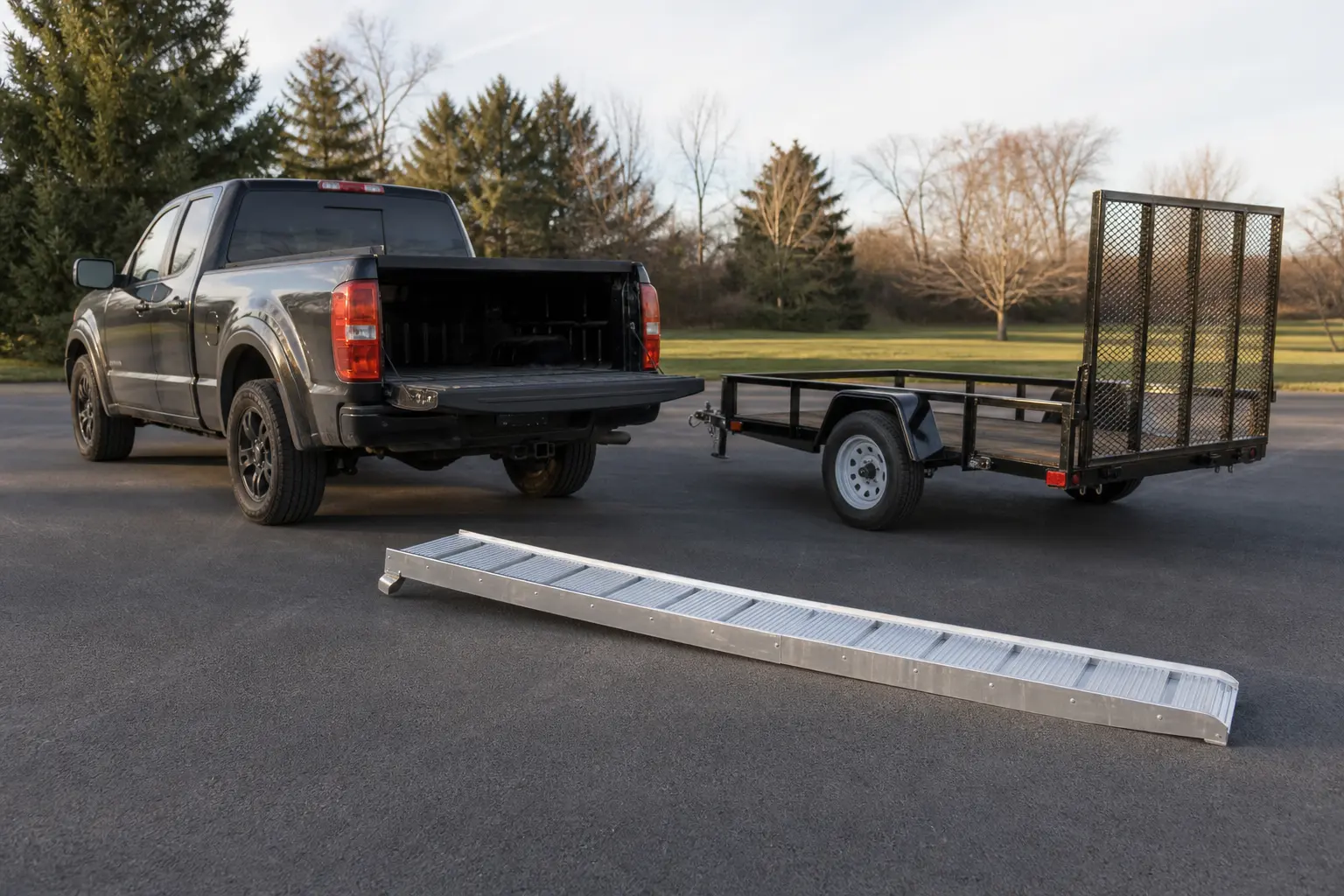
The most vulnerable moment in motorcycle transport is often the transition from the ground to the elevated bed or trailer. A correct tie-down plan does not erase the risk of a slippery ramp, a steep approach, insufficient space, poor lighting, or too few capable helpers.
Choose firm ground with room for the vehicle, ramp, motorcycle, and people involved. The goal is to avoid a rushed or crowded movement. A sloped shoulder, soft grass, loose gravel, traffic pressure, darkness, rain, or fatigue can turn an otherwise reasonable plan into a poor one.
Harley-Davidson advises reducing the ramp angle where possible because a steep angle can cause a motorcycle’s frame or side stand to contact the transition abruptly. It also advises delaying the task in rain, when ramp and bed surfaces can become slick. (harley-davidson.com)
Use those points as decision triggers:
- If the approach angle creates an obvious clearance conflict, do not force the motorcycle over it.
- If the ramp cannot be secured to prevent movement, do not load.
- If the surface is too slippery to walk confidently beside the motorcycle, wait or relocate.
- If visibility prevents everyone from seeing the ramp, wheel path, and hand signals clearly, improve lighting or stop.
- If the machine reaches a height where you cannot confidently control it, obtain help or use another method.
Helpers need a plan before the motorcycle moves. Decide who directs, who manages steering and braking, who pushes or steadies, and where each person will stand. Harley-Davidson similarly recommends assigning roles in advance and placing a helper in the truck bed when enough people are available to assist. (harley-davidson.com)
Do not let helpers stand where a shifting motorcycle could pin them against a trailer wall, bed side, or ramp edge. Keep communication simple and agree that anyone can call for a stop. The right time to reassess is before a loss of balance, not after one person is already trying to save the motorcycle.
A manual-first workflow for tying down a motorcycle
This is a conservative planning workflow rather than an exact tie-down procedure. It does not prescribe one attachment point, strap count, suspension setting, or route because those decisions are model- and equipment-specific.
1. Gather the governing instructions
Have the motorcycle manual and the instructions for the ramp, chock, straps, truck, trailer, and relevant towing equipment available before loading. If directions conflict, the motorcycle manufacturer controls what may be done to the motorcycle, while each equipment manufacturer controls how its component should be used. An unresolved conflict means the setup is not ready.
2. Confirm the vehicle can accept the load
Review fit, payload-related guidance, anchor locations, tailgate considerations where applicable, and the full towing arrangement where a trailer is involved. Include the weight and space taken by equipment, not only the motorcycle. Do not assume an older bed, aftermarket anchor, borrowed trailer, or unmarked ramp has the capacity needed.
3. Inspect the loading path as one continuous route
Check the ground, ramp contact points, ramp security, alignment with the wheel support, and the path once the motorcycle is onboard. Harley-Davidson recommends securing the ramp to the truck and aligning it with the chock so the motorcycle has a direct path to the wheel support. (harley-davidson.com)
The objective is controlled movement, not speed. If your equipment or experience does not provide a comfortable margin, stop and recruit capable help.
4. Position the wheel according to the chock instructions
Once the motorcycle is in the chock, check that its wheel is centered and seated as the chock maker intends. Harley-Davidson’s chock instructions describe aligning the wheel with the cradle and moving it until the tire reaches the front stop. (serviceinfo.harley-davidson.com)
Then make the important mental shift: wheel position is established, but transportation restraint is not complete. Continue only with the manual-supported tie-down plan.
5. Use the motorcycle’s approved attachment locations
Connect restraints only at locations supported by the documentation for the exact motorcycle. Select vehicle anchors intended to receive those loads. Keep strap routing clear of cables, hoses, wiring, sharp edges, and components that could be damaged or could damage the strap.
Harley-Davidson highlights those routing concerns in its loading guidance, warning against pinching or binding hoses, cables, and wiring, and against running straps over sharp edges or bolt heads. (harley-davidson.com)
Protective material can reduce cosmetic contact, but it cannot transform an unsuitable motorcycle component into an approved tie-down point. If the only route available crosses a sharp edge, interferes with wiring, or depends on unapproved hardware, choose a different arrangement.
6. Control movement in more than one direction
A motorcycle can move forward, rearward, and sideways relative to the truck or trailer. The chock and the restraint layout must work together to limit that movement as the vehicle accelerates, turns, and stops. Harley-Davidson’s truck guidance calls for securing the rear so the motorcycle cannot shift. (harley-davidson.com)
Follow your motorcycle manual for the permitted rear restraint approach. Never infer suitability from the fact that a rear component is convenient to reach. Bodywork, luggage structures, passenger hardware, wheels, and other visible parts may have limits that are not obvious.
7. Do a no-rush final walkaround
Before the tow vehicle or truck moves, step away and inspect from each side, front, and rear. Look for straps that can rub, loosen, or contact edges; unsecured loose ends; an unstable wheel position; gear left in the bed or trailer; and ramps or tools that have not been stowed.
Harley-Davidson recommends tying up excess strap material and completing a final inspection before moving the vehicle. (harley-davidson.com) A pause at this stage is valuable. If anything looks uncertain, it probably deserves correction before the road adds motion and speed.
Manual-first motorcycle transport checklist
Use this checklist as a decision aid. It does not replace the instructions for your specific motorcycle or equipment.
Documentation and fit
- I reviewed the exact motorcycle operator’s manual for transport instructions, approved restraint areas, stand guidance, and any transport-related electronic setting.
- I reviewed the instructions for the ramp, chock, straps, truck or trailer, and towing equipment involved.
- The truck bed or trailer is compatible with the motorcycle’s size and the complete load.
- Vehicle-side anchor locations are known and suitable for the intended restraint arrangement.
- The wheel chock fits the tire and clears the motorcycle as its manufacturer requires.
Loading environment
- The staging surface is firm, reasonably level, and free from avoidable slip or trip hazards.
- The loading angle does not create an apparent clearance or control problem.
- The ramp is appropriate for the task, securely attached, and aligned with the wheel-support path.
- Weather, lighting, fatigue, traffic, and available space allow a calm loading attempt.
- Helpers know their responsibilities and safe positions before the motorcycle moves.
Restraints and departure review
- Every motorcycle attachment location is supported by the exact manual or direct manufacturer confirmation.
- Straps and related hardware appear undamaged and appropriate for the intended use.
- Strap routes avoid sharp edges, wiring, hoses, cables, bodywork hazards, and interference with moving parts.
- The wheel chock is being used as wheel support, not as the only travel restraint.
- The motorcycle is not depending on a stand unless the model documentation explicitly supports that arrangement.
- Loose strap ends, ramp parts, tools, and accessories are secured before departure.
- The final walkaround revealed no unresolved concern.
When not to transport the motorcycle yourself
Choosing not to load is often the safest and most efficient outcome. A delay, dealer pickup, professional carrier, or a better-equipped friend is preferable to an improvised plan with narrow margins.
Stop and reconsider if any of the following applies:
- You cannot find the operator’s manual or cannot identify its transport guidance.
- The manual does not establish suitable tie-down locations and you cannot obtain manufacturer clarification.
- The ramp is too narrow, too steep, unstable, damaged, or cannot be secured.
- Weather, lighting, surface condition, available room, or traffic makes controlled loading doubtful.
- You do not have enough capable help for the machine, ramp width, and vehicle height.
- The chock does not fit cleanly or cannot be installed according to its instructions.
- The truck, trailer, tailgate, anchors, hitch, tires, or towing limits are uncertain.
- Accessories, prior crash damage, custom fabrication, or unusual wheel and tire fitment make standard documentation incomplete.
Harley-Davidson notes that dealer transportation can be the better option when self-loading is not the right fit. (harley-davidson.com) That is not a failure of skill. It is a sensible response to an arrangement that does not offer a clear safety margin.
How Vojo Helps
Before transport day, create a dedicated checklist in Vojo and save the motorcycle manual section, photos of the stationary ramp-and-chock layout, and notes identifying the vehicle and approved tie-down plan. After arrival, record a short post-transport inspection for strap-contact marks, wheel-support fit, or any issue that needs follow-up. Keeping this in the Motorcycle Service History creates a repeatable record for future trips rather than relying on memory or an old photo thread.
Download Vojo on the App Store
Final takeaway: restraint starts before the straps
The safest answer to how to tie down a motorcycle in a truck or trailer is not a universal diagram. It is a compatibility process. Start with the manual for the exact motorcycle, then confirm that the ramp, chock, straps, anchors, truck or trailer, and towing arrangement all support that motorcycle without requiring guesswork.
Treat the wheel chock as support for the wheel rather than the complete securing method. Treat the ramp as a controlled access route that must be stable and suited to the available angle. Treat every apparent tie-down point as unconfirmed until the manufacturer documentation says otherwise. Finally, treat uncertainty as useful information: it is the signal to pause, ask, change equipment, or use professional transport.
FAQ
Can I carry a motorcycle in a wheel chock without tie-down straps?
No. A wheel chock can support and locate the wheel, but Harley-Davidson’s wheel-chock instructions say that motorcycles carried in a truck or trailer must also be secured with appropriate straps or tie-downs. (serviceinfo.harley-davidson.com)
Where should I attach tie-down straps on my motorcycle?
Use only attachment locations identified by the operator’s manual for your exact motorcycle or confirmed directly by its manufacturer. Do not select a component merely because it looks solid or because an online guide used it on another model.
Can I transport a motorcycle on its center stand?
Follow the documentation for your specific motorcycle. Harley-Davidson cautions against carrying a motorcycle on its center stand because movement off the stand can leave the restraint system loose. (harley-davidson.com)
Do I need help loading a motorcycle into a truck?
It depends on the motorcycle, ramp width, vehicle height, surface, and your ability to maintain control. Harley-Davidson advises planning helper roles and warns against attempting an unassisted load when the ramp is not wide enough to walk alongside the motorcycle. (harley-davidson.com)
What if my wheel chock is too tight or does not fit the front wheel correctly?
Do not force the motorcycle into it and do not assume straps will compensate. Stop, review the chock maker’s fit guidance, and use only a chock that fits and mounts correctly. Harley-Davidson notes that tire manufacturing variation can affect recommended chock settings. (serviceinfo.harley-davidson.com)
Is any pickup truck suitable for transporting a motorcycle?
No. Confirm usable bed length, anchor locations, tailgate guidance, loading angle, and the full load plan. Harley-Davidson specifically advises measuring the motorcycle and truck, checking for bed tie-down eyes, and consulting the truck manual for tailgate capacity. (harley-davidson.com)
Quick answers
Frequently asked questions
Can I carry a motorcycle in a wheel chock without tie-down straps?
No. A wheel chock supports wheel position, but appropriate tie-down restraints are still needed when the motorcycle is carried in a truck or trailer.
Where should I attach tie-down straps on my motorcycle?
Use only the attachment locations identified by the operator’s manual for the exact motorcycle or confirmed by its manufacturer.
Can I transport a motorcycle on its center stand?
Follow the exact model documentation. Harley-Davidson cautions that movement off a center stand can allow restraints to loosen.
Do I need help loading a motorcycle into a truck?
Assess the motorcycle, ramp width, vehicle height, surface, and your control margin. Get capable help when those conditions make solo loading uncertain.
What if my wheel chock does not fit correctly?
Do not force the wheel into a poor-fitting chock. Stop and use equipment that fits the motorcycle and can be installed as its manufacturer specifies.
Is any pickup truck suitable for transporting a motorcycle?
No. Confirm bed length, anchor locations, tailgate guidance, ramp angle, and the complete load arrangement before loading.