
Dead Motorcycle Battery: When Charging Is Safer Than Jump-Starting
Decide whether a dead motorcycle battery calls for controlled charging, a limited jump-start, or professional help with this manual-first safety path.
Fact-checked against cited official documentation
Reviewed against Fact-checked against MSF guidance on routine battery maintenance and T-CLOCS inspection points for battery condition, mounting, terminals, venting, wiring, and electrical items..
Last updated November 13, 2026
A motorcycle that does not start can make the quickest-looking option feel like the best one. A jump source may be nearby, the ride may be planned, and a silent starter can create pressure to act before understanding the problem.
But dead motorcycle battery charging versus jump starting is not just a choice between two ways to add power. It is a decision about whether the battery and surrounding electrical system appear suitable to involve at all, whether the no-start symptom is actually battery-related, and whether a temporary start would create a new problem away from home.
A controlled charge is often the calmer first option when the motorcycle is parked safely, the battery appears normal, and the manufacturer documentation confirms the charger is appropriate. A jump-start can have a narrower place as a recovery measure when the manual permits it and the objective is limited: getting the motorcycle to a safe location or qualified support. Neither option proves that the battery is healthy or that the motorcycle’s charging system is working correctly.
The Motorcycle Safety Foundation includes battery care in routine motorcycle maintenance. Its T-CLOCS pre-ride material also directs riders to inspect battery condition, mounting, terminals, venting, wiring, and electrical items. Those are useful reminders that a starting complaint is not separate from the motorcycle’s overall condition (Know Your Motorcycle; T-CLOCS Pre-Ride Inspection Checklist).
This is deliberately a manufacturer-first guide. Your motorcycle owner’s manual, battery documentation, and charger or jump-source instructions control the safe method for your equipment. Do not use general internet advice to substitute for a model-specific instruction, connection method, battery identification, or service limit.
Dead Motorcycle Battery Charging Versus Jump Starting: The Practical Difference
Charging and jump-starting can both lead to an engine start, but they answer different immediate needs.
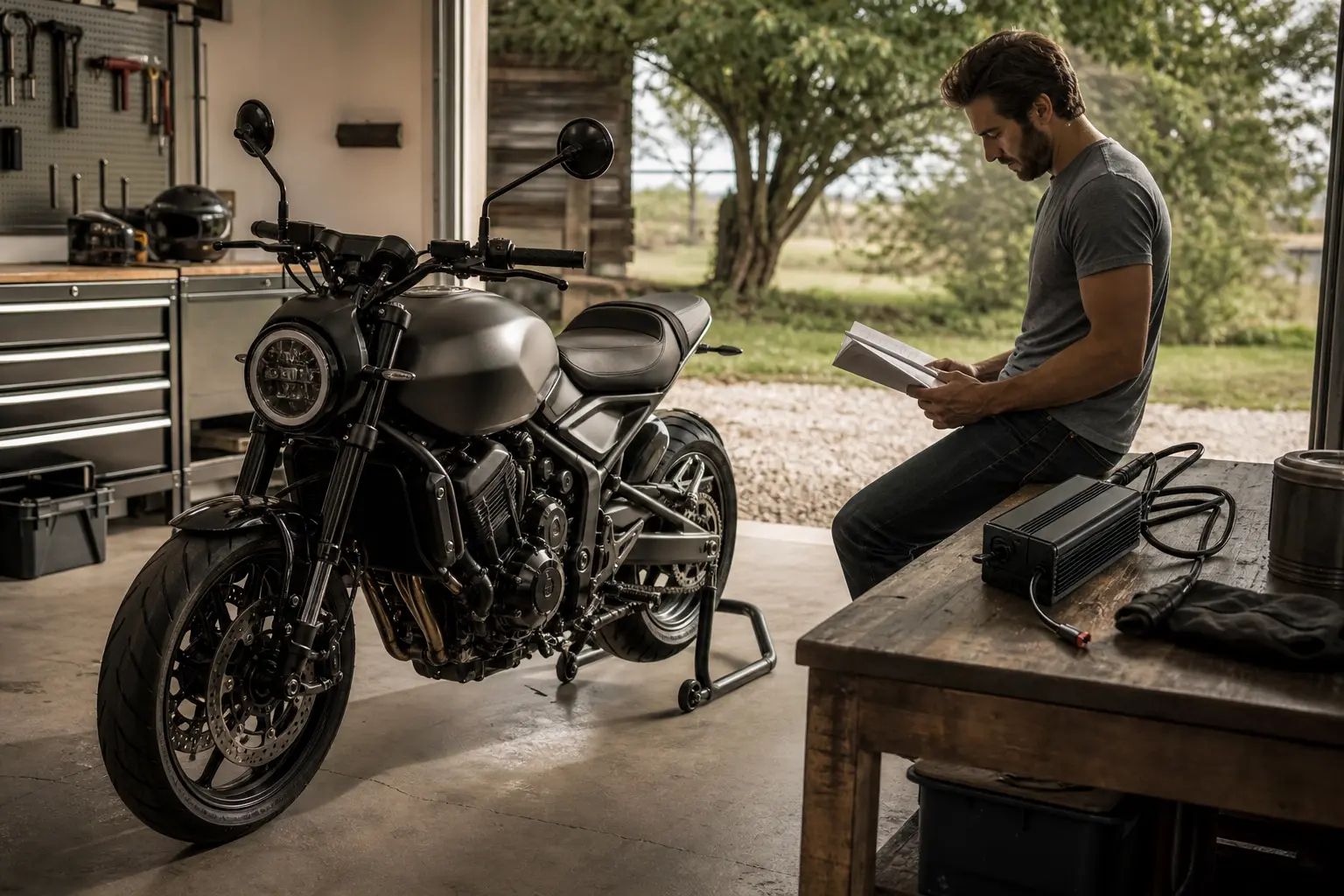
A controlled charge supplies energy to the installed battery over the process intended by the battery and charger manufacturers. When compatibility is established and there are no visible concerns, this approach gives the rider an opportunity to pause, document the event, and see whether the motorcycle behaves normally after the charge. It is useful when there is time to keep the motorcycle parked and make a careful decision.
A jump-start relies on an external source to help the starting system operate. It can be useful only when the motorcycle manual and the external-source instructions allow the specific arrangement. It should not be treated as a diagnosis. An engine that starts with assistance may still have a battery that does not retain usable energy, an insecure connection, an unintended electrical load, or a charging-related issue that needs investigation.
The distinction matters because an engine running at this moment is not the same as a motorcycle ready for a normal ride. If it stops at a fuel station, a junction, or far from help and will not restart, the original inconvenience has become a location and traffic-management problem.
| What you observe | Conservative first choice | What not to conclude |
|---|---|---|
| The motorcycle has sat unused, the battery looks normal, and compatible documentation is available | Use the manufacturer-approved charging path while the motorcycle is parked | A completed charge does not automatically confirm battery health |
| The case, wiring, terminals, mounting, or venting raises concern | Leave charging and jump-starting aside; seek manufacturer or qualified assistance | A start attempt is not a safe inspection method |
| You cannot identify the battery type or confirm charger compatibility | Pause and obtain the applicable documentation | A connector that fits does not establish suitability |
| The starter turns the engine normally but the engine does not run | Follow the normal manual-approved starting checks or seek diagnosis | External power may not address the fault |
| A jump-start works once | Record the event and arrange follow-up if the symptom returns | The jump did not establish why the battery was low |
| Electrical behavior remains unusual after a start | Keep the motorcycle out of normal traffic use and seek help | A running engine does not clear an electrical concern |
The table is not a repair guide and does not authorize bypassing a manufacturer instruction. Battery construction, approved charging equipment, access arrangements, and jump-start restrictions can differ among motorcycles. When the instructions are missing, conflict, or are difficult to apply with confidence, qualified assistance is the conservative choice.
Why a No-Start Is Not Automatically a Battery Problem
A rider may describe several different symptoms as a “dead battery.” The instrument display may be inactive. Lighting may appear weak. There may be a single click, a slow starter response, no starter response, or an engine that cranks but never begins to run. These are observations, not confirmed diagnoses.
That distinction prevents an unhelpful response. If the engine turns as expected but does not start, adding an external power source may not address the reason it will not run. If normal starting controls have not been set according to the owner’s manual, the motorcycle may be responding as designed. If a terminal, cable, fuse area, or other wiring is visibly compromised, a jump does not make that condition less important.
Before selecting equipment, use only the ordinary, manual-approved starting sequence. Confirm the motorcycle is in the state the manual requires for starting. Do not defeat an interlock, bridge electrical connections, probe wiring, or try repeated improvised tests. Safety systems and normal controls should not be overridden simply to make an engine start.
It also helps to preserve the first symptom. Instead of repeatedly pressing the starter until the battery is weaker, make a short note: what illuminated, what sounded different, whether the engine moved, when the motorcycle last ran, and whether anything had been connected during storage. This is more useful for later diagnosis than a vague report that the motorcycle was “completely dead.”
Inspect Before Choosing Charging or a Jump-Start
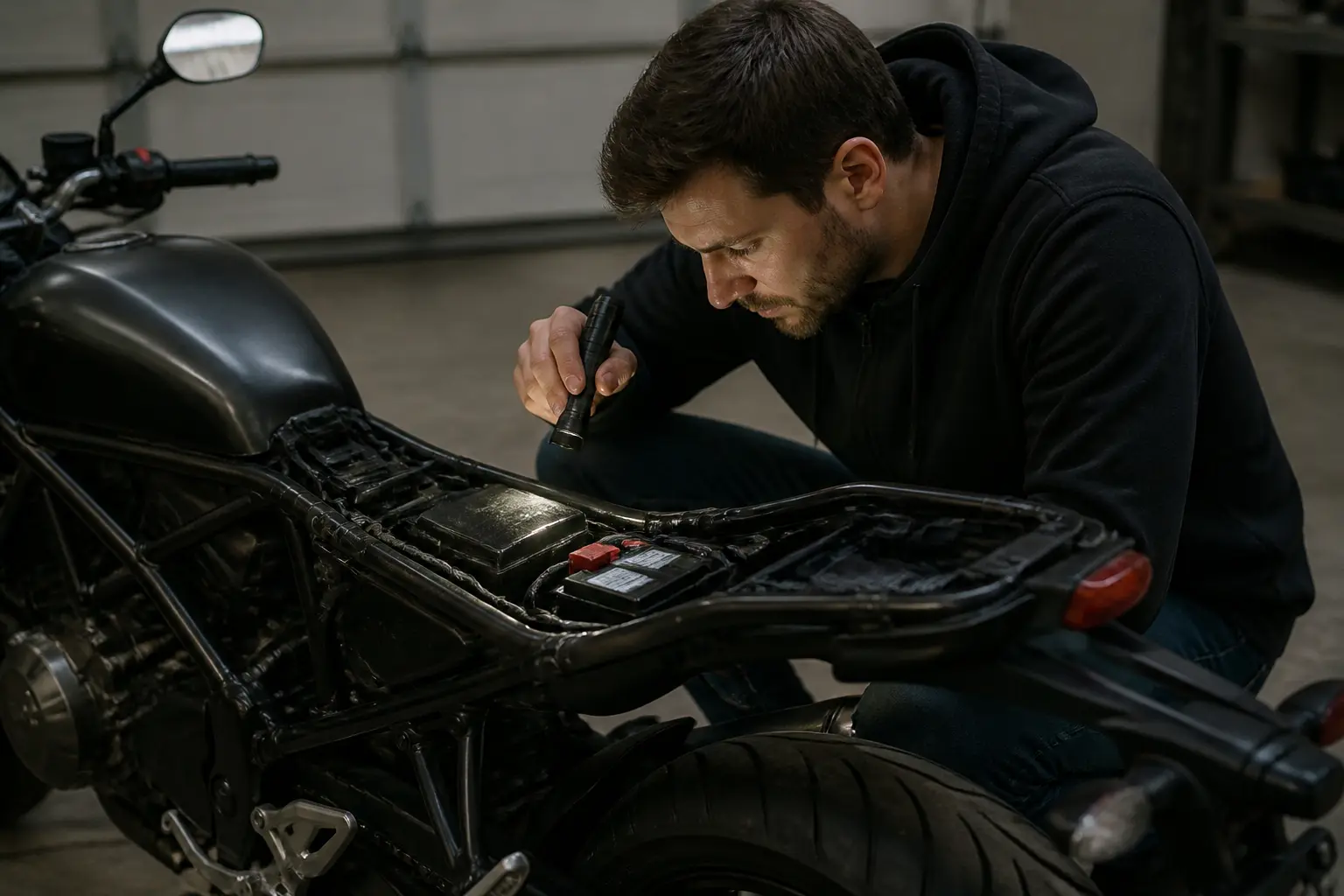
The MSF T-CLOCS checklist provides a sensible visual-inspection frame: consider battery condition, its secure mounting, terminals, venting, wiring, and other electrical items before riding (T-CLOCS Pre-Ride Inspection Checklist). You are not trying to perform a repair. You are deciding whether there is an obvious reason not to proceed with external power.
Begin with the motorcycle stable and switched off in an appropriate, ventilated place. Keep the work area clear of unnecessary people and avoid an environment where a motorcycle movement, spill, or hurried connection would create another hazard. If the motorcycle has just been operated, allow it to cool before considering the battery area.
Look for conditions that change the decision from recovery to escalation: a battery case that appears damaged; an installation that does not appear secure; terminals or cables with obvious damage, looseness, or contamination; wiring that appears chafed, heat-affected, pinched, or unsecured; and a venting arrangement that does not look intact. A smell, heat, leakage, smoke, or anything that simply seems abnormal is also a reason to stop rather than experiment.
A battery that has been dropped, impacted, exposed to unknown storage conditions, or left with an uncertain history deserves the same caution. A quick view may not reveal every concern. If you cannot confidently establish the battery’s condition from the documentation and visible inspection, leave the motorcycle parked and seek manufacturer or professional guidance.
Controlled Charging: When It Is the Better First Move
Charging is generally the more measured option when four things are true: the motorcycle can stay parked; no visible battery, venting, terminal, mounting, or wiring concern has appeared; the battery type can be identified; and the charger is expressly suitable under the relevant manufacturer instructions.
The value of charging is not merely that it may restore enough energy for a start. It avoids turning a low-energy symptom into a rushed roadside exercise. It gives the rider time to confirm the approved charger mode, location, supervision requirements, and completion guidance instead of assuming that all motorcycle batteries use the same approach.
Read the motorcycle manual first, then the battery information if available, and then the charger instructions. Those documents should resolve whether the charger is compatible, whether the battery should remain installed, and what the maker expects the rider to do. If the documents do not make the arrangement clear, do not select a setting by guesswork and do not substitute a device because it is marketed for vehicles generally.
Follow the equipment instructions rather than a generic online duration. There is no single charging time that can responsibly be applied across motorcycles, batteries, and chargers. Likewise, do not assume a device described as a maintainer can be used in every situation or left connected in every circumstance. The written directions for the particular battery and device are the relevant authority.
After charging, a calm reassessment matters. Does the motorcycle start through its normal procedure? Is the battery still secure? Is there any abnormal smell, warmth, display behavior, lighting behavior, or warning indication? A successful start after charging is useful information, but it is not a certificate that the battery has full capacity or that no further action is needed.
If the same weakness returns promptly, avoid an endless cycle of charging and retrying. Record the recurrence and arrange inspection. The underlying reason could relate to the battery, its connections, storage conditions, an accessory load, or the motorcycle’s charging system; the event itself does not reliably choose among those possibilities.
Jump-Starting: A Limited Recovery Option, Not a Diagnosis
A jump-start may be considered only after the visible inspection is satisfactory, the motorcycle manual permits the proposed method, and the instructions for the donor source also support it. Those conditions are important because a second motorcycle, a car, and a portable jump unit are not automatically interchangeable sources.
The goal should be specific and limited. Perhaps the motorcycle needs to be moved from an exposed place, loaded for transport, or brought to a place where proper assessment can occur. The goal should not be to erase uncertainty and begin a long ride as though nothing happened.
Do not invent a connection arrangement. Use the exact manufacturer guidance for the motorcycle and the external source, including any instructions on allowable connection points, source type, sequence, and precautions. If you cannot identify terminals confidently, if the manuals do not clearly authorize the setup, or if the location makes careful work unrealistic, choose roadside assistance instead.
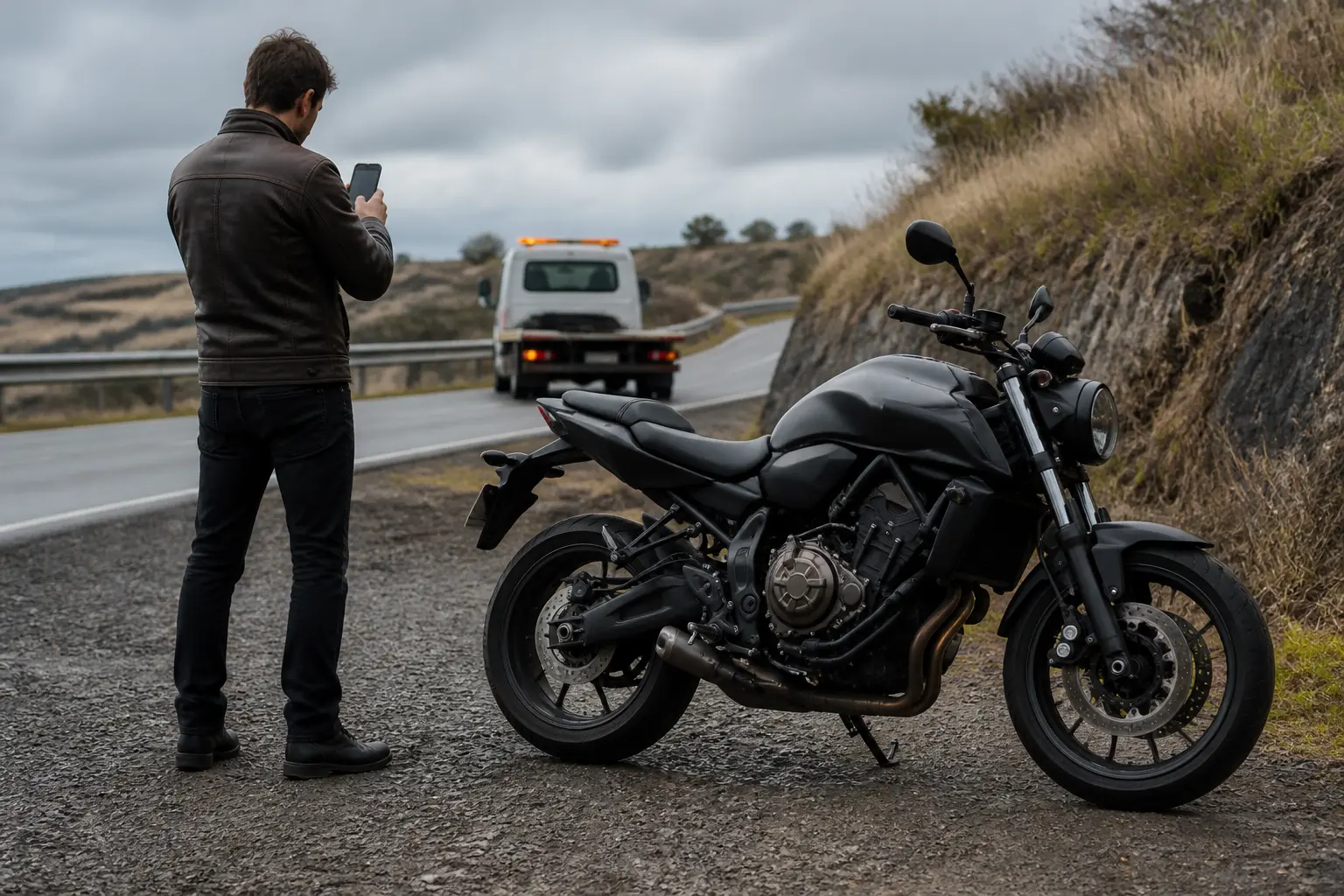
This is especially important when the rider is rushed, tired, in poor light, close to traffic, or distracted by companions. An electrical task that might be manageable in a controlled garage can become an unacceptable risk at the roadside. Moving away from traffic or arranging recovery is often the better decision than attempting to make a difficult situation work.
Once the engine runs, reassess rather than celebrate prematurely. Check that required lights and controls behave as expected before considering movement. If there are warning indications, irregular electrical behavior, signs of heat, a new smell, or concern about whether the engine will restart, do not enter ordinary traffic. If movement is necessary to get out of an immediate hazard, keep the objective narrow: reach the nearest safer location or qualified help.
What the Start Result Can—and Cannot—Tell You
A motorcycle that starts after a charge tells you that it started after a charge. A motorcycle that starts with an external source tells you that it started with an external source. Neither result, alone, identifies the root cause.
Several patterns deserve recording rather than assumption. A battery that becomes weak after an extended parked period may call for review of storage conditions, connected equipment, battery condition, and manual-recommended care. A motorcycle that has trouble starting after it has been ridden may warrant a different discussion with a technician. A repeated problem after a recent charge or jump makes a follow-up more urgent than a one-time unexplained event.
Create a brief record while details are fresh: date; place; weather and storage context; when the motorcycle last ran; accessories or charging leads that were connected; exact dashboard, lighting, and starter observations; whether a charger or external source was used; and what happened after the engine started. This is practical diagnostic context, not an attempt to self-diagnose.
MSF’s maintenance guidance encourages riders to know their motorcycle and keep up with routine care, rather than treating maintenance as an emergency-only task (Know Your Motorcycle). For the broader planning picture, use the Motorcycle Maintenance Guide. For battery-specific specifications and action limits, return to the manufacturer documentation for your own motorcycle.
When to Stop Riding and Arrange Help
Do not rely on a charged or jump-started motorcycle for normal travel when its battery is loose, damaged, leaking, unusually hot, or associated with a concerning smell; when wiring or terminals appear compromised; or when electrical equipment does not behave normally. These are conditions for pausing, not for testing through a ride.
Also step back when the motorcycle starts only with assistance and there is no reliable basis to expect a restart. Being stranded after a voluntary stop is inconvenient; being stranded where traffic, weather, darkness, or distance reduces options is more serious.
A conservative escalation plan can be simple: keep the motorcycle parked in a safe place, use roadside recovery if its location is unsafe, contact the manufacturer network or a qualified technician, and bring your notes and manuals. That approach may feel slower than immediately trying another jump, but it protects against turning an uncertain electrical condition into a roadside decision.
Checklist: Before and After Battery Recovery
Before charging or using an external start source
- Park the motorcycle securely in a suitable, ventilated location.
- Switch it off and follow the owner’s manual before accessing any battery area.
- Identify the battery and find the applicable motorcycle, battery, and equipment instructions.
- Confirm that the charger or donor source is specifically supported by those instructions.
- Inspect visible battery condition, mounting, terminals, venting, and wiring.
- Stop if there is damage, leakage, heat, unusual odor, smoke, insecurity, or uncertainty.
- Use only normal, manual-approved controls; do not bypass safety systems.
- Record the original no-start symptom before repeated attempts obscure it.
After a charge or permitted jump-start
- Confirm the motorcycle starts by its normal procedure.
- Look again for abnormal smells, heat, smoke, warnings, or unusual electrical behavior.
- Confirm required lights and controls function as expected before entering traffic.
- Do not assume one successful start proves the battery or charging system is healthy.
- Log the event and arrange follow-up if the problem repeats.
- Choose recovery or qualified service over a normal ride when restart reliability is uncertain.
How Vojo Helps
Create a repeatable no-start workflow in Vojo: open the motorcycle’s maintenance record, log the date and location, select the symptom you observed, note how long the bike had been parked, and add visible inspection findings before any follow-up work is arranged. Then create a task for the manufacturer-manual check or service appointment, with a reminder to record whether the issue returned after charging or permitted external assistance.
Using the Motorcycle Maintenance Tracker, keep that event beside routine service entries instead of leaving the details in a phone note or trying to remember them at the workshop. A clear history helps reveal a pattern and gives a technician useful context without replacing manufacturer instructions or professional diagnosis.
Quick answers
Frequently asked questions
Is charging safer than jump-starting a dead motorcycle battery?
Charging is often the more controlled first option when the motorcycle is safely parked, the battery appears normal, and the battery and charger are confirmed compatible by their manufacturers. It is not appropriate when the inspection reveals damage, leakage, heat, insecure mounting, wiring concerns, or unresolved uncertainty.
Can I jump-start a motorcycle from a car?
Do not assume a car is an approved donor source. The motorcycle owner’s manual and the donor equipment instructions must specifically support the proposed method. If they do not provide a clear arrangement, roadside assistance or qualified service is the safer alternative.
How long should I charge a motorcycle battery?
There is no responsible universal duration. Battery type, battery condition, and charger instructions vary. Use the instructions supplied for the motorcycle, battery, and charger rather than choosing a time from generic advice.
If a jump-start works, is the motorcycle battery good?
No. It only shows that the engine started with outside assistance in that moment. It does not establish battery capacity, connection condition, accessory draw, or charging-system condition. Record the event and seek diagnosis if the symptom recurs.
Should I ride immediately after charging or jump-starting?
Not if you find battery or wiring concerns, abnormal heat or odor, warning indications, irregular electrical behavior, or doubt that the motorcycle will restart. A safe location, recovery support, or qualified service is preferable to testing an unresolved problem in traffic.