
Motorcycle Battery Terminal Corrosion: When a “Dead Battery” May Really Be a Connection Problem
Motorcycle battery terminal corrosion symptoms can mimic a dead battery. Learn what to notice, when not to ride, and how to choose a manual-first next step.
Fact-checked against cited official documentation
Reviewed against Fact-checked against Harley-Davidson’s accessible official starting and maintenance guidance on corrosion-free, secure battery terminals, battery-area safety, fuse concerns, and escalation for persistent electrical faults..
Last updated October 14, 2026
A motorcycle that suddenly acts as if its battery is dead can create a strong urge to buy a battery, connect a charger, or keep pressing the starter. But motorcycle battery terminal corrosion symptoms can point to a different problem: the battery may hold some charge while the connection between the battery and the motorcycle is compromised.
That distinction matters. A battery stores electrical energy; battery terminals and their leads provide the path that lets that energy reach the motorcycle. When there is visible buildup, moisture, damage, or an insecure connection at that path, the symptoms can overlap with a discharged battery: no dash illumination, an intermittent display, a click without normal starting, or a motorcycle that seems to wake up and then immediately goes quiet.
The practical goal is not to diagnose the entire electrical system from one look. It is to recognize what a rider can safely observe, avoid treating corrosion as cosmetic, and follow the exact instructions for the motorcycle before anyone works around the battery. Harley-Davidson’s official starting guidance specifically includes checking that battery-terminal leads are both tight and free of corrosion when battery power is not reaching the motorcycle’s electrical system or when the starter behavior suggests weak available power. Its maintenance guidance also calls for regular terminal inspection for corrosion or damage. See Sources 1 and 2 below.
This article is intentionally conservative. A corroded-looking terminal is a clue, not proof that the battery itself is healthy, that the charging system is working, or that the visible location is the only fault. If starting trouble persists, the motorcycle’s owner’s manual and a qualified technician are more useful than repeated guesses.
What corrosion can—and cannot—tell you
A battery connection has a simple job: it must provide a sound electrical path between the battery and the motorcycle’s wiring. Visible buildup around a terminal, on a cable end, or near the battery case deserves attention because it may interfere with that path or signal a condition that needs closer inspection.
From the rider’s point of view, the useful observations are often straightforward:
- A powdery, crusty, damp, or discolored deposit around a terminal area.
- A cable end that does not appear to sit securely where it meets the battery connection.
- Greenish, whitish, bluish, or otherwise unusual residue on exposed metal parts of the connection.
- A terminal area that looks wet, damaged, cracked, or contaminated.
- A starting complaint that changes from one attempt to another, especially if lights or the display also behave inconsistently.
None of those observations identifies the underlying cause by itself. A rider cannot reliably conclude, from color alone, whether the issue began with a battery fault, moisture exposure, an insecure lead, age-related wear, a charging-system problem, a damaged cable, or something elsewhere in the motorcycle’s electrical system. Likewise, a clean-looking terminal does not prove that every connection is sound.
That is why “the battery is dead” is often too broad a conclusion. A battery may be discharged. It may be unable to provide adequate starting power. The motorcycle may also have a poor path from the battery into the electrical system, an interlock condition, a blown fuse, a charging-system fault, or another starting issue. Harley-Davidson separates these possibilities in its starting guidance: lack of electrical power calls for checking terminal condition and the main fuse, while clicking can suggest weak available battery power and an engine that cranks but does not start leads to a different set of checks. Source 1 supports that broader fault-path mindset.
Treat the visible terminal area as a decision point, not a repair verdict. The best first question is: “Is there a battery-area condition I can document and have assessed before I assume the battery needs replacement?”
Why a connection problem can feel exactly like a dead battery
Modern motorcycles depend on electrical power before the engine ever runs. The instrument panel, lighting, fuel-injection controls on applicable motorcycles, starter circuit, and safety interlocks all rely on the motorcycle’s electrical system behaving normally. If the connection from the battery is inconsistent, the rider may see symptoms that resemble an empty battery even when the explanation is more complicated.
A poor connection can show up in several ways. With the ignition switched on, the display may fail to wake up, appear dim, reset, or act inconsistently. Pressing the starter may produce silence, a single click, repeated clicks, or a brief attempt followed by a loss of electrical activity. A motorcycle may seem normal at one moment and unresponsive at the next.
These are symptom categories, not a ranked diagnosis. For example, a repeated clicking sound may be associated with insufficient available battery power, but it does not rule out a terminal or cable condition. A silent starter does not automatically mean terminal corrosion; the run switch, neutral/clutch requirements, side-stand interlock, fuse condition, and model-specific systems can matter too. The owner’s manual is the authority for the exact motorcycle.
The important practical lesson is that a connection fault can restrict the system’s ability to use battery power. That is why a rider should not dismiss buildup at the battery as merely an appearance issue. Harley-Davidson’s official maintenance advice directs riders to inspect battery terminals for corrosion or damage regularly, keep the battery clean and dry, and seek professional inspection when issues are observed. Source 2.
Symptom map: what to observe before assuming a battery replacement
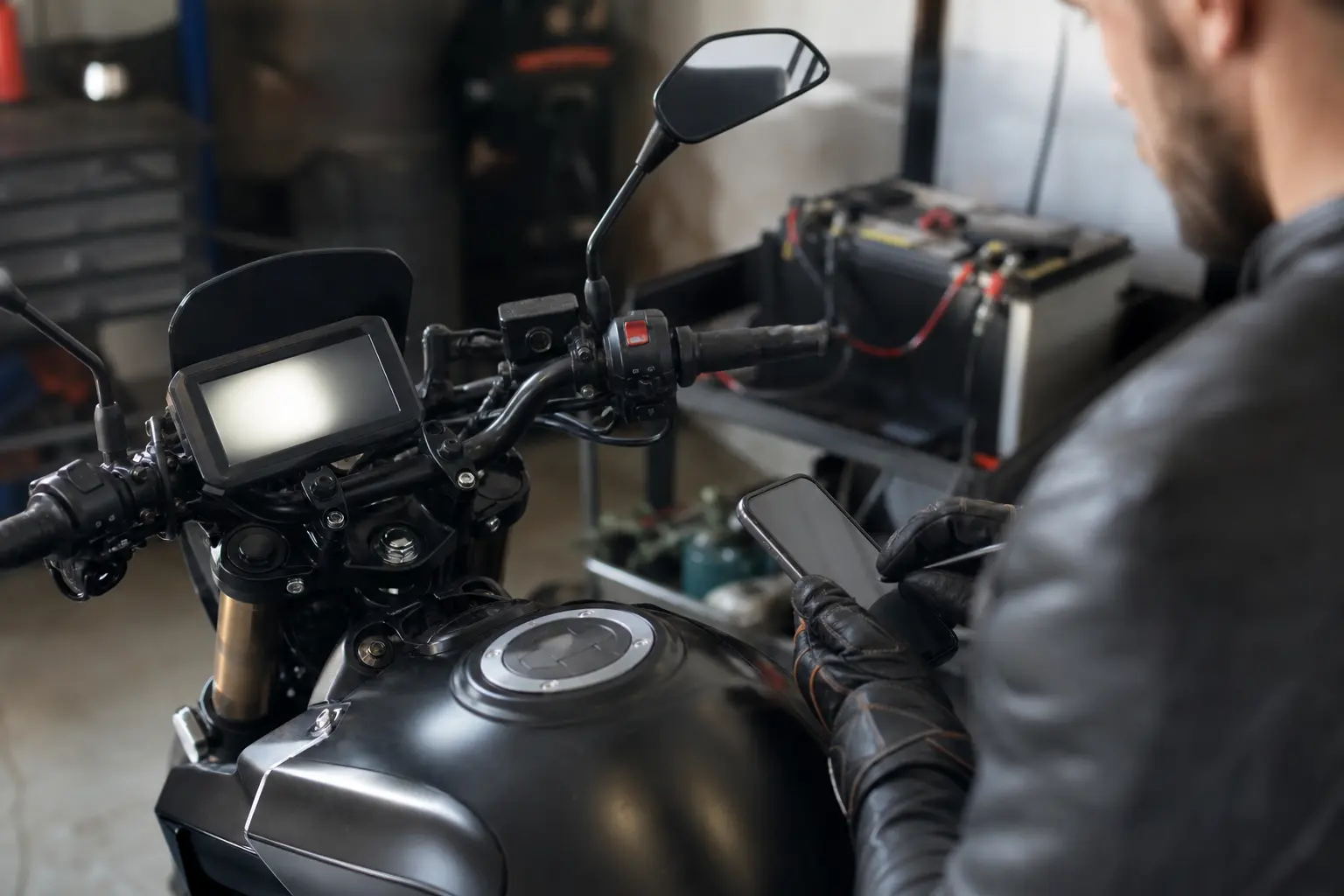
Use this table to organize what happened. It does not diagnose the motorcycle; it helps prevent a vague “won’t start” story from becoming the only information available to a technician.
| What you notice | What it may indicate | What it does not prove | Sensible next step |
|---|---|---|---|
| No display, lights, or other electrical response after switching on | Battery power may not be reaching the motorcycle electrical system | That the battery alone has failed | Stop repeated start attempts; inspect the accessible battery area only as allowed by the manual, and check model documentation or arrange service |
| Display or lights appear intermittently | An electrical connection or power-supply issue may be present | That visible corrosion is the only cause | Record the behavior, inspect for obvious battery-area damage or buildup, and seek a model-specific assessment |
| Click or repeated clicks when starting | Available power may be insufficient for normal starter operation | That the battery is necessarily discharged or permanently failed | Avoid guessing from sound alone; document the condition and follow the manual’s starting guidance |
| Starter turns the engine but it does not start | The motorcycle has some electrical activity | That the battery connection is not involved, or that the cause is fuel-related | Use the owner’s manual and qualified service guidance rather than treating terminal appearance as a complete answer |
| Visible residue, dampness, cracking, or damage near a terminal | The battery area needs closer attention | The source of the condition or a safe repair method for your model | Do not ride until the concern has been assessed if damage, leakage, heat signs, or unreliable electrical operation are present |
| Starts normally after sitting but fails unpredictably later | An intermittent condition may exist | That one successful start means the issue is resolved | Log the circumstances and arrange evaluation before relying on the bike for traffic or a remote ride |
The table is also a reminder that a battery terminal is part of a larger system. A rider who sees corrosion and immediately installs a new battery may still be left with the same symptom if the underlying concern involves the connection, cable condition, charging system, or another electrical component.
Manufacturer-first safety guidance around the battery
Motorcycle batteries deserve more caution than a casual inspection might suggest. Harley-Davidson’s official maintenance guidance tells riders to wear eye protection when working with a battery, keep sparks, flames, and cigarettes away, and ensure proper ventilation rather than storing a battery in a sealed container. Source 2. Those directions are a good baseline, but your owner’s manual and battery documentation take priority for the exact motorcycle and battery type.
For riders, the safest boundary is clear: observation is not the same as repair. Do not improvise a terminal-cleaning process, apply household chemicals, bridge connections, bypass fuses or interlocks, or use tools around the battery unless the owner’s manual explicitly supports the work and you understand the model-specific precautions. A wrong connection, a short circuit, ignition source, or battery damage can turn a small starting problem into a larger safety issue.
Pause and arrange qualified help rather than continuing to troubleshoot if you notice any of the following:
- A cracked battery case, fluid leakage, swelling, or a strong unusual odor.
- Smoke, heat, melted insulation, scorching, or signs of arcing.
- Damaged, frayed, pinched, or loose-looking wiring.
- A blown fuse that returns after replacement.
- A motorcycle that loses electrical power while being ridden, then will not restart.
- A motorcycle that starts unpredictably and cannot be relied on for a ride in traffic.
Harley-Davidson notes that a fuse that blows again can indicate a short in the electrical system and calls for further service. It also identifies charging-system failure as a possible reason a motorcycle stops while riding and then has a weak or apparently dead battery. Source 1. Those are not situations to solve by repeated starts, by riding “just to see,” or by assuming a dirty terminal is the whole story.
A parked-bike observation routine before calling for service
You do not need to become an electrician to provide useful information. A careful, non-invasive observation routine can make service conversations more efficient while keeping the motorcycle in a safer state.
First, make the motorcycle stable and follow the owner’s manual for parking, ignition, and battery-access instructions. Let the motorcycle cool if it has been running. Avoid a rushed inspection at the roadside, in poor lighting, around traffic, or near fuel vapors.
Next, observe rather than manipulate. If the battery compartment can be viewed without disassembly beyond what the manual allows, look for residue, dampness, damaged insulation, obvious cable distress, or a battery case that does not appear intact. Do not scrape, pry, twist, or force anything simply to obtain a closer look.
Then, capture the starting story. Note whether the motorcycle was ridden recently, whether accessories had been used, whether the display came on, whether lighting changed during a start attempt, whether the starter was silent or clicked, and whether the engine turned over. A brief phone note can be more valuable than memory after the motorcycle has been charged, transported, or serviced.
Finally, use the right escalation path. If the manual provides a rider-level inspection or charging instruction appropriate to your model and you can follow it safely, use that documentation. If the manual does not make the next step clear—or if the battery area shows damage, leakage, or heat-related evidence—book qualified service or arrange transport. The aim is to preserve safety and evidence, not to win a diagnosis in the driveway.
For a wider, recurring inspection routine that keeps battery-area observations alongside tires, controls, lights, fluids, and the chassis, see the Motorcycle Maintenance Guide.
Checklist: battery-terminal corrosion symptoms and safer next steps

Use this checklist after a no-start or unreliable-start event. It is deliberately written as a check-and-escalate list, not a terminal repair procedure.
- Park the motorcycle securely and move away from traffic, open flames, sparks, smoking, and fuel vapors.
- Read the battery and starting sections of the exact owner’s manual before opening a cover or touching battery-related parts.
- Wear eye protection if you will be near the battery area, following the manufacturer’s safety guidance.
- With the ignition in the condition specified by the manual, note whether the display, lights, and other normal electrical functions respond.
- Record whether the starter is silent, clicks, repeatedly clicks, turns the engine, or behaves inconsistently.
- Look only for accessible, obvious signs of terminal-area buildup, wetness, damaged insulation, cracked battery housing, or loose-looking hardware.
- Do not treat color, residue, or one successful restart as confirmation of the root cause.
- Do not bypass a fuse, safety switch, or starting interlock to force a start.
- Stop and arrange qualified help if there is leakage, heat, smoke, melted wiring, repeated fuse failure, or electrical loss while riding.
- Save the date, circumstances, photos of visible concerns, and observed symptoms in the motorcycle’s service record.
This checklist complements—not replaces—the model’s service schedule. Regular checks make it more likely that a small visible issue is found before it becomes an inconvenient no-start at a gas stop, trailhead, hotel, or work parking lot.
Avoid the two common misreads: “only corrosion” and “only the battery”
The first misread is to see buildup and decide that cleaning the terminal area will necessarily solve the problem. That skips too many possibilities. The battery may be discharged, damaged, or nearing the end of its useful life. A cable may be compromised. The motorcycle may have an accessory-related drain, a fuse issue, an interlock problem, or a charging-system concern. Visible corrosion can be relevant without being the complete explanation.
The opposite misread is to ignore a visibly compromised connection because the battery is old or because a charger temporarily restores enough power for a start. A fresh charge and a single successful start are observations, not a comprehensive bill of health. If the motorcycle’s electrical behavior remains inconsistent, do not let a temporarily normal display erase the earlier symptom.
This is particularly important before longer or more consequential rides. A motorcycle that starts weakly in the garage may leave a rider stranded after a fuel stop. A motorcycle that has lost power while moving deserves a much more cautious response than one that simply sat unused and now needs routine attention. In both cases, documentation, manufacturer guidance, and qualified evaluation are more dependable than trial-and-error riding.
How to communicate the problem clearly to a technician
A useful service request separates what you saw from what you assume. Instead of saying, “The battery is dead,” say what the motorcycle actually did:
“After switching on the ignition, the display came on intermittently. On the first start attempt there was a click; on the next, there was no response. I observed residue around the battery terminal area, but I did not disturb it. There was no visible smoke or leakage.”
That statement gives a technician a starting point without claiming a diagnosis. Add the motorcycle’s exact year, model, battery age if known, recent storage period, accessory use, recent service, and whether the problem occurred after rain, washing, a tip-over, or a ride. If you have photos, take them from a safe distance and do not remove covers or parts solely to create a more dramatic picture.
Also mention whether the motorcycle had any electrical changes before the issue: added charging leads, heated gear, lighting changes, USB equipment, alarm systems, or other accessories. This does not prove an accessory caused the fault; it simply gives the technician a complete picture of what changed.
Prevention is mostly about inspection, dryness, and records
There is no universal mileage or calendar interval in this article because battery access, battery type, use pattern, climate, storage needs, and manufacturer instructions vary. Instead, build battery-terminal observation into the checks your manual expects and into any time the motorcycle has been stored, washed, exposed to weather, or shown unusual starting behavior.
Harley-Davidson’s maintenance guidance recommends regular terminal checks for corrosion or damage and advises keeping the battery clean and dry. Source 2. The transferable takeaway is not a brand-specific schedule; it is the habit of making the battery area part of regular maintenance rather than waiting for a no-start event.
A simple record helps distinguish one odd incident from a repeating pattern. Note the date, the symptom, any visible battery-area condition, and what happened after the motorcycle was inspected or serviced. Over time, that history can help you see whether the concern follows storage, weather exposure, electrical accessory use, or a recurring service interval.
How Vojo Helps
After a no-start event, create a maintenance entry in Vojo’s motorcycle service history with the date, the exact starting symptom, a photo of any visible terminal-area buildup, and a note that you avoided disturbing the connection. Then add a follow-up reminder for the manual-specified inspection or the qualified service appointment. At the next pre-ride check, review that open item before deciding whether the motorcycle is ready for a normal ride. This turns an easy-to-forget electrical incident into a clear record for you and the technician.
Download Vojo on the App Store
Bottom line
Motorcycle battery terminal corrosion symptoms can resemble a dead battery, but they should not lead to instant certainty. Visible residue, damaged-looking hardware, dampness, or erratic electrical behavior all justify a closer, manual-first assessment. The responsible rider response is to observe safely, document the symptoms, keep sparks and flames away from the battery area, and escalate rather than improvising when the problem involves damage, leakage, heat, repeated fuse failure, power loss while riding, or continuing starting trouble.
A terminal connection is small, but it is part of the path that lets the motorcycle’s electrical system work. Give it the same respect you would give any other safety-relevant maintenance clue: notice it early, avoid unsupported assumptions, and use the exact model documentation or qualified service to determine the proper correction.
Sources
- Harley-Davidson, What to Do When Your Motorcycle Won’t Start: Tips & Fixes — official starting-fault guidance covering tight, corrosion-free terminal leads, fuse concerns, weak-battery symptoms, and charging-system escalation.
- Harley-Davidson, 6 Harley-Davidson Maintenance Essentials — official maintenance guidance covering terminal inspection, battery cleanliness, eye protection, ventilation, and ignition-source precautions.
Quick answers
Frequently asked questions
Can corroded motorcycle battery terminals make the bike seem completely dead?
They can be part of a no-power or unreliable-power situation because the terminal connection is part of the path from the battery to the motorcycle electrical system. However, the symptom does not prove corrosion is the only cause; battery condition, fuses, wiring, interlocks, and charging-system issues may also need assessment.
What do motorcycle battery terminal corrosion symptoms look like?
Riders may notice powdery or crusty buildup, discoloration, dampness, residue near exposed connection hardware, or damaged-looking cable insulation. Appearance alone cannot identify the cause or confirm a safe repair, so use the owner’s manual and arrange inspection when needed.
Should I ride if the motorcycle starts after I notice terminal corrosion?
One successful start does not establish that the electrical system is reliable. Do not ride if there is leakage, cracking, heat, smoke, melted wiring, repeated fuse failure, power loss while riding, or continuing intermittent electrical behavior. Otherwise, follow the exact owner’s manual and arrange a timely assessment.
Does a clicking starter prove that the battery needs replacing?
No. Clicking can be consistent with weak available battery power, but it does not establish why that power is insufficient. A discharged or failing battery, a terminal or cable concern, and other electrical faults can require different next steps.
Can I just clean the visible buildup and continue riding?
Do not assume that visible buildup is a cosmetic issue or that removing it will resolve the underlying fault. Battery work has model-specific precautions and electrical risks. Follow the owner’s manual exactly or use qualified service, especially if the connection looks damaged or the starting problem returns.