
Five Used Motorcycle Red Flags That Should Make You Walk Away
Use this inspection-led guide to spot five risky used-motorcycle listings, verify recalls, and decide when to walk away before you buy.
Fact-checked against cited official documentation
Reviewed against Fact-checked against MSF T-CLOCS inspection guidance, NHTSA VIN-recall information, and Honda owner-manual resources for model-first maintenance and tire inspection..
Last updated August 31, 2026
The cheapest motorcycle can become the most expensive one
A used motorcycle does not have to be perfect to be a good purchase. It does need to be identifiable, inspectable, and supported by evidence that its essential maintenance and safety work have not been ignored.
That distinction matters more than the badge, the claimed horsepower, or a seller’s description of the bike as “just needs a little work.” A motorcycle can have cosmetic age and still be a sensible project. Another can look freshly detailed while concealing crash damage, neglected fluids, damaged wiring, or a backlog of parts and labor that overwhelms its low asking price.
This is not a list of brands or models to ridicule. It is a way to identify five types of used-bike listings that deserve a pause—or a polite walk-away. The goal is to shift the question from “Is this motorcycle cool and cheap?” to “Can I verify what this particular motorcycle is, what condition it is in, and what it needs before it is safe to ride?”
Start with the specific owner’s manual for the exact year and model. The manufacturer’s maintenance and inspection instructions take priority over generic advice, including the correct fluids, wear limits, tire information, service procedures, and warnings for that machine. Honda’s official owner-manual library is one example of a public source for model documentation. (powersports.honda.com)
The five used-motorcycle listings that create expensive surprises
1. The motorcycle with an unclear identity
A motorcycle that cannot be confidently identified is not merely inconvenient. It makes every next step harder: checking recalls, finding the applicable owner’s manual, ordering correct parts, confirming whether equipment belongs on the bike, and understanding its maintenance requirements.
Treat these as stop signs until the seller can resolve them:
- The VIN is missing, damaged, obscured, or does not match the paperwork.
- The listing uses only a vague name, such as “250 sport bike” or “café racer,” without a clear make, model, and model year.
- Engine, frame, and title information create unanswered questions.
- The seller will not provide the VIN before you travel to inspect the bike.
- The motorcycle wears a mix of decals, engine covers, or bodywork that prevents a clear identification of what it actually is.
Do not try to solve an identity problem by trusting a logo or a story. Ask for the VIN, compare it with the title or registration where applicable, and use it to find the relevant manufacturer documentation. In the United States, NHTSA’s recall search lets consumers check a vehicle by VIN for unrepaired safety recalls; NHTSA also states that a recall does not expire. (nhtsa.gov)
A VIN check is not a mechanical inspection. It is a separate safety step. A clean recall result does not prove a motorcycle has been maintained, has not crashed, or has correct parts. But a seller who cannot or will not provide enough information for you to complete basic due diligence is asking you to accept unnecessary uncertainty.
2. The “recently restored” bike with no maintenance evidence
“Restored,” “rebuilt,” and “fresh service” can describe excellent work. They can also mean paint, polish, and a battery charge. The words alone do not tell you which.
Ask what was done, who did it, when it was done, and what records are available. A useful answer is specific: invoices, dated parts orders, workshop documentation, photographs taken during the work, and an explanation of what remains unfinished. A vague answer—“my buddy went through it”—does not establish the condition of brakes, tires, steering bearings, suspension, fuel system, or electrical repairs.
The most important evidence is not necessarily a stack of receipts for shiny accessories. Prioritize documents and physical checks that address roadworthiness:
| Area | Evidence worth asking for | Why it matters before purchase |
|---|---|---|
| Tires and wheels | Tire date/condition, correct cold-pressure guidance, damage inspection | Tires, wheels, and bearings are core control components. |
| Brakes | Pad condition, disc condition, fluid/service evidence where applicable | Brake performance must be assessed before a road test. |
| Fluids and leaks | Maintenance record plus a clean, cold inspection | Freshly cleaned surfaces can hide active leaks. |
| Controls and steering | Free throttle action, undamaged levers, smooth steering movement | Binding, damaged, or poorly routed controls can affect operation. |
| Lights and wiring | Working headlamp, brake lamp, signals, switches, secure wiring | Electrical faults may be inconvenient—or safety critical. |
| Drive system | Correct chain/belt/shaft inspection for that model | Neglect here can be expensive and can affect safe operation. |
Use the owner’s manual to verify the exact procedure and limits for the motorcycle you are considering. As a broader inspection framework, the Motorcycle Safety Foundation’s T-CLOCS checklist covers tires and wheels, controls, lights and electrics, oil and other fluids, chassis, and stands. It calls out issues such as leaks, damaged hoses, tire defects, free play, worn brake components, frayed wiring, and a throttle that must move freely and snap closed. (msf-usa.org)
If the seller says the bike has been restored but will not allow a cold inspection, does not have records, and cannot explain what was serviced, price it as an unknown project—not a ready-to-ride motorcycle.
3. The cheap sport-oriented bike with a missing history
A low price on a performance-focused motorcycle can be attractive because the machine may appear complete, run, and wear popular aftermarket parts. The problem is that the visible condition rarely answers the questions that matter most: how it has been ridden, whether it has been crashed, whether repairs were performed correctly, and whether the engine, cooling, brakes, suspension, and drivetrain received the model-specific maintenance they require.
Do not assume hard use from the category alone. Instead, refuse to assume gentle use without evidence. Examine the individual motorcycle.
Look for inconsistencies: mismatched fasteners, scraped engine covers, damaged frame or chassis areas, bent controls, non-matching paint, poorly aligned panels, improvised wiring, or parts that interfere with steering and suspension movement. Ask whether the motorcycle has been used on a closed course, crashed, repaired, or modified, then compare the answer with the bike in front of you.
A road test should not be your first inspection tool. First confirm that the tires, brakes, controls, fluids, lights, chassis, and stands pass a stationary check. MSF specifically includes brake function, tire condition and cold pressure, steering-head movement, suspension movement, chain or belt condition, fasteners, and side-stand condition in its inspection approach. (msf-usa.org)
If a test ride is appropriate and lawful, it should be brief, controlled, insured, and performed only after you are satisfied that the motorcycle is safe enough to operate. If you lack experience evaluating a motorcycle’s behavior, arrange an independent pre-purchase inspection rather than relying on confidence or excitement.
4. The old “legend” that has become an unfinished project
Age does not automatically make a motorcycle bad. Older motorcycles can be enjoyable, repairable, and historically important. The risk begins when a buyer confuses a reputation for durability with proof that a particular decades-old example is healthy.
Rubber, seals, hoses, tires, fluids, electrical connections, wheel bearings, steering components, suspension parts, and fuel-system components all deserve careful attention on a bike that has sat, changed hands repeatedly, or lacks records. A motorcycle may start easily in a driveway and still need substantial work before it should be ridden regularly.
Avoid making an offer based on one reassuring feature, such as a quiet engine or clean fuel tank. Work through the whole machine. Honda’s owner-manual guidance, for example, directs riders to inspect tires for cuts, cracks that expose fabric or cords, embedded objects, bulges, and abnormal wear, and to measure pressure when tires are cold. The applicable manual for the specific bike remains the authority for its tire specifications and replacement guidance. (cdn.powersports.honda.com)
For a vintage or long-stored motorcycle, it is reasonable to buy a project if you consciously budget for inspection, parts, professional help, and downtime. It is not reasonable to call it reliable transportation before that work has been evaluated. The safer decision is often to separate the purchase price from the return-to-service budget—the money needed to make the bike known, inspected, and ready to ride.
5. The heavily modified motorcycle with unknown workmanship
Modifications are not automatically defects. Some are professionally designed, correctly installed, documented, and appropriate for the motorcycle. But undocumented changes can make diagnosis, maintenance, parts ordering, and safety inspection much more difficult.
Be particularly cautious when modifications involve brakes, tires and wheels, suspension, steering, lighting, fuel delivery, wiring, or structural mounting points. These systems should not be judged from photos alone. A modification that appears tidy may still have incorrect routing, interference at full steering lock, loose hardware, inadequate clearance, or incompatibility with the motorcycle’s intended setup.
Ask for the original parts, installation records, and the reason for each change. Then compare the setup with the manufacturer documentation. If the seller cannot identify the components or explain how the work was completed, do not treat the modification as added value.
The same principle applies to accessories that hide important areas. Remove or look behind covers where practical and agreed. The MSF checklist recommends checking wiring for fraying, chafing, pinching, interference, and secure connectors; it also directs attention to cracked or bent stands, missing fasteners, chassis cracks, and steering or swingarm play. (msf-usa.org)
A motorcycle with unknown modifications is best evaluated as a custom project. Its market price should reflect the time and expert inspection needed to establish what is fitted and whether it is safe.
Pre-purchase walk-away checklist
Use this checklist before agreeing to buy, paying a deposit, or riding the motorcycle:
- Obtain the VIN and confirm it matches the available ownership documents.
- Check the VIN for unrepaired recalls through NHTSA before purchase. (nhtsa.gov)
- Download the exact manufacturer owner’s manual for the model year and compare its maintenance and inspection guidance with the motorcycle.
- Inspect the bike cold; do not let a warmed-up engine replace a full inspection.
- Check tires, wheels, brakes, controls, lights, fluids, chassis, drive system, and stands using the model manual first and T-CLOCS as a broad reminder. (msf-usa.org)
- Look for leaks, crash damage, damaged wiring, missing or improvised fasteners, and modification-related interference.
- Ask for service records, parts invoices, recall-repair evidence, and an explanation of every major modification.
- Treat missing records as missing information—not proof that maintenance happened.
- Arrange an independent inspection if you cannot assess the motorcycle confidently.
- Walk away if the seller blocks reasonable inspection, cannot resolve identity or paperwork questions, or pressures you to decide immediately.
Make the buying decision with a risk budget
The best used motorcycle purchase is not necessarily the newest one, the rarest one, or the lowest-priced one. It is the one whose condition you can verify well enough to make an informed decision.
Create three numbers before negotiating: the purchase price, the immediate safety-and-service budget, and a contingency amount for unknowns. Then decide whether the total still makes sense for your riding plans. This reduces the temptation to spend the whole budget at the moment of purchase and postpone essential inspection or maintenance.
A seller’s honesty, a complete VIN, accessible documentation, a calm inspection, and permission for a qualified technician to examine the bike are all positive signals. None guarantees perfection. Together, however, they give you a far better foundation than a dramatic listing title and a bargain price.
How Vojo Helps
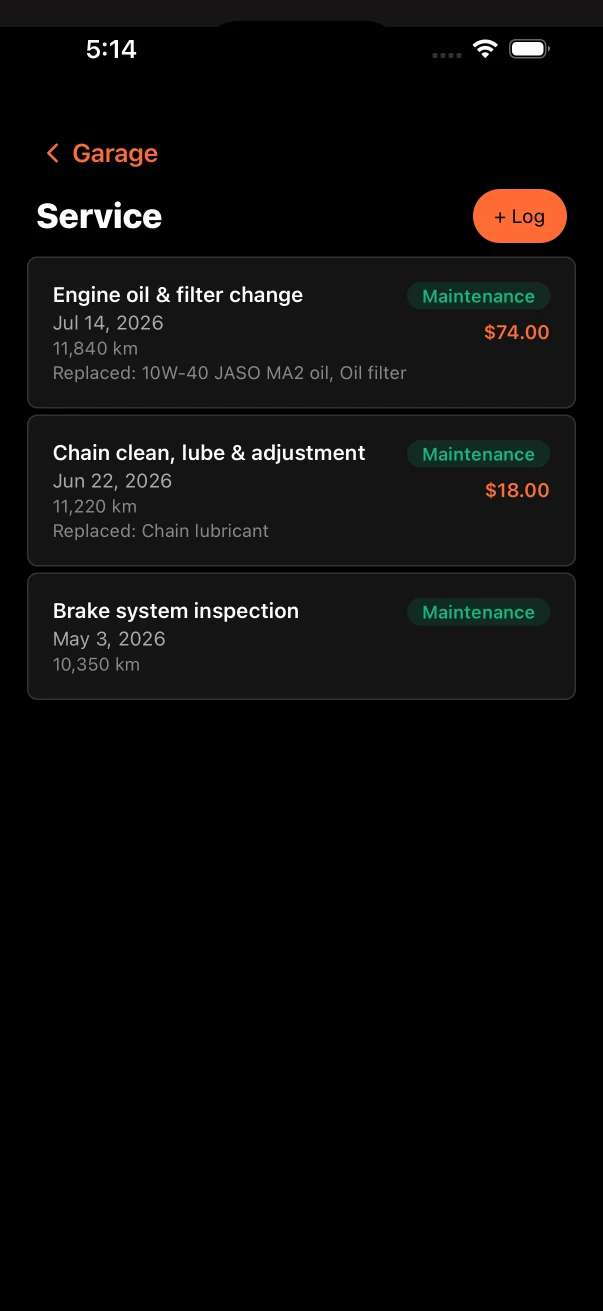
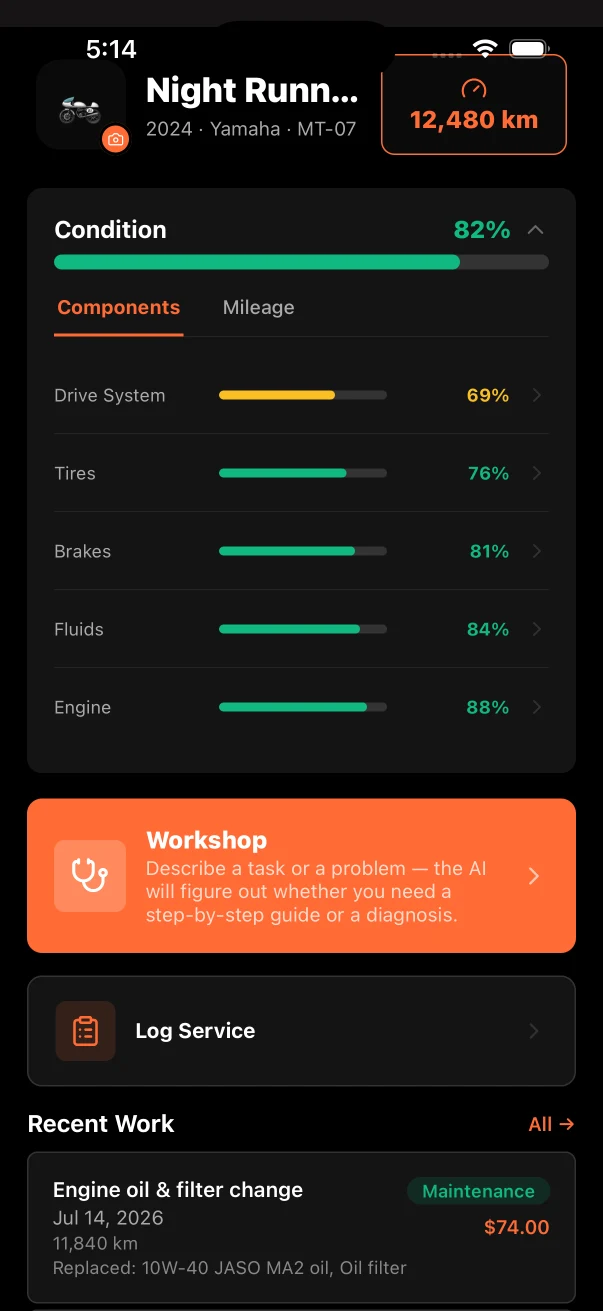
After inspecting a candidate motorcycle, create it in your motorcycle garage, then add a dated pre-purchase note with the VIN, recall-check result, seller-provided records, visible defects, and the service items you would complete before riding. Use that single record to compare multiple bikes consistently, rather than relying on memory after several viewings. If you buy the bike, keep the inspection note as the starting point for its maintenance history. Download Vojo on the App Store
Inside Vojo
Turn seller claims into records you can inspect
Quick answers
Frequently asked questions
Should I avoid every used motorcycle with high mileage?
No. Mileage alone does not establish condition. Review the exact model’s owner-manual requirements, service evidence, recall status, and the motorcycle’s present condition. A lower-mileage bike with long storage, damaged tires, leaks, or no records can require more immediate work than a regularly maintained higher-mileage example.
Is an NHTSA VIN recall check enough before buying a used motorcycle?
No. It is an important safety step, but it does not replace a title review, manufacturer-manual research, physical inspection, or an independent pre-purchase inspection. NHTSA says its VIN search identifies unrepaired recalls for the entered vehicle.
Can I trust a motorcycle that starts and idles well?
A successful start is only one observation. Inspect tires, brakes, controls, lights, fluids, chassis, drive components, and stands before deciding whether the motorcycle is safe to ride. Use the model-specific owner’s manual as the primary guide.
What if the seller has no service records?
Lack of records does not prove neglect, but it leaves maintenance unverified. Budget and negotiate as though the condition of overdue items is unknown, or arrange a qualified inspection. Do not let a verbal assurance substitute for evidence.
Are modifications always a reason to walk away?
No. Documented, properly installed modifications may be suitable. Be cautious when changes affect safety-critical systems such as brakes, tires, wheels, steering, suspension, lighting, fuel delivery, or wiring. If parts and workmanship cannot be identified or inspected, evaluate the motorcycle as a project rather than a proven road-ready bike.