
Off-Road Motorcycle Types: Choose the Right Bike
Learn how motocross, cross-country, hard enduro, trials, dual-sport, and adventure motorcycles differ, then choose for your terrain and plans.
Fact-checked against cited official documentation
Reviewed against Fact-checked against Honda CRF450R, CRF450RX, and CRF450RL technical documentation plus NHTSA helmet guidance and MSF off-highway training material..
Last updated September 23, 2026
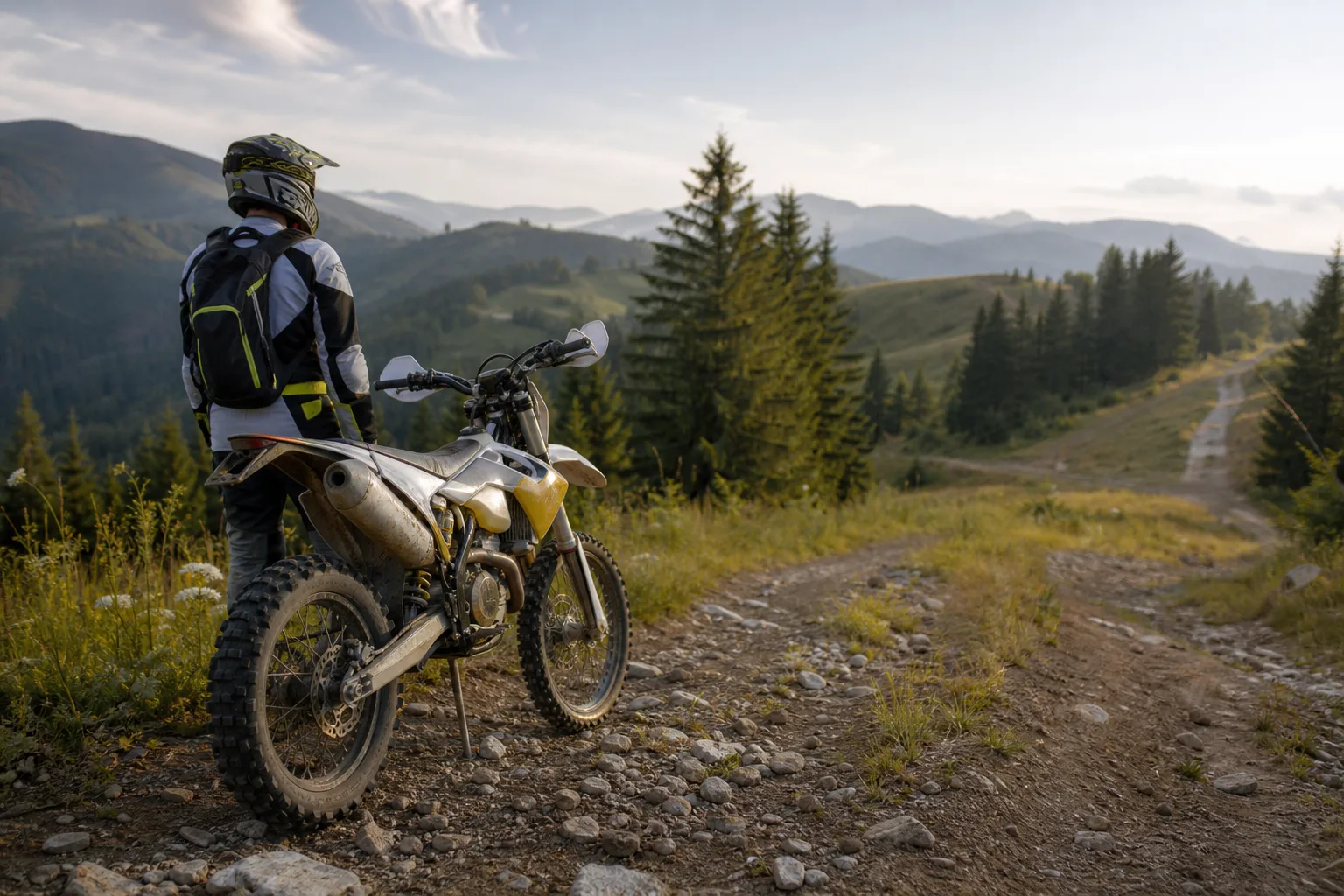
Off-road motorcycle types are easier to understand when you begin with the ride—not the styling. A motocross bike, a cross-country racer, a dual-sport, and an adventure motorcycle can all have a high front fender and knobby tires, but they are built around very different priorities.
The useful question is: where will you ride most often, at what pace, and how will you get there? That answer should guide your shortlist more than engine size, internet labels, or the appearance of a bike in a showroom.
For a broader ownership baseline after choosing a bike, see the Motorcycle Maintenance Guide.
Start With the Ride You Actually Plan to Do
Write down your most likely riding day in plain language:
- Motocross track: repeated braking bumps, turns, jumps, and short sessions on a closed course.
- Woods or cross-country course: longer riding over changing dirt, roots, rocks, and tighter trails.
- Technical hard enduro terrain: slow, steep, obstacle-heavy riding where balance, clutch control, and recovery matter as much as speed.
- Trials practice: low-speed precision over obstacles, with minimal interest in covering distance.
- Mixed public roads and dirt: riding to trails as well as on them.
- Long-distance travel with unpaved sections: carrying gear, covering pavement miles, and accepting that difficult trail work is not the main mission.
Be honest about access. If your nearest legal riding is a motocross facility, buying a road-oriented adventure bike because it looks versatile will not make track riding easier. Likewise, a competition motocross bike is not automatically appropriate for public roads.
The Main Off-Road Motorcycle Types
Motocross
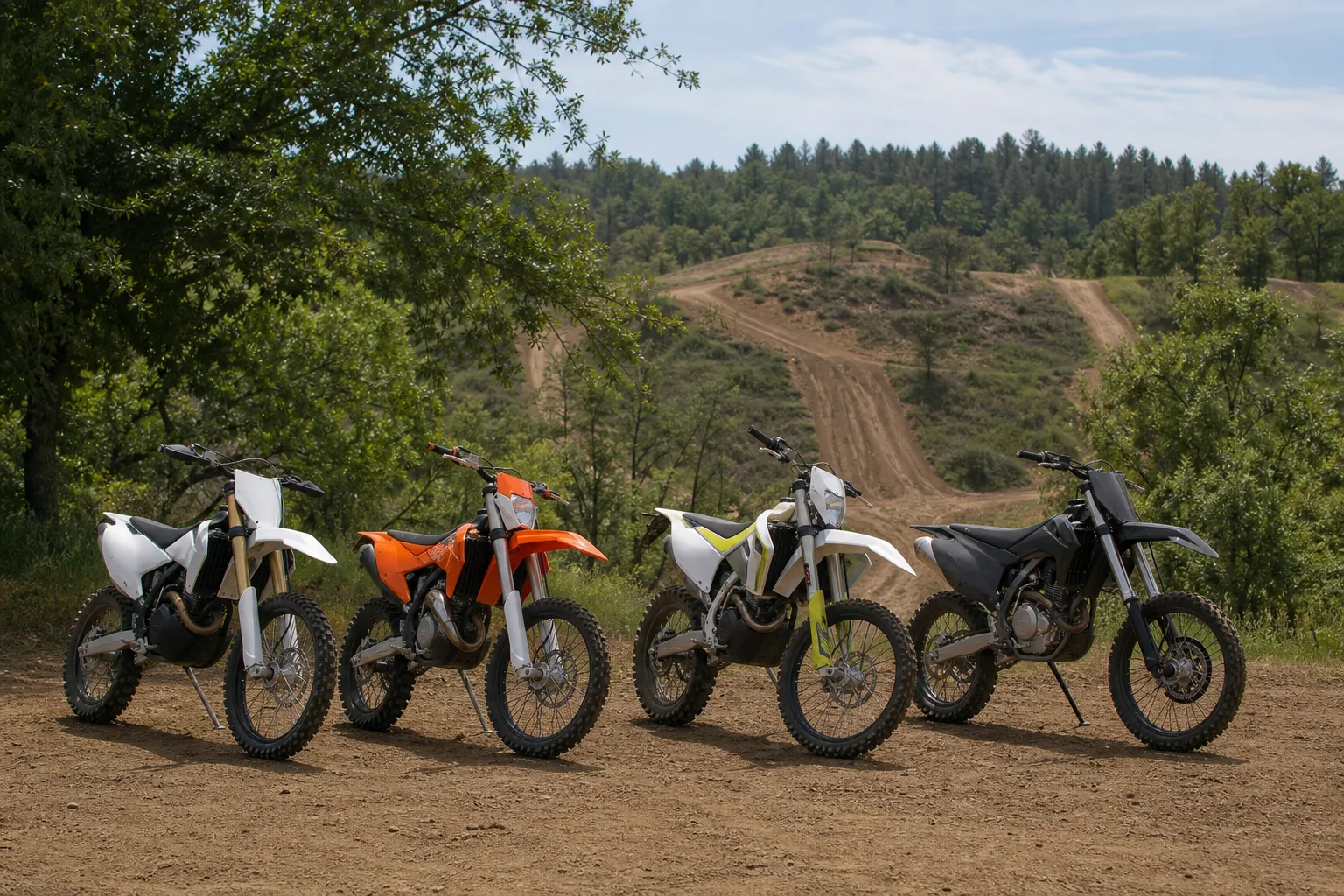
Motocross motorcycles are purpose-built for closed-course MX riding. They prioritize a responsive chassis, strong suspension performance for track impacts, and close-ratio gearing suited to racing conditions. Honda’s CRF450R is one current example: its published specification lists a close-ratio five-speed gearbox, a 19-inch rear tire, and roughly 12 inches of front and rear suspension travel.
Choose this type when a motocross track is your primary destination. It is a specialist tool, not the default answer for casual trail exploration.
Cross-country and traditional enduro
Cross-country machines are aimed at fast off-road riding over more varied terrain than a motocross track. They often preserve a competition-focused feel while using details that better suit woods and rough ground. For example, Honda lists the CRF450RX with an 18-inch rear tire and a larger fuel capacity than the CRF450R in its owner documentation.
This category can suit riders who want organized off-road events, quicker trail riding, or a race-oriented bike that spends more time away from groomed jumps.
Hard enduro
Hard enduro is less a single universal motorcycle specification than a demanding style of riding: steep climbs, rocks, logs, ledges, tight turns, and frequent low-speed technical work. Riders usually value manageable power delivery, precise control, traction, low-speed balance, and the ability to recover the bike when momentum disappears.
Do not buy into the category solely because it looks exciting online. Hard enduro exposes fitness, technique, and risk management quickly. A skills course and easier terrain are better first steps than copying an expert rider’s equipment list.
Trials
Trials motorcycles are designed around balance and precise obstacle negotiation rather than distance or speed. Their compact layout, standing-focused ergonomics, and very low-speed control make them excellent training tools for body position and clutch/throttle finesse.
They are not practical substitutes for a trail bike or a travel motorcycle. Choose trials because you want to practice trials.
Dual-sport
A dual-sport motorcycle is the practical bridge between public roads and unpaved routes. Honda describes its CRF450RL as street legal and pairs its off-road-oriented chassis with a wide-ratio six-speed transmission. That combination illustrates the category’s central compromise: usable road access alongside real off-pavement capability.
Before buying, verify the exact model’s road equipment, emissions status, title, registration requirements, insurance requirements, and permitted riding areas where you live. “Dual-sport” is not a guarantee that every road, trail, or public land route is legal to use.
Adventure motorcycle
Adventure motorcycles are designed for travel flexibility: pavement distance, luggage, weather exposure, rough roads, and moderate unpaved surfaces. They can be highly capable, but their mass, width, height, and luggage load can make difficult terrain more consequential.
Choose an adventure motorcycle when the trip itself matters as much as the trail: long approaches, overnight gear, passenger use, and mixed-surface travel. For a deeper fit-and-use comparison, see How to Choose an Adventure Touring Motorcycle That Actually Fits Your Riding.
Compare Categories by Their Job
| Type | Best starting use | Main design priority | Usually a poor match for |
|---|---|---|---|
| Motocross | Closed motocross tracks | Repeated high-speed track impacts and fast lap riding | Public-road access and long-distance comfort |
| Cross-country / enduro | Woods, off-road events, varied trails | Sustained off-road pace over changing terrain | Frequent highway travel |
| Hard enduro | Severe technical obstacles | Low-speed control and technical terrain performance | Beginners seeking an easy all-rounder |
| Trials | Balance and obstacle practice | Precision at very low speed | Covering distance or conventional trail travel |
| Dual-sport | Roads plus dirt routes | Legal road access with off-pavement ability | Being the absolute specialist in either role |
| Adventure | Travel and mixed surfaces | Distance, carrying capacity, and all-day versatility | Tight, high-consequence technical terrain for most riders |
The table is a starting point, not a rulebook. Manufacturers make models that overlap, and setup changes can shift a bike’s behavior. Compare the exact owner’s manual, specification sheet, tire fitment, load limits, maintenance schedule, and safety notices for the bike you are considering.
A Manufacturer-First Safety Check Before You Buy
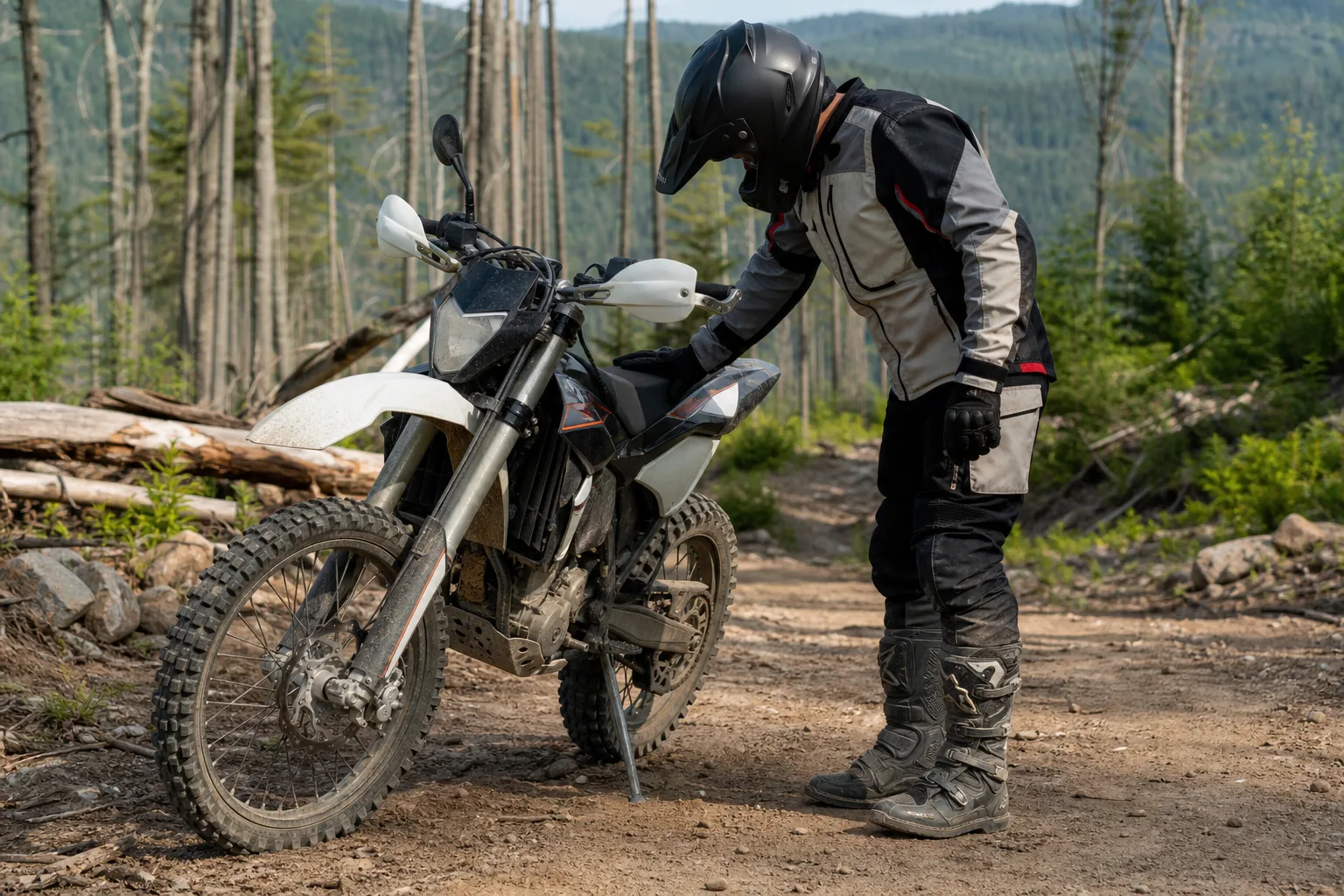
Start with the manufacturer’s owner information for the exact year and model. Do not transfer tire pressures, service intervals, oil specifications, loading limits, or suspension settings from another motorcycle, even if it looks similar.
For riding gear, use a properly fitted helmet that carries the required DOT marking for U.S. road use. NHTSA distinguishes off-road and dual-sport helmet designs and emphasizes fit as well as compliance. For new or returning off-road riders, hands-on training is a sensible first investment: the Motorcycle Safety Foundation’s DirtBike School focuses on fundamental off-highway skills and protective gear.
If you will ride on public roads, learn the motorcycle in a controlled area first, ride sober, and complete the before-ride checks in the owner’s manual. NHTSA specifically recommends checking tires, brakes, lights, signals, fluid levels, leaks, and cargo security before a road ride.
Checklist: Choose an Off-Road Motorcycle With Fewer Regrets
- Name the terrain you will ride most, not the terrain you hope to try once.
- Decide whether public-road registration is essential.
- Check whether you can safely manage the bike’s height, weight, and recovery after a tip-over.
- Read the exact model’s owner’s manual and maintenance schedule before placing a deposit.
- Confirm legal access rules for your intended riding area.
- Budget for helmet, eye protection, boots, gloves, protective clothing, training, transport, and routine service.
- Test the standing position, control reach, clutch feel, and ability to move the motorcycle with the engine off.
- If buying used, inspect service records, recall status, air filtration condition, controls, brakes, tires, wheels, and leaks.
- Begin on terrain below your limit and build skill before adding speed, passengers, luggage, or difficult obstacles.
Test the Category Assumption Before Buying
Rent, borrow through an approved program, attend training, or arrange a legal demonstration when possible. Evaluate starting, stopping, standing position, slow control, lifting effort, transport, maintenance access, and the terrain you can actually reach. A short controlled experience can expose a mismatch that specification tables miss.
Write down what the test changed about your plan. If the motorcycle is excellent on one surface but difficult to transport, license, maintain, or ride on the route to the trail, that tradeoff belongs in the decision. Choose for the riding week you can realistically repeat, not the most dramatic image in the brochure.
Include the support ecosystem in the choice: nearby training, legal riding areas, transport, parts access, service capability, protective equipment, and people who can help recover the motorcycle. A theoretically ideal category is not practical when its basic operating needs cannot be met.
How Vojo Helps
After you choose a category, create the motorcycle in Vojo and use the Motorcycle Maintenance Tracker to make a repeatable pre-ride checklist for that bike. Add its owner-manual items—such as tire inspection, brake check, chain check, and fluid check—then log what you found after each ride. This keeps track-day, trail-day, and travel-bike routines separate instead of relying on a generic checklist.
Quick answers
Frequently asked questions
Is an enduro motorcycle the same as a motocross motorcycle?
Not necessarily. Motocross motorcycles are designed around closed-course MX riding, while enduro and cross-country motorcycles are generally aimed at more varied off-road terrain. Compare the exact model’s gearing, tires, fuel capacity, equipment, and owner guidance rather than relying on the label alone.
Can I ride a motocross bike on public roads?
Do not assume so. Road use depends on the motorcycle’s certification and equipment, state registration rules, insurance requirements, and local law. Check the exact model documents and your state requirements before purchase.
Should a beginner start with hard enduro?
Usually, no. Hard enduro terrain adds technical difficulty and higher consequences. Build braking, standing, turning, clutch, throttle, and recovery skills in a controlled setting first; structured off-highway instruction is a strong option.
What is the biggest difference between a dual-sport and an adventure motorcycle?
A dual-sport usually puts more emphasis on lighter, more trail-oriented riding with legal road access. An adventure motorcycle generally prioritizes travel range, pavement comfort, carrying gear, and mixed-surface versatility. Individual models can overlap substantially.
Do I need different gear for dirt and dual-sport riding?
Your gear must fit the riding environment and meet applicable legal requirements. NHTSA notes that off-road and dual-sport helmets have different feature sets; in every case, choose a correctly fitted helmet and use protective clothing, boots, gloves, and eye protection appropriate to the ride.