
New Motorcycle Break-In: Why the First-Service Plan Must Come From Your Exact Owner’s Manual
A new motorcycle break in period guide that explains why RPM limits, ride distance, brake use, and first service must follow your exact owner’s manual.
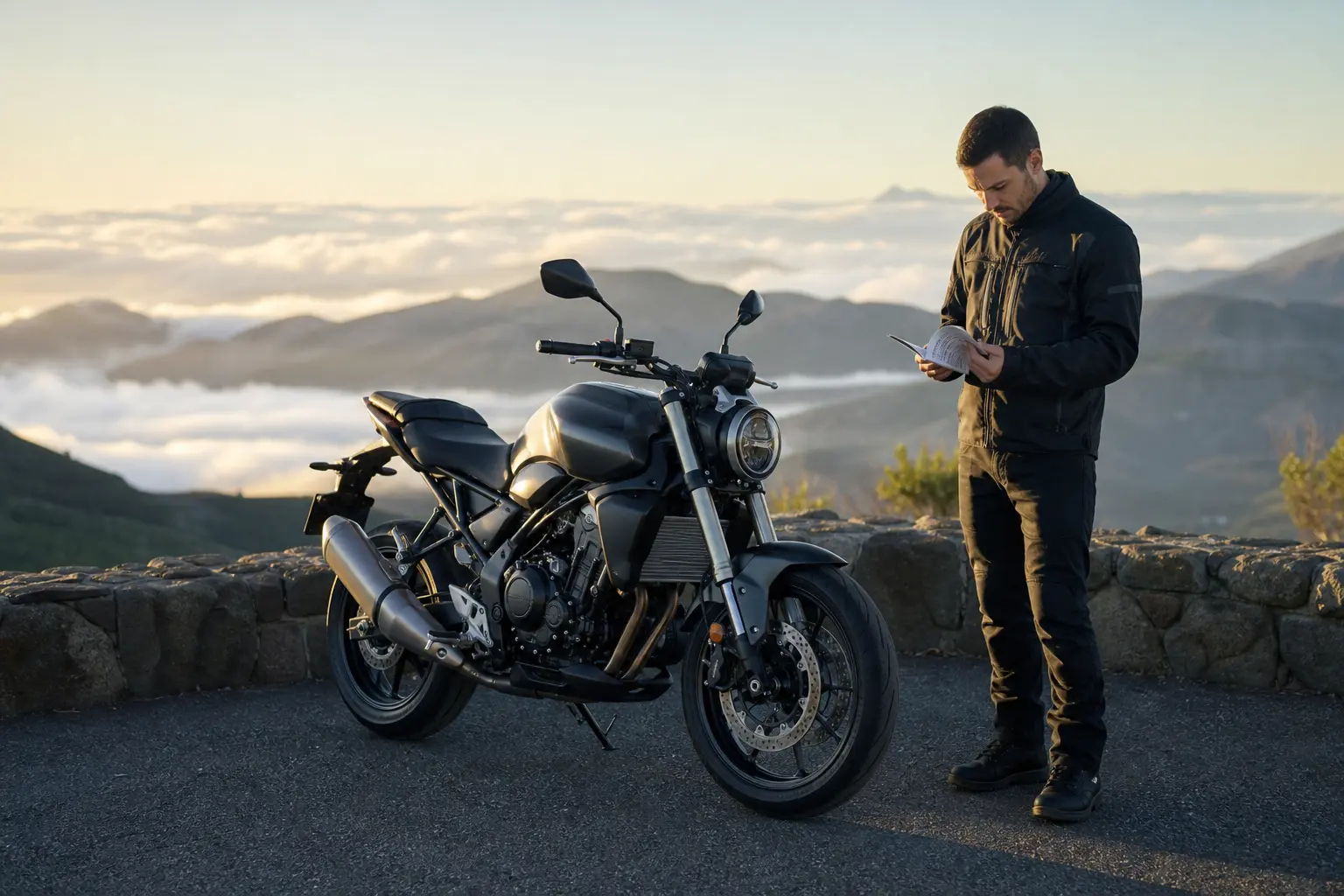
Fact-checked against cited official documentation
Reviewed against Honda CRF300F and CRF450L owner manuals plus Harley-Davidson break-in guidance, checked for differing break-in periods, operating advice, and initial-service direction..
Last updated September 28, 2026
A new motorcycle break in period guide should not hand you one mileage target, one RPM ceiling, or one generic first-service appointment. Those details can change with the motorcycle, its intended use, and the manufacturer’s instructions.
The reliable rule is simpler: use the owner’s manual supplied for your exact model and model year as the governing document. Read its break-in section, maintenance schedule, warning-light guidance, and first-service record before the first substantial ride. If the manual and a dealer handout differ, ask the dealer to clarify the instruction in writing before you improvise.
Why a universal break-in plan fails
“Keep it below a certain RPM for a certain number of miles” sounds useful, but it may be wrong for the bike in your garage. Manufacturer documents show that break-in frameworks can differ not only between brands, but even between on-road and off-road use of the same motorcycle family.
| Official example | Break-in framework described | What it proves for every new-bike owner |
|---|---|---|
| Honda CRF300F owner’s manual | First operating day or 15 miles; avoid full-throttle starts and rapid acceleration | An off-road motorcycle may use a short, use-based break-in window. |
| Honda CRF450L owner’s manual | Separate on-road and off-road break-in guidance | Intended use can change the instruction even within one model’s documentation. |
| Harley-Davidson owner guidance | A longer initial period with model-specific engine-speed, load, braking, and initial-service instructions | A street motorcycle may call for a more structured plan, including varied operating conditions and an initial service. |
These are comparisons, not transferable settings. Do not borrow the numbers, RPM guidance, brake advice, or service timing from any example above for another motorcycle. Honda’s published manuals show different break-in periods for its CRF300F and CRF450L examples, while Harley-Davidson’s guidance uses another framework altogether. That difference is the point: your manual wins.
What your exact manual should answer

Open the manual’s table of contents or index and look for break-in, maintenance schedule, service records, before riding, and warning indicators. Capture the answers below in one place:
- What starts the break-in period: mileage, time, operating day, or another condition?
- Are there engine-speed, throttle, acceleration, load, or cruising instructions?
- Does the guidance differ for road, trail, competition, passenger, or cargo use?
- Is there separate guidance for bedding in brakes or other components?
- When is the initial inspection or service due, and what documentation should be retained?
- What warnings require you to stop, reduce speed, or contact a dealer?
This is more useful than memorizing a universal rule because it produces a plan you can actually follow. It also keeps your riding decisions aligned with the motorcycle’s intended operating conditions.
Manufacturer-first safety guidance
Treat the break-in period as a time to learn both the motorcycle and its controls. Start with the manufacturer’s pre-ride checks, approved protective gear, and operating limits. Choose low-stress routes or terrain where you can concentrate on smooth inputs, traffic, surfaces, and the machine’s behavior rather than chasing speed or distance.
Do not use break-in as a reason to overlook a concern. Park the motorcycle and consult the owner’s manual or an authorized dealer if you see a warning indicator that does not behave as the manual describes, find a fluid leak, notice an abnormal control feel, or suspect damage. Do not attempt to compensate with a guessed adjustment, an internet RPM limit, or an unverified repair.
For a broader, model-first routine beyond the initial period, see the Motorcycle Maintenance Guide.
Your manual-first break-in checklist
- Confirm the VIN, exact model, and model year match the owner’s manual.
- Read the complete break-in section before your first substantial ride.
- Write down the manual’s end point and any riding restrictions in your own words.
- Find the maintenance schedule and reserve the required initial service using the manual’s stated timing.
- Review the pre-ride inspection and perform only the checks the manual assigns to the rider.
- Plan early rides around conditions that make smooth, attentive operation practical.
- Avoid adding passenger, cargo, accessories, or riding modes that the manual restricts or that complicate learning the bike.
- Record the odometer, date, questions, warning lights, and dealer-service confirmation.
- Keep the service invoice and manual together with the motorcycle’s records.
First service is part of the plan, not an afterthought
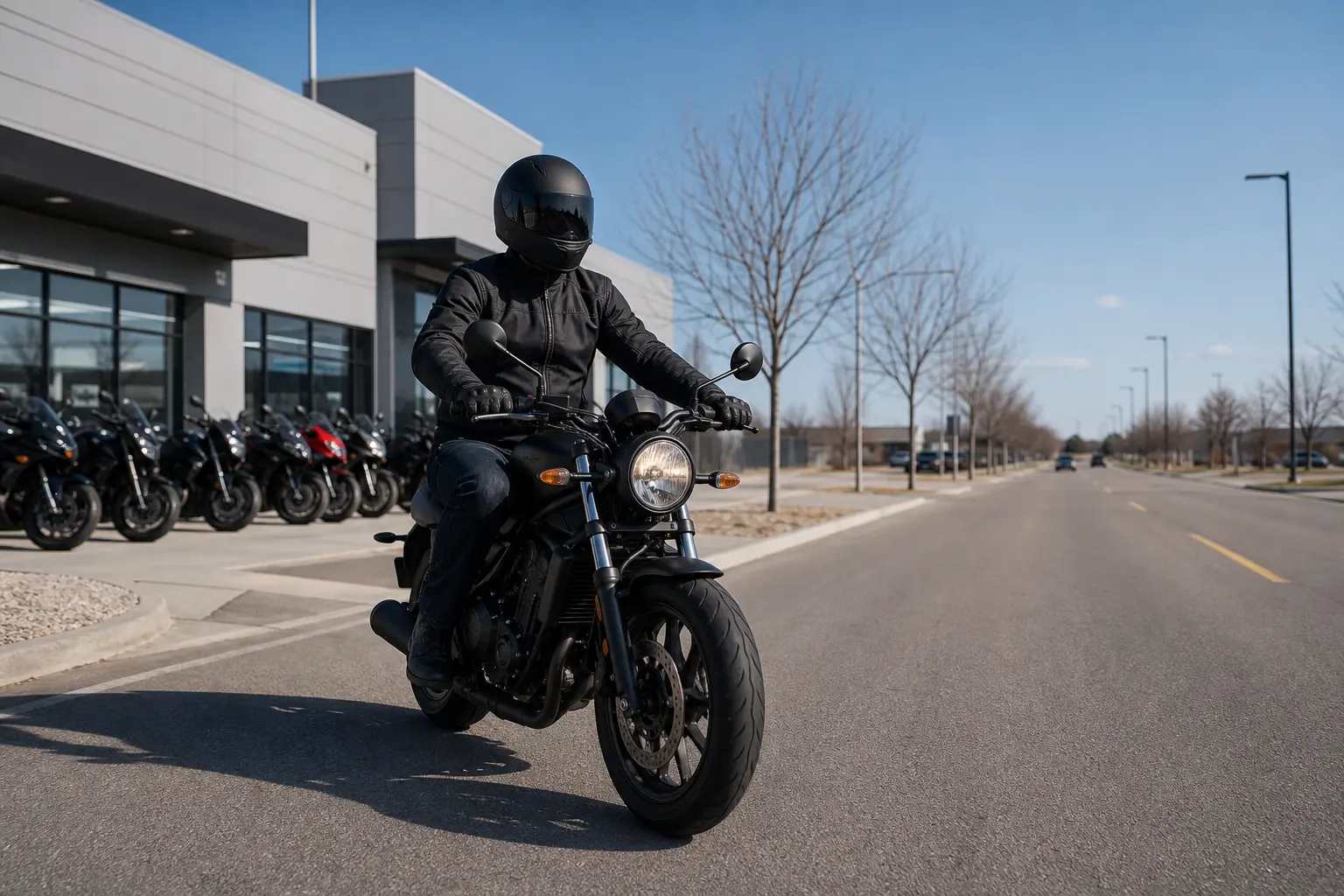
The initial service is not a generic “oil change at some number of miles.” It is a manufacturer-scheduled event for a particular motorcycle. Harley-Davidson’s owner guidance explicitly connects its initial service with component break-in and powertrain contaminants; Honda manuals likewise place break-in guidance alongside scheduled maintenance material.
Your job is not to duplicate service work from a generic guide. Your job is to identify the appointment point in the exact manual, arrange qualified service when required, and keep the record. If the first-service deadline will arrive before you can get an appointment, contact the dealer before passing it rather than assuming a small overrun is harmless.
How to compare advice without copying the wrong plan
A good comparison asks what category of instruction varies, rather than asking which model has the most aggressive limit.
| Compare this | Safe conclusion | Unsafe conclusion |
|---|---|---|
| Break-in duration | Manufacturers may define the period differently. | Every motorcycle should be broken in for the same distance. |
| Engine operation | Some manuals specify speed, throttle, load, or variation guidance. | Another bike’s RPM number is suitable for mine. |
| Braking | A manual may include a distinct initial brake-use instruction. | All new brakes need the same treatment. |
| First service | The due point and record may be model-specific. | A dealer’s generic interval replaces the manual. |
| Riding environment | Street and off-road use can be addressed differently. | Terrain, load, and intended use do not matter. |
The practical result: comparisons can teach you to look harder at your manual, but they cannot replace it.
How Vojo Helps
Create a motorcycle in the Vojo maintenance tracker, then add a one-time Break-in complete task using the exact end point from your owner’s manual. Add the manufacturer’s initial-service due point as a separate task, attach a photo or note of the relevant manual page, and log each early ride’s odometer reading. When the service is complete, save the invoice and date so the next owner—or future you—has a clear record.
Quick answers
Frequently asked questions
Do all new motorcycles have the same break-in RPM limit?
No. Official manufacturer guidance differs by motorcycle and intended use. Use only the RPM, throttle, load, and riding instructions printed for your exact model and model year.
Can I use another rider’s first-service mileage as my target?
No. Another motorcycle’s interval is only a topic signal, not a service specification for yours. Follow your owner’s manual and confirm the appointment with an authorized dealer when needed.
Why might road and off-road break-in guidance differ?
The manufacturer may define separate operating conditions and break-in periods for different uses. Honda’s CRF450L manual is one official example that distinguishes on-road from off-road guidance.
Should I use cruise control during break-in?
Only if your exact owner’s manual permits it. Do not infer permission from another model; Harley-Davidson’s cited guidance, for example, says not to use cruise control during its stated initial period.
What if a warning light appears during a new motorcycle’s break-in period?
Follow the warning-light instructions in your owner’s manual. If the manual calls for stopping, reducing speed, or dealer attention, do that rather than continuing simply to complete the break-in mileage.