
Motorcycle Headlight Aim: Why Load, Suspension, and Rider Position Change What You See
Motorcycle headlight aim can change with a passenger, luggage, suspension adjustment, or rider position. Use this conservative inspection and troubleshooting guide.

Fact-checked against cited official documentation
Reviewed against Fact-checked against MSF T-CLOCS headlamp inspection guidance and MSF visibility guidance on keeping the headlight working..
Last updated October 22, 2026
A motorcycle headlight can be electrically functional and still show the road poorly. A passenger climbs aboard, luggage is strapped to the rear, suspension settings change, or the rider settles into a different position. The motorcycle’s attitude changes with them. The beam may then point farther upward or downward than expected.
That is the practical problem behind motorcycle headlight aim adjustment with rider load. It is not primarily a question of buying a brighter bulb. It is a question of whether the motorcycle is configured and loaded as it will be ridden, whether the headlamp is operating correctly, and whether the beam is directed appropriately for that situation.
The safest approach is conservative: start with the owner’s manual, inspect the motorcycle while parked, and do not improvise an adjustment based on a generic measurement or another model’s instructions. If the lamp is damaged, loose, flickering, unexpectedly aimed, or impossible to evaluate confidently, postpone a night ride and use a qualified technician.
This guide explains how to reason through the symptoms without presenting an exact repair procedure. For the wider routine, keep a Motorcycle Maintenance Guide alongside the model-specific service information.
Why Rider Load Changes Headlight Aim

A motorcycle does not remain at exactly the same angle when its load changes. The rider’s weight is part of the normal operating load. A passenger adds another major change, while a top case, touring luggage, tools, or other cargo can alter how the motorcycle settles. The result can be a different relationship between the headlamp and the road.
When the front of the motorcycle points higher relative to the road, the beam can reach higher than it did during a solo inspection. That may reduce useful illumination close to the motorcycle and increase the chance of dazzling another road user. When the front sits lower, the beam can appear short and concentrated near the motorcycle, reducing the rider’s view farther ahead.
The important point is not that every passenger or bag creates the same result. Motorcycle design, suspension condition, load placement, and the model’s approved load limits all matter. A touring motorcycle and a small commuter motorcycle may respond very differently to the same bag. Even the same motorcycle can behave differently when cargo is placed high, far back, or unevenly.
Treat headlight aim as part of the motorcycle’s loaded setup rather than as a permanent setting that can be forgotten after a solo check. If the motorcycle has a manufacturer-provided load or headlamp adjustment method, use that method. If the manual does not explain a rider-adjustable feature, do not assume that a visible knob, screw, or lever is intended for casual adjustment.
The Motorcycle Safety Foundation includes headlamp condition, aim, and operation in its T-CLOCS pre-ride inspection guidance. That makes aim a normal inspection topic, not an issue reserved for a failed bulb or a workshop visit. Read the MSF T-CLOCS checklist.
What You Should Notice Before Touching an Adjustment
A changed beam pattern is a symptom, not a diagnosis. Before thinking about adjustment, separate a load-related change from an electrical, mechanical, or visibility problem.
Begin with the motorcycle parked securely in a suitable place. Look at the headlamp lens, housing, mounting area, and surrounding bodywork. You are checking for obvious damage, looseness, displacement, contamination, or anything that suggests the lamp is no longer held in its intended position. Do not reach into a hot assembly or begin disassembly just because the beam looks unusual.
Then switch the headlamp on using the motorcycle’s normal controls. Confirm that the lamp illuminates as expected and that its operation is stable. A headlamp that cuts out, flickers, dims unexpectedly, or behaves differently when the handlebars move is not simply an aim problem. It deserves an electrical and mechanical diagnosis before riding in darkness.
Consider what changed immediately before the symptom appeared:
- Was a passenger added?
- Was luggage or a top case fitted, removed, or repositioned?
- Was the rear suspension setting changed?
- Was the motorcycle recently serviced, dropped, or moved after a collision?
- Was the headlamp, fairing, bracket, or front end disturbed?
- Does the problem occur only with the motorcycle loaded, or also when ridden solo?
- Does another road user repeatedly flash their lights at you at night?
These questions help identify the next safe decision. If the beam changes only with a known load change and the motorcycle remains within the manufacturer’s approved loading guidance, the owner’s manual is the place to look for the intended setup. If the beam is wrong in every configuration, suspect a more fundamental issue and seek service rather than compensating blindly.
Rider Position, Suspension, and the Beam Pattern
Rider position can affect what you perceive even when the lamp itself has not moved. A rider sitting farther forward, standing briefly, leaning into a turn, or carrying weight differently changes the viewing angle. The motorcycle may also respond dynamically to braking, acceleration, bumps, and road slope. A beam that looks acceptable while stationary on level ground may not provide the same view in motion.
This does not mean a rider should repeatedly alter the headlamp for every body movement. It means the inspection should reflect the way the motorcycle will actually be used. A solo commuter, a rider with a passenger, and a loaded touring setup are different operating conditions.
Suspension changes deserve particular caution. Preload or other settings may be intended to help the motorcycle accommodate a different load, but the correct setting is model-specific. The owner’s manual may provide approved settings, load information, or a procedure for using a built-in headlamp adjustment. Do not substitute a forum recommendation or a setting copied from a different model.
If the motorcycle has recently had suspension work, a lowered or raised chassis configuration, replacement parts, or a significant change in carrying equipment, the old beam check may no longer represent the current setup. A technician can evaluate whether the suspension, load, and headlamp relationship is within the manufacturer’s intended range.
The goal is not to make the beam as long as possible. A beam that reaches farther but points into approaching traffic is not a successful adjustment. Useful forward visibility and consideration for other road users have to be evaluated together.
A Conservative Troubleshooting Sequence
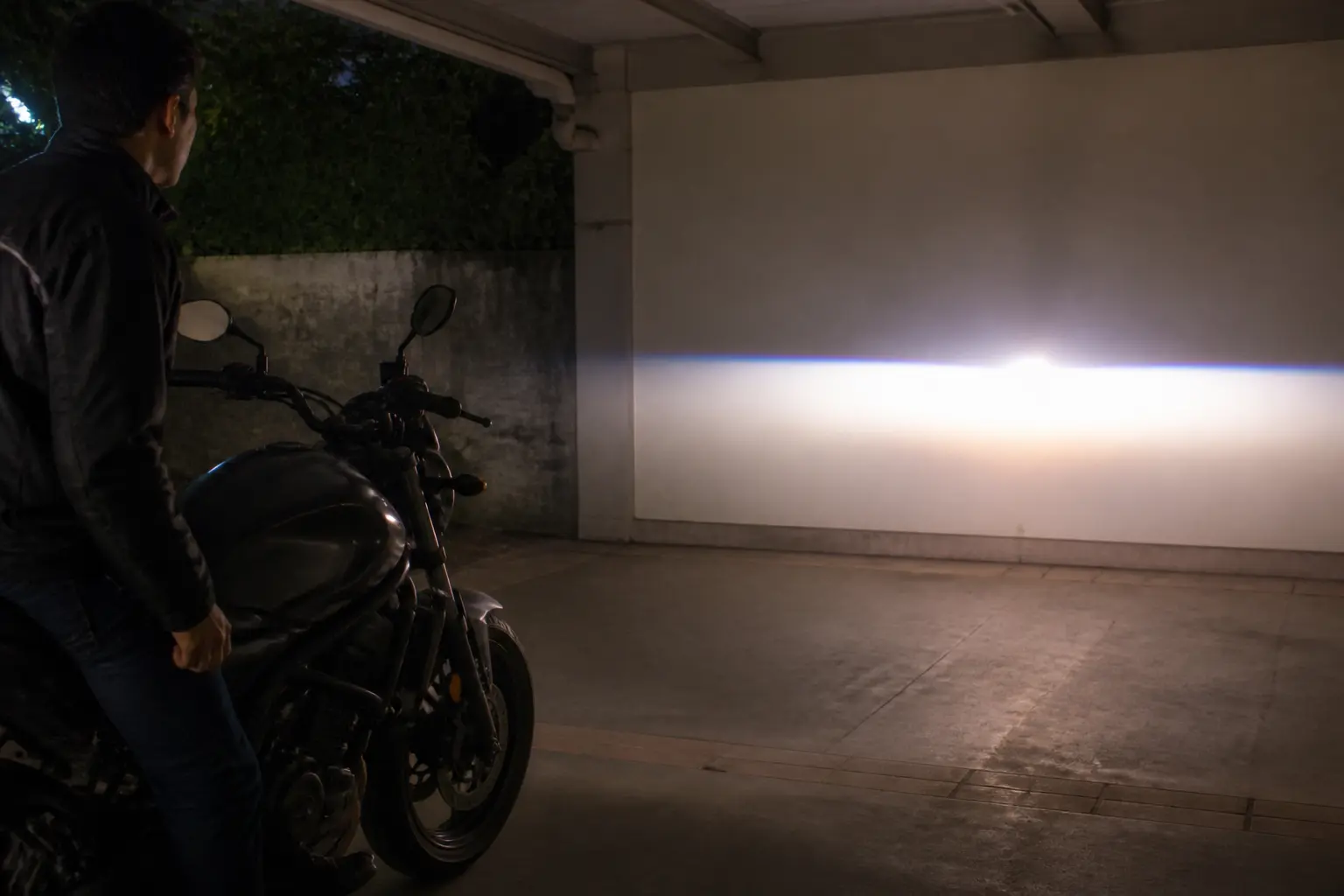
Use the following sequence as a decision aid, not as a substitute for the manufacturer’s instructions.
1. Establish the normal configuration
Write down how the motorcycle is normally used at night. Include whether you ride alone, carry a passenger, use side cases or a top case, and regularly carry tools or other equipment. Note any approved load information in the owner’s manual.
This creates a baseline. Without one, it is easy to adjust the motorcycle for an unusual empty or overloaded state and then ride with an inappropriate setup later.
2. Check the obvious condition of the lamp
With the motorcycle parked, inspect the lens and housing for visible damage, moisture, contamination, or displacement. Check that the assembly appears secure and that nothing is pressing against it. Confirm normal operation using the motorcycle’s controls.
Do not interpret a dark area, irregular beam, or weak output as proof that the aim is wrong. The cause may be a lamp problem, a power problem, a damaged reflector, a cloudy lens, or a component that is not seated correctly. Those conditions require model-specific diagnosis.
3. Recreate the intended load without exceeding it
If the headlight seems correct solo but wrong with luggage or a passenger, compare the two configurations in a controlled parked inspection. Use only the motorcycle’s approved seating and cargo arrangements. Secure cargo as directed by the manufacturer, and do not use a passenger or loose load as a makeshift test weight.
A passenger should never be asked to help with a headlight check in a place where the motorcycle could move unexpectedly. The purpose of the comparison is to observe a configuration, not to turn the inspection into a balancing exercise.
4. Check the manual for permitted adjustment
Look for the sections covering lighting, load limits, suspension settings, and pre-ride checks. Some motorcycles provide a rider-accessible way to accommodate load; others require a service operation or provide no user adjustment of the type you may be expecting.
Follow the exact instructions for your model if an adjustment is authorized. Do not force a control, turn an unidentified fastener, or change several settings at once. If the manual is unavailable, obtain the correct documentation before making changes.
5. Evaluate the result for both directions of traffic
A headlight is not correct merely because the rider sees a bright patch. Consider whether the beam appears unreasonably high, whether approaching traffic could be affected, and whether the useful view close to the motorcycle has become inadequate.
Use a safe, controlled location and avoid treating public traffic as a test environment. If you cannot make a confident assessment without riding into darkness, do not conduct the experiment on the road.
6. Escalate when the symptom does not fit the load
Arrange inspection by a qualified technician when the aim changes unexpectedly, the lamp is loose, the beam is asymmetric in a way the manual does not describe, the light flickers, the housing is damaged, or the motorcycle has recently been involved in a fall or front-end impact.
A professional inspection is also the sensible choice when a suspension or chassis change has altered the motorcycle’s attitude and you are unsure how the manufacturer expects the lamp to be set. Avoid compensating for a possible structural or suspension issue by pointing the lamp elsewhere.
Headlight Aim Scenarios at a Glance
| Situation | What may change | Safe first response | When to stop and seek help |
|---|---|---|---|
| Solo rider to rider with passenger | Motorcycle attitude and beam direction | Check approved passenger and load guidance, then consult the manual | Beam is high, unstable, or cannot be evaluated confidently |
| Empty motorcycle to loaded touring setup | Rear loading and the rider’s position | Use the manufacturer’s cargo limits and intended settings | Cargo exceeds guidance or the beam remains wrong after the approved setup |
| Recent suspension adjustment | Chassis attitude and ride behavior | Review the model’s suspension and lighting information together | You are unsure which setting is approved or the motorcycle handles abnormally |
| Headlamp or fairing recently disturbed | Lamp position or mounting security | Inspect for visible displacement and confirm operation | Housing is loose, damaged, wet inside, or no longer aligns normally |
| Beam appears weak or intermittent | Possible operating or electrical fault | Treat it as a function problem, not an aim problem | Flicker, cutout, unusual dimming, or loss of illumination occurs |
| Other drivers react to the beam | Possible excessive glare or poor aim | Avoid night riding until the cause is checked | You cannot establish a safe beam position without guesswork |
Why Brightness Is Not the Same as Correct Aim
A brighter light does not automatically solve poor aim. If the beam is directed too high, additional intensity can increase glare without improving the road immediately ahead. If the lamp is aimed too low, brightness may not compensate for a short useful viewing distance. A damaged or incorrectly installed lighting component can also produce a pattern that looks bright from the rider’s seat but performs poorly on the road.
This is why a headlight aim complaint should not automatically become a bulb-selection project. The existing lamp may be operating normally, while the motorcycle’s load or attitude has changed. Conversely, a headlight that has been modified may have a compatibility or beam-pattern issue that adjustment alone cannot correct.
For this article’s question, keep the diagnostic order simple: condition and operation first, load and motorcycle setup second, manufacturer-approved aim information third, and replacement or repair decisions only after the cause is understood. The separate question of LED replacement has different compatibility and compliance considerations; it should not be used as a shortcut for an aim problem.
Manufacturer-First Safety Guidance for Night Riding
The manufacturer’s owner’s manual should control model-specific decisions. Use it for approved passenger and cargo arrangements, load limits, suspension information, lamp controls, and any rider-accessible adjustment. If the manual and a generic online instruction disagree, stop and resolve the conflict before riding.
The MSF’s broader motorcycle guidance emphasizes keeping the headlight working and using visibility strategies. That is consistent with a wider safety principle: being able to see is only one part of being seen. Clothing, lane position, following distance, speed appropriate to the available view, and a plan for stopping all matter, but none excuses a headlamp that is not operating or aimed appropriately. Review the MSF motorcycle safety guidance.
Do not use high beam around other road users when the situation or local rules make it inappropriate. Do not assume that a driver’s failure to react means your lamp is correctly aimed, and do not assume that a driver flashing you proves a specific fault. Treat repeated reactions as a reason to inspect the motorcycle before the next night ride.
If visibility is poor because of rain, fog, glare, road geometry, or fatigue, reduce the ride’s demands. A technically correct headlamp does not make an aggressive speed or an exhausted rider safe. When the view is not adequate for a controlled stop, the conservative answer is to slow down, leave the route, or postpone the trip.
A Pre-Ride Headlight and Load Checklist
Use this checklist before a night ride, especially after adding a passenger, fitting luggage, changing suspension settings, or servicing the front of the motorcycle.
Checklist
- Confirm the motorcycle is configured within the manufacturer’s approved passenger and cargo limits.
- Secure luggage as directed by the owner’s manual and check that it does not obstruct the lamp or controls.
- Identify whether tonight’s setup differs from the setup used during the last headlight inspection.
- Inspect the lens, housing, mounting area, and surrounding parts for visible damage, looseness, contamination, or moisture.
- Confirm that the headlamp operates normally and remains stable rather than flickering or cutting out.
- Check the owner’s manual for any approved load-related lighting or suspension guidance.
- Do not turn an unidentified fastener or force a control because the beam looks unusual.
- Evaluate whether the beam provides useful forward visibility without appearing unreasonably high.
- Consider whether approaching road users could be affected by the beam.
- If the motorcycle was dropped, impacted, modified, or recently serviced, treat a changed beam as a reason for inspection.
- If the lamp is damaged, unstable, intermittent, or impossible to assess, avoid riding at night until it is checked.
- Record the configuration and any symptom so a technician can reproduce the condition.
A checklist cannot confirm a precise aim specification. Its purpose is to prevent a rider from overlooking an obvious problem or treating an unknown condition as normal.
How to Document a Changing Beam
A short record can make troubleshooting more efficient. Note the date, motorcycle configuration, rider or passenger arrangement, luggage position, relevant suspension setting if the manual identifies one, and the conditions under which the beam looked wrong. Record whether the symptom appeared while parked, while riding, or only after braking or accelerating.
Avoid relying on memory such as “the light seemed low.” Describe what you observed: the road immediately ahead looked poorly illuminated, the beam appeared to rise when loaded, the lamp flickered over bumps, or approaching traffic reacted repeatedly. This distinction helps separate aim, operation, and riding-environment concerns.
Photographs can be useful for your own records, but they are not a reliable substitute for a controlled inspection. Camera exposure, road slope, lens flare, and automatic image processing can make two beam patterns appear different when the motorcycle has not changed. Give a technician the physical symptoms and the configuration, not only a phone image.
If you use a maintenance tracker, create an entry for the headlight inspection and link it to the load configuration. Record what the owner’s manual says and whether a professional inspection was recommended. This turns an intermittent observation into a usable service history rather than a forgotten concern.
When a Professional Inspection Is the Better Choice
Seek qualified help when the motorcycle has suffered a front-end impact, when the headlamp housing or bracket may be damaged, or when the beam cannot be brought into a confident manufacturer-compliant condition. The same applies when a suspension change has altered handling, when a lamp modification has produced an unfamiliar pattern, or when electrical symptoms accompany the aim complaint.
A technician can assess the complete context rather than chasing the most visible symptom. That context may include the lamp assembly, mounting security, wiring, chassis attitude, suspension condition, and the motorcycle’s intended load. You do not need to identify the failed component before asking for help.
Do not ride to a shop at night if the headlamp is unreliable or the beam creates an obvious visibility risk. Arrange a safer transport option or schedule the inspection when conditions allow. The convenience of riding immediately is not worth turning a known lighting concern into a road hazard.
How Vojo Helps
Use Vojo to turn a load-related headlight concern into a repeatable maintenance workflow. First, open the motorcycle’s service record and create an inspection entry named “Headlight aim—loaded configuration.” Record whether the motorcycle was solo or carrying a passenger, list the luggage arrangement, attach the relevant owner’s-manual note, and add the observed symptom. Then set a reminder for the next night-riding check or for a technician appointment. After the inspection, update the entry with the outcome instead of creating an unrelated note.
That workflow is especially useful when you alternate between commuting, touring, and passenger riding. Your motorcycle service history keeps the configuration and follow-up together, so a future beam change can be compared with what was previously normal.
Quick answers
Frequently asked questions
Can a passenger make a motorcycle headlight point too high?
A passenger changes the motorcycle’s load and attitude, so the beam may appear higher or lower than it does in a solo setup. Check the owner’s manual for approved passenger, load, suspension, and lighting guidance rather than assuming a universal adjustment.
Should I adjust the headlight every time I add luggage?
Not necessarily. First stay within the manufacturer’s load guidance and check whether your model provides an approved load-related setting. Do not make repeated improvised adjustments or turn an unidentified fastener. If the beam changes substantially, have the configuration evaluated.
What if the headlight is bright but the road still looks poorly lit?
Brightness does not prove correct aim or a healthy beam pattern. The lamp may be aimed too low or high, damaged, contaminated, incorrectly installed, or experiencing an operating fault. Treat the symptom as an inspection issue rather than immediately choosing a brighter bulb.
Is a flickering headlight an aim problem?
Usually, flickering or cutting out should be treated as an operation or electrical concern, not a simple aim issue. Avoid night riding until the cause is identified, particularly if the lamp changes when the handlebars move or the motorcycle encounters bumps.
Can I use another motorcycle’s headlight adjustment setting?
No. Adjustment points, load guidance, and intended settings are model-specific. Use the correct owner’s manual or qualified service information for your motorcycle, and do not rely on a generic measurement or a forum recommendation as proof of a safe setting.
When should I stop riding and arrange an inspection?
Stop and arrange help if the lamp is damaged, loose, intermittent, unexpectedly displaced, or impossible to evaluate confidently. Escalate as well after a fall, front-end impact, significant suspension change, or lighting modification that changes the beam pattern.