
Motorcycle Fork Seal Leak: What a Wet Fork Tube Can Signal—and When to Stop Riding
A wet fork tube can signal a leaking seal. Learn when brake-area contamination, reduced damping, or ongoing oil loss means stop riding and arrange inspection.
Fact-checked against cited official documentation
Reviewed against Fact-checked against Harley-Davidson guidance on leaking forks, low oil and rebound, plus MSF T-CLOCS pre-ride checks for brakes, seals, leaks, controls, wheels and suspension..
Last updated October 16, 2026
A motorcycle fork seal leak can I ride? Treat the answer as “not until you have checked the full situation.” A faint mark on a fork tube does not establish a diagnosis by itself. But fresh or recurring oily residue deserves attention because the front forks affect the motorcycle’s stability and handling, and because fluid found near the wheel and brake area changes the safety decision.
The conservative approach is simple: pause before riding, inspect with the motorcycle parked and cool, use your exact owner’s manual as the model-specific authority, and escalate early if oil is present beyond a trace or anywhere it could migrate toward braking parts. Harley-Davidson’s published guidance says leaking, damaged, or worn front-fork parts can adversely affect stability and handling; it also says to see a dealer if a significant fork-oil leak develops.1 The Motorcycle Safety Foundation (MSF) likewise includes suspension condition, seals, brakes, hoses, and fluid leaks in its T-CLOCS pre-ride inspection framework.2
This is not a fork-repair guide. It is a practical, manufacturer-first decision guide for interpreting what you can see, avoiding a risky assumption, and documenting the concern for qualified service.
Start With the Question Behind the Wetness
A wet fork tube is a signal, not a complete verdict. The useful question is not merely, “Is there oil?” It is: What is the material, where is it located, does it return, and what safety systems might it reach?
Motorcycle forks move through a large range of travel. Their exposed tubes pass through sealing areas, and the front end sits close to the fender, wheel, brake hardware, and road spray. That compact layout means an observation that starts as a suspension concern can also become a brake-area cleanliness concern. Do not turn that observation into a precise cause from appearance alone. A qualified technician may need to determine whether the issue is a seal, tube condition, component damage, prior service residue, contamination from another source, or something else.
A useful first separation is between old-looking grime, a one-time trace, and active wetness:
- Old-looking grime is dull, dry, dusty, or stuck in place. It may be road dirt, old cleaner residue, or evidence that something happened earlier. It still warrants a closer check, but it is not proof of an active leak.
- A one-time trace is a small amount of residue with no fresh return after a careful wipe and a short period of stationary observation. This calls for caution and follow-up rather than confidence.
- Active wetness looks fresh, slick, glossy, or newly gathered around the same fork area. If it reappears, spreads, forms a visible run, or reaches nearby components, move from monitoring to a no-ride/service decision.
Do not rely on color alone. Lighting, dust, cleaners, and road film can all distort what you think you see. Likewise, do not assume both fork legs must look identical for the motorcycle to be safe or unsafe. The decision should be based on the total condition: fresh fluid, recurrence, amount, location, brake-area exposure, fork behavior, and the requirements of the motorcycle’s own documentation.
What a Wet Fork Tube Can Signal
Fork oil is part of the fork’s damping system. Harley-Davidson specifically warns that rebound action is impaired when fork-oil level is low.1 In practical terms, that means an oil-loss concern is not cosmetic simply because the motorcycle still rolls, steers, or feels mostly familiar on a gentle ride around the block.
A wet tube can signal several broad categories of concern, without proving any one of them:
- A possible loss of fork oil. If the residue is fork oil and it continues to escape, the amount and distribution of oil inside the fork may no longer be what the manufacturer intended. Harley-Davidson connects low fork-oil level with impaired rebound action.1
- A suspension condition that deserves inspection. The manufacturer guidance groups leaking, damaged, and worn fork parts together as conditions that may adversely affect stability and handling.1 That is a reason not to dismiss leakage as appearance alone.
- A contamination pathway. A wet area can collect grit and spread fluid as the fork moves. If there is oil on, near, or plausibly able to reach brake parts, tire surfaces, or other critical areas, do not attempt to reason your way into a ride based on how small the spot looks.
- A maintenance-history question. Recent service, storage, a wash, transportation, or previous work can create residue that needs to be distinguished from ongoing leakage. The safe response is documentation and rechecking, not a guess that the matter is resolved.
The key is proportionality. A substantial fresh leak is an obvious stop-riding concern. A tiny ambiguous trace may not tell you enough to diagnose the motorcycle, but it still tells you enough to inspect carefully before you add speed, braking heat, bumps, rain, passenger weight, luggage, or highway traffic to the equation.
Why handling can change before a rider recognizes it
Riders naturally compare today’s feel with yesterday’s feel. That comparison is useful, but it has limits. Gradual changes are easy to normalize, especially if the route is familiar and the rider unconsciously compensates by slowing down or avoiding rough pavement.
Instead of treating “it feels okay” as clearance to ride, consider it one observation among several. A motorcycle may still feel acceptable while parked, at walking speed, or on smooth roads. The more relevant issue is whether the front suspension is in a condition the manufacturer considers safe for normal stability and handling. Harley-Davidson’s warning is deliberately direct: leaking, damaged, or worn fork components can affect both.1
That does not mean every mark calls for panic. It means visible fork-oil evidence should move you from a casual pre-ride glance to a deliberate inspection and a conservative decision. If uncertainty remains, qualified inspection is the safer choice.
Ride, Monitor, or Stop? Use a Conservative Decision Table
The following table is not a substitute for your owner’s manual or a technician’s inspection. It is a way to prevent an ambiguous wet spot from being minimized without thought.
| What you find while parked | Conservative interpretation | Sensible next step |
|---|---|---|
| Dry dust or old grime, with no fresh slick residue visible | The source is uncertain; it may not be active, but it should not be ignored | Clean only as allowed by your manual, document the area, and recheck before the next ride |
| A small fresh-looking trace confined to one fork area | Possible active seepage or leftover residue; appearance alone cannot confirm which | Pause riding until you have checked nearby brake components and reviewed model-specific guidance; arrange inspection if it returns |
| Fresh wetness returns after wiping or is spreading down the fork | An ongoing leak is plausible | Do not continue normal riding; arrange qualified service or transport |
| Oil is visible on brake parts, wheel components, tire surfaces, or the surrounding area | Potential safety-critical contamination concern | Do not ride; arrange qualified inspection and follow the manufacturer or technician’s advice |
| Fork action feels abnormal, front-end behavior has changed, or a leak appears significant | Suspension performance and stability may be affected | Stop riding and seek qualified service; Harley-Davidson specifically directs riders to a dealer for a significant fork-oil leak1 |
| You cannot tell what the fluid is, where it came from, or whether it is recurring | Uncertainty itself prevents a sound go decision | Treat the motorcycle as needing inspection before use rather than testing it in traffic |
This framework intentionally favors a false inconvenience over a false reassurance. Missing a ride is frustrating. Discovering that fluid had migrated where it should not, or that a developing suspension fault was more serious than it appeared, is worse.
Check the Brake Area Before You Consider Moving the Motorcycle
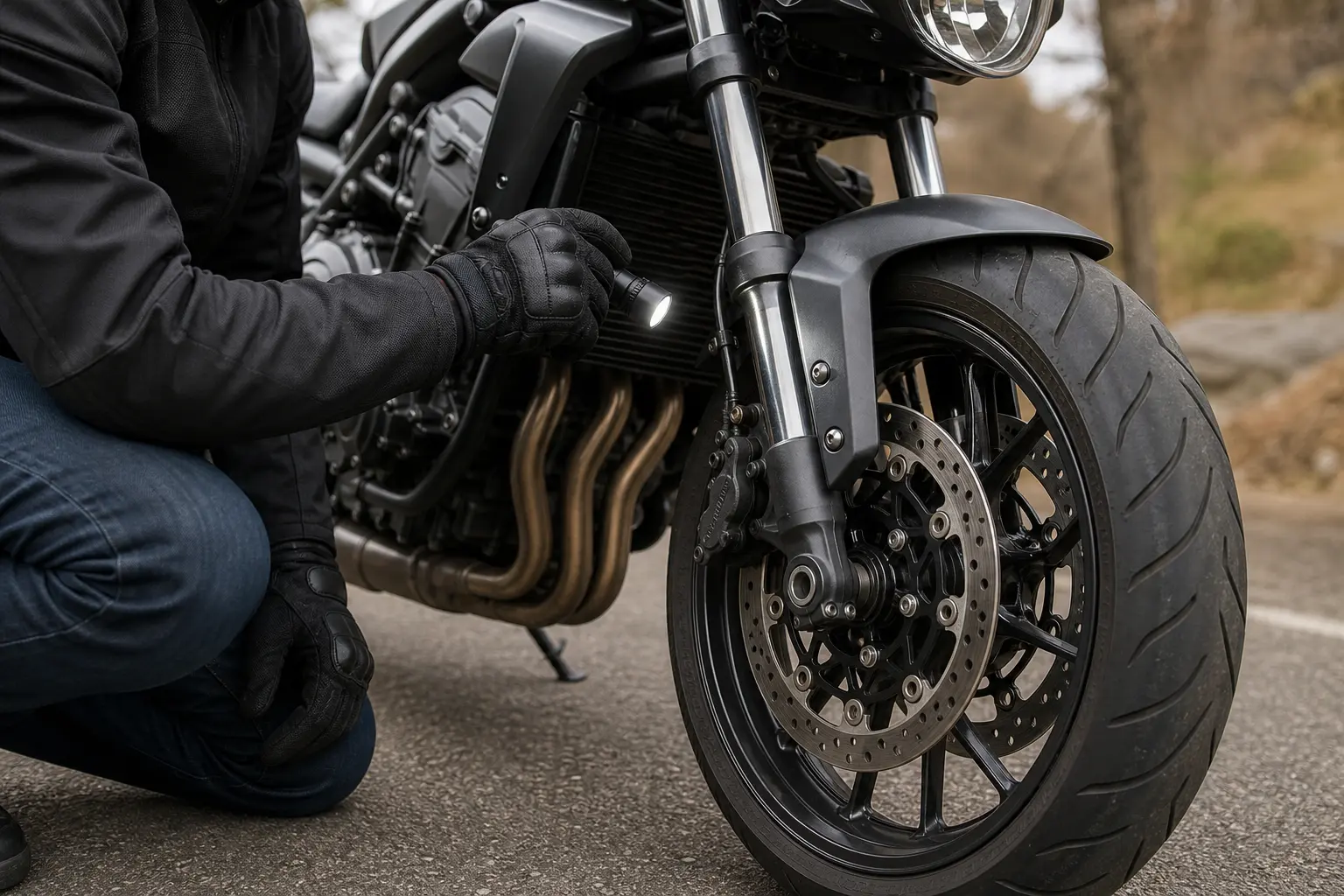
A fork leak becomes more urgent when the inspection extends beyond the fork tube. The front brake system sits in the same general area as the wheel and fork. The MSF checklist directs riders to check brake function and the condition of brake pads and discs, while also checking seals, hoses, leaks, and front-fork travel.2 That makes the brake-area review a sensible part of a fork-leak decision.
With the motorcycle parked, switched off, and stable, visually assess the accessible areas around the front end. You are not trying to perform a repair or prove the source. You are looking for reasons not to ride:
- Is there fresh fluid on or near the brake disc, caliper area, brake hose, wheel, rim, tire, or fender?
- Has fluid collected below the apparent fork-seal area or made a path toward lower components?
- Does the other fork leg also show wetness, or is the concern localized?
- Are there signs of a separate brake-fluid or hose issue, such as obvious leaking around brake components?
- Are the brake disc and pads visibly clean and dry from what you can safely observe?
If anything in the brake area is wet with an unknown or oily substance, do not take a “careful test ride” to evaluate it. A careful test ride still demands braking, steering, balance, and an expectation that the motorcycle will respond consistently. The parked-bike evidence is already enough to select the conservative path: do not ride and arrange professional assessment.
Avoid improvised cleaning, solvents, abrasives, or disassembly as a way to convert uncertainty into permission to ride. Those actions can create additional problems, obscure evidence, or conflict with the manufacturer’s instructions. If the concern involves brake components, have a qualified technician determine the appropriate inspection and corrective work.
Clearly Titled Checklist: Wet Fork Tube Go/No-Go Checklist
Use this checklist before deciding whether a motorcycle with a wet fork tube should leave the driveway.
- Park safely first. Put the motorcycle on stable, level ground using the support method specified for your model. Do not inspect a bike that is precariously balanced.
- Use light and patience. Inspect in good light. Do not make a ride decision from a quick glance in a dark garage or parking lot.
- Identify the exact location. Note whether wetness is on one fork tube, both tubes, the lower fork area, the fender, wheel, brake area, or somewhere else.
- Look for fresh recurrence. If a wiped area becomes freshly wet again, treat that as a meaningful escalation rather than a cosmetic issue.
- Inspect the brake neighborhood. Look for fluid on or around the discs, calipers, hoses, wheel, tire, and nearby surfaces. Any possible contamination means no ride.
- Review control and brake condition. MSF’s pre-ride framework includes checking brakes, hoses, controls, and front-fork operation.2 If you find another concern, do not isolate the fork issue from it.
- Notice abnormal fork behavior without forcing it. If movement seems abnormal, uneven, harsh, or otherwise concerning, do not continue testing through riding.
- Check your exact owner’s manual. Follow its warnings, inspection limits, maintenance schedule, and instructions for contacting an authorized dealer or qualified service provider.
- Document what you saw. Take clear photos before wiping anything significant, and record the date, odometer reading, location of the wetness, and whether it returned.
- Choose transport over a risky ride. If the leak appears significant, fluid may be near brake components, fork behavior is abnormal, or you cannot identify the substance, arrange service rather than riding there.
This approach fits within a broader Motorcycle Maintenance Guide: observe first, compare with manufacturer guidance, record the condition, and avoid turning a safety-critical question into a roadside experiment.
What Not to Do When You See Fork Oil
A fork leak can invite quick fixes, confident internet diagnoses, and “it will be fine for one more ride” reasoning. Those are precisely the moments when a rider benefits from limits.
Do not confuse cleaning with correction. Removing residue may make the motorcycle look better, but it does not establish why the residue was there or prove it will not return. If cleaning is permitted by your model documentation, it can be useful for observation; it is not a repair certification.
Do not force the suspension through travel to investigate it. Repeatedly bouncing, compressing, or manipulating the front end is not necessary to make a safe initial decision. The MSF’s framework calls for smooth front-fork travel as an inspection item,2 but a questionable motorcycle does not need to be aggressively exercised to establish that it needs service.
Do not ride to “see if the handling is different.” If oil loss is affecting rebound action, or if fluid may have migrated toward braking components, riding is a poor diagnostic method. The risk grows with speed, traffic, road surface changes, wet conditions, and hard braking.
Do not assume a short route is automatically low risk. A trip to a shop can include stop signs, emergency braking, gravel, rain, potholes, or freeway merging. Distance is not the same thing as safety margin.
Do not borrow specifications from another motorcycle. Fork-oil type, capacity, level, maintenance intervals, inspection methods, and component design are model-specific. Use the exact manual for the exact motorcycle, and leave corrective work to someone equipped to follow the applicable service information.
Factors That Make “I’ll Ride It Carefully” a Worse Bet
The same visible residue can carry different practical risk depending on the rider’s plan. A conservative decision should account for context, not only the size of the wet spot.
The case for stopping is stronger when any of these are true:
- The planned ride includes high speed, curves, rough pavement, rain, gravel, or heavy traffic.
- You will carry a passenger, luggage, or other load that changes braking and suspension demands.
- The route has limited places to stop or limited cell service.
- You have not ridden the motorcycle since the residue appeared and do not know whether it is recurring.
- The motorcycle already has an unrelated concern involving brakes, tires, steering, wheel condition, or controls.
- You are tempted to ride because an appointment, group meet, commute, or event is time-sensitive.
Time pressure is not evidence that the motorcycle is safe. It is evidence that the rider may be more vulnerable to rationalizing a marginal choice. If the fork condition is unclear, choose a different transportation plan and keep the motorcycle parked until the issue is resolved.
Make the Service Conversation More Useful

A good service appointment starts with useful observations, not a confident diagnosis. You do not need to explain how forks work or identify the failed part. A concise, factual report helps the technician prioritize the inspection.
Record:
- motorcycle make, model, model year, and current odometer reading;
- the date and conditions when you first noticed the wetness;
- whether it is on the left fork, right fork, both, or another nearby part;
- whether the residue was fresh, streaked, pooled, or mixed with dirt;
- whether it returned after the motorcycle sat or after it was moved;
- whether any fluid was seen near brake hardware, the wheel, tire, or fender;
- whether you noticed changed ride behavior, noises, or control concerns; and
- whether the motorcycle recently had suspension work, transport, storage, a wash, or an impact.
Photos taken in consistent light can be more useful than a long explanation. Take an overview photo to show location, then a closer photo to show the residue. Avoid touching brake components or applying products before documenting the condition, unless your manufacturer’s instructions or service provider directs otherwise.
When you contact service, say plainly: “I found fresh wetness on the front fork area and have kept the motorcycle parked because I am concerned about a possible fork-oil leak and brake-area contamination.” That communicates the safety context without overstating the diagnosis.
How Vojo Helps
Create a maintenance event in the Vojo motorcycle maintenance tracker as soon as you spot the wet fork tube. Add the date, odometer reading, photos of the affected area, a note about whether the wetness returned, and a safety status such as “parked pending inspection.” Then attach the eventual service invoice and technician findings to the same record. This creates a clear before-and-after history, helps you notice recurrence, and gives you a concise record to share at a service appointment.
Download Vojo on the App Store
FAQ
Can I ride with a motorcycle fork seal leak if it is only a little wet?
Do not decide from the amount alone. A faint trace may be leftover residue, but it may also be the beginning of an active leak. Check whether it returns, inspect the surrounding brake and wheel area, consult your model’s manual, and choose qualified inspection if the source remains uncertain. If fluid is near brake components or the wetness is recurring, do not ride.
Is fork oil on the tube always proof that the fork seal has failed?
No. A wet tube is an observation, not a confirmed diagnosis. Residue can have more than one source, and a technician may need to identify it. What matters immediately is whether it is fresh, recurring, spreading, or near safety-critical components. Avoid guessing at the exact part and focus on a safe inspection decision.
Why is a fork-oil leak a handling concern?
Harley-Davidson states that leaking, damaged, or worn front-fork parts can adversely affect stability and handling, and that low fork-oil level impairs rebound action.1 Because forks contribute to how the motorcycle responds over braking, bumps, and changing road surfaces, visible leakage should be treated as more than a cosmetic problem.
Can I clean the fork tube and keep riding if it stays dry afterward?
Cleaning may help you observe whether residue returns, but it does not prove the motorcycle is safe or correct the cause. Follow your owner’s manual, do not use improvised products around brake components, and avoid riding if there is any possibility of contamination, a recurring leak, abnormal fork behavior, or uncertainty about the source.
Should I replace both fork seals if only one side looks wet?
That is a repair-planning question for your model’s authorized service information and a qualified technician. This article does not recommend parts, replacement scope, or repair procedure. Document which side is wet and any related observations, then ask the service provider what the manufacturer’s requirements and inspection findings support.
What should I check besides the fork tube?
Use a complete pre-ride mindset. The MSF checklist includes tires and wheels, brakes, controls, lights, fluids, chassis, suspension, and stands.2 For a wet fork tube specifically, give extra attention to accessible brake-area cleanliness, hoses, wheel and tire surfaces, fork behavior, and any other fresh leaks.
Footnotes
Quick answers
Frequently asked questions
Can I ride with a motorcycle fork seal leak if it is only a little wet?
Do not decide from the amount alone. Check whether residue returns, inspect the brake and wheel area, consult your model manual, and arrange inspection if the source is unclear. Do not ride if fluid is near brake parts or the wetness is recurring.
Is fork oil on the tube always proof that the fork seal has failed?
No. A wet tube is an observation rather than a confirmed diagnosis. Focus on whether the residue is fresh, recurring, spreading, or near safety-critical components, and have a qualified technician identify the source if needed.
Why is a fork-oil leak a handling concern?
Harley-Davidson warns that leaking, damaged, or worn fork parts can affect stability and handling, and that low fork-oil level can impair rebound action. Treat visible leakage as a safety concern rather than a cosmetic one.
Can I clean the fork tube and keep riding if it stays dry afterward?
Cleaning may help observation, but it does not prove the motorcycle is safe or correct the cause. Follow your owner’s manual and avoid riding if contamination, recurrence, abnormal fork behavior, or uncertainty remains.
Should I replace both fork seals if only one side looks wet?
Replacement scope is model- and inspection-specific. Do not select parts or repair scope from appearance alone; document the observation and ask a qualified technician to follow the applicable manufacturer information.
What should I check besides the fork tube?
Use a whole-bike pre-ride view: brakes, hoses, wheel and tire surfaces, controls, suspension action, fluids, and stands. For a wet fork tube, inspect accessible brake-area cleanliness especially carefully.